Conviction Confirmed for Abuse of Authority and Violation of National Public Officials Act
'Special Hiring of Dismissed Teachers Pre-Selected Under the Guise of Open Recruitment' Recognized
Cho: "Regretful but Must Follow Court Decision... Will Live as a Free Person"
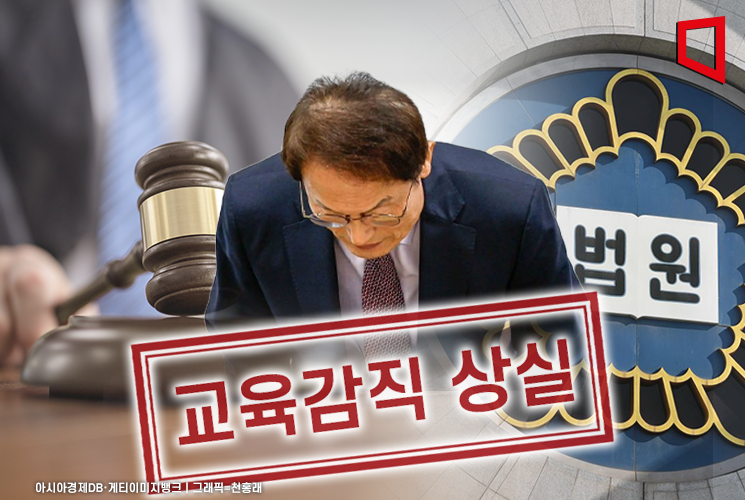
The suspended sentence for a prison term was confirmed for Cho Hee-yeon, the Seoul Metropolitan Office of Education Superintendent, who was indicted on charges of preferentially hiring five dismissed teachers, including four teachers from the Korean Teachers and Education Workers Union (JeonGyoJo).
According to the Local Education Autonomy Act (Education Autonomy Act) and the Public Official Election Act, which stipulate automatic dismissal for those sentenced to imprisonment or higher and whose sentence is finalized, Superintendent Cho lost his position as superintendent.
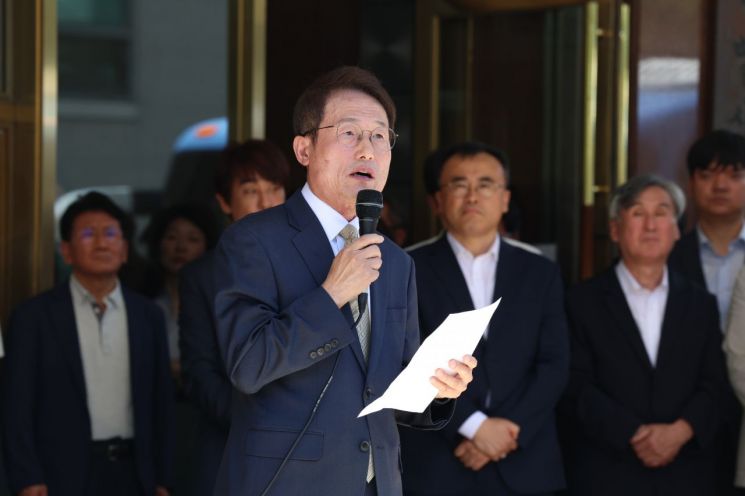 Cho Hee-yeon, Superintendent of Education of Seoul, expressing his position at the entrance of the Seoul Metropolitan Office of Education building on the afternoon of the 29th, when the Supreme Court confirmed the loss of his position as superintendent. Photo by Seoul Metropolitan Office of Education
On the 29th, the Supreme Court's 3rd Division (Presiding Justice Oh Seok-jun) dismissed Superintendent Cho's appeal in the final trial on charges of abuse of authority and violation of the National Public Officials Act, confirming the original court's ruling of one year and six months imprisonment with a two-year suspended sentence.
The court explained the reason for dismissing Superintendent Cho's appeal, stating, "There is no error in the lower court's judgment such as failing to conduct necessary hearings, violating the rules of logic and experience, exceeding the limits of free evaluation of evidence, misunderstanding or omitting the legal principles regarding the specification of charges, the establishment of abuse of authority and violation of the National Public Officials Act, joint perpetration, and the relationship between offenses, or applying unconstitutional laws."
The Supreme Court dismissed or rejected Superintendent Cho's request for a constitutional review regarding the criminal law's abuse of authority charge. The court dismissed the request for constitutional review concerning the phrase "in relation to examination or appointment" in Article 44 of the National Public Officials Act (Prohibition of interference with examination or appointment), stating that it was a matter of judicial interpretation and thus inappropriate.
Additionally, the request for constitutional review concerning Article 12, Paragraph 1 of the Education Officials Act (Special Appointment), which delegates cases where special appointments can be made to presidential decree, and Article 123 of the Criminal Act (Abuse of Authority) was rejected on grounds that they do not violate the principle of delegation or clarity.
Superintendent Cho was indicted for abusing personnel authority from October to December 2018 to appoint five dismissed teachers from JeonGyoJo by ordering supervisors to conduct a special hiring process disguised as an open competitive exam.
Among the five specially hired by Superintendent Cho, four were teachers from JeonGyoJo who were automatically retired in November 2012 after being fined 2.5 million won for violating the Education Autonomy Act due to illegal election campaigning related to the 2008 superintendent election. The remaining one was a teacher who was automatically retired in October 2003 after being sentenced to ten months imprisonment with a two-year suspended sentence for violating the Public Official Election Act due to negative expressions about a specific party candidate in the 2002 presidential election.
According to the investigation by the High-ranking Officials' Crime Investigation Unit (HOCI), Superintendent Cho decided to hire these five and instructed the personnel officers to proceed with the special hiring process. Despite opposition from the deputy superintendent and others, who argued it violated the principle of open competition, Superintendent Cho pushed forward.
It was investigated that Superintendent Cho ordered this preferential hiring at the request of a branch of JeonGyoJo in the second half of 2017. Notably, despite opposition from supervisors and officials in the approval line of the special hiring process, he pushed the illegal preferential hiring through his secretary-general A, who was not directly involved in hiring duties.
A, who received instructions from Superintendent Cho and made calls to interview committee members regarding the special hiring of these dismissed teachers, was indicted alongside Superintendent Cho and sentenced to ten months imprisonment with a two-year suspended sentence in both the first and second trials, with the second trial ruling confirmed on this day.
In court, Superintendent Cho argued that the Education Officials Appointment Decree, which requires open selection through competitive exams for special appointments, was unconstitutional, but this was rejected. The first trial court stated, "Not all special appointments stipulated in Article 12 of the Education Officials Act can be conceptually contradictory to 'competitive exams' or 'open selection.'"
Superintendent Cho also claimed that special appointments are a separate selection process that restricts competition, so he did not abuse his authority, and regarding the violation of the National Public Officials Act, he was unaware of and did not conspire with A's actions toward the examiners. These claims were also rejected.
The court stated, "Article 9-2, Paragraph 2 of the Education Officials Appointment Decree stipulates that special appointments of education officials must be made through open selection via competitive exams. Even if the defendant exercised the superintendent's authority by hiring five people through collusion, if the special hiring process was only superficially conducted as an open selection via competitive exams but was substantively unfair and unjust to appoint these five predetermined individuals, it cannot be considered hiring through open competitive selection. Therefore, it violates Article 12, Paragraph 1, Item 2 of the Education Officials Act and Article 9-2, Paragraph 2 of the Education Officials Appointment Decree."
The court judged that although Superintendent Cho disguised the process as open competition, he substantively abused his authority and committed illegal and unjust acts.
The court explained, "This special hiring was conducted based on the nomination of five individuals, including B, requested by a branch of JeonGyoJo. A, who was involved in the special hiring process by the defendant's instruction, selected examiners who were acquaintances or friendly to some of the defendants and B and others. Some examiners were individually contacted and informed of conditions favorable to B and the others. During the second interview, examiners' mobile phones were not confiscated, applicants' career and personal information were not properly anonymized, and A sent text messages to some examiners stating that hiring C was Superintendent Cho's intention. The examiners who received such messages gave unusually high scores to C and the others, compromising fairness and appropriateness of the evaluation. Considering the circumstances, procedures, examiner selection, and evaluation results, the special hiring was merely a disguise of open competition, violating Article 9-2, Paragraph 2 of the Education Officials Appointment Decree. There is no reasonable necessity or justification for conducting such a special hiring beyond the scope and purpose of related laws."
It concluded, "Therefore, the instructions related to this special hiring by Superintendent Cho constitute an abuse of the authority granted to the Seoul Metropolitan Office of Education Superintendent, resulting in substantial and specific illegal and unjust acts."
A argued that prosecutors and police officers dispatched to HOCI could only perform general administrative tasks and had no investigative authority over cases under HOCI investigation, so all evidence obtained was illegally collected. However, the court judged that it cannot be concluded that they could not assist in investigations.
The first trial court noted regarding sentencing, "The defendant, as the appointing authority, had the duty to ensure the special hiring process was fair and transparent according to relevant laws. However, he allowed secretary-general A, who had no direct authority over hiring, to direct personnel officers for special hiring of specific teachers requested by a branch of JeonGyoJo, preselected five individuals for special hiring, and pushed the process forward despite opposition from personnel officers in the chain of command. By disguising the special hiring as open competition, he abused his authority and unduly influenced the appointment of public school teachers, damaging the fairness and transparency of the teacher appointment process at the Seoul Metropolitan Office of Education." According to the prosecution, on December 20, 2018, Superintendent Cho finalized the special hiring by signing next to the names of the five preselected dismissed teachers on the official document confirming the final results and number of special hires.
The chain of command refers to the organizational structure responsible for performing the organization's core functions and achieving its goals, such as the deputy superintendent, director of education policy, and head of secondary education, who are responsible for approval functions in this case.
However, the court considered it a mitigating factor that Superintendent Cho did not commit the crime for monetary gain or personal benefit.
Both defendants appealed, but the second trial court's judgment was the same.
Superintendent Cho's side argued that they received positive legal opinions twice from lawyers and that the fact that some examiners knew certain applicants did not compromise the fairness of examiner selection.
However, the court judged that such legal opinions alone do not guarantee the openness of the special hiring and that Superintendent Cho's intent to abuse authority cannot be denied.
The court concluded, "Although Superintendent Cho's exercise of authority in this special hiring appears formally and externally to be through open selection via competitive exams, considering the specific purpose, circumstances, content, necessity, and appropriateness of the exercise of authority, it cannot be regarded as hiring through open competition. Therefore, it constitutes abuse of authority beyond legitimate powers."
Superintendent Cho's side also argued that similar special hiring cases had occurred before. However, the court stated, "Although the Seoul Metropolitan Office of Education previously conducted special hiring to reinstate dismissed teachers, most cases occurred when open competitive selection was unnecessary, and the purpose was to reinstate teachers dismissed for reasons such as 'democratization movement' or 'whistleblowing,' which had social justification or broad consensus."
It added, "However, in this case, the five were automatically retired due to criminal punishment for illegal election campaigning, so it is difficult to consider their dismissal as falling under 'realization of public values' or similar grounds used as conditions for collusion. Therefore, there is no necessity or justification for this special hiring."
This case was the first directly investigated by HOCI, established in January 2021. However, since HOCI only has investigative authority but not prosecution authority over superintendents, it completed the investigation in September 2021 and transferred the case to the prosecution, requesting indictment.
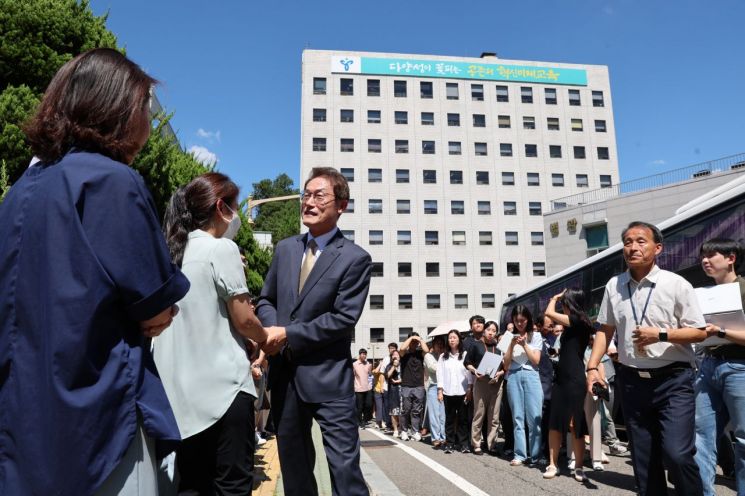 Cho Hee-yeon, Superintendent of Education of Seoul, shaking hands with employees as he leaves the Seoul Metropolitan Office of Education building on the afternoon of the 29th, the day his dismissal from the superintendent position was confirmed by the Supreme Court. Photo by Seoul Metropolitan Office of Education
On the afternoon of the day, Superintendent Cho stated in front of the Seoul Metropolitan Office of Education headquarters in Jongno-gu, Seoul, "According to the Supreme Court ruling and related laws, I conclude my ten-year history as Seoul Metropolitan Office of Education Superintendent."
About 300 officials from the Seoul Metropolitan Office of Education, education sector officials, and education organization representatives gathered for Superintendent Cho's farewell. Members of the Democratic Party of Korea, including Kwak Sang-eon, Kim Nam-geun, Kim Jun-hyuk, Nam In-soon, Park Joo-min, and Park Hong-geun, were also present.
He said, "How can I not feel regret over this absurd reality where a superintendent is dismissed for reinstating dismissed teachers? However, I believe the court's decision must be respected and followed regardless of personal gains or losses."
He continued, "The original reasons for the dismissal of the teachers reinstated in 2018 are related to the issue of 'teachers' political basic rights' as citizens, which is now being discussed in the National Assembly. I also believe that their reinstatement carries the meaning of further guaranteeing teachers' rights, which is demanded after the tragedy at Seo-i Elementary School."
He added, "The path of innovative education will continue. I will return to society as a free person and live diligently," expressing his gratitude.
After Superintendent Cho finished speaking, members of the Seoul Education Protection Joint Countermeasures Committee presented him with bouquets and shed tears. Superintendent Cho also wiped his tears and responded, "Now, I hope you will open a new path for education in the Republic of Korea."
Then, Superintendent Cho left the venue shaking hands one by one with education office officials lined up from the headquarters to the main gate. Civic groups such as the Seoul Special School Parents Association, Seoul Education Protection Joint Countermeasures Committee, and Seoul Disabled Parents Solidarity chanted slogans to see him off.
© The Asia Business Daily(www.asiae.co.kr). All rights reserved.
![From Bar Hostess to Organ Seller to High Society... The Grotesque Con of a "Human Counterfeit" [Slate]](https://cwcontent.asiae.co.kr/asiaresize/183/2026021902243444107_1771435474.jpg)


















