Yoon "Will Definitely Achieve 4 Major Reforms Including Healthcare"
"Reforms Inevitably Bring Resistance"
"National Pension Increase Rates Differ by Generation"
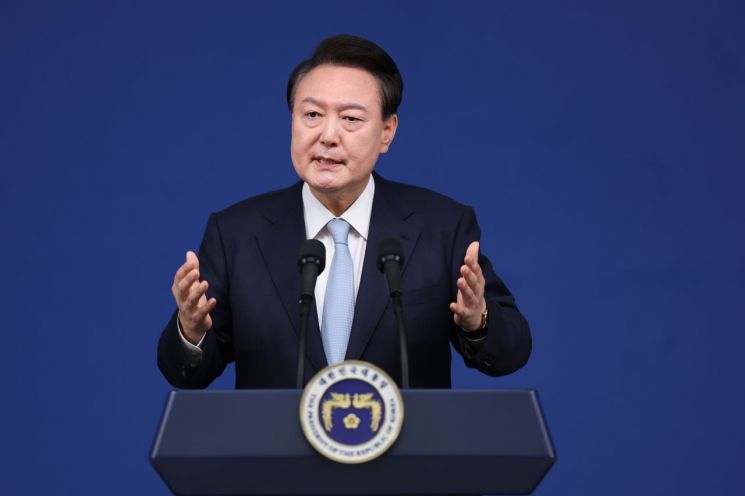 President Yoon Suk-yeol is holding a 'National Briefing and Press Conference' on the morning of the 29th at the Yongsan Presidential Office building in Seoul. [Image source=Yonhap News]
President Yoon Suk-yeol stated on the 29th, "The current pension system, where the elderly are poor and the youth cannot trust it, must be fundamentally reformed," adding, "We will pursue reforms that the younger generation, who pay insurance premiums the longest and the most but receive pensions the latest, can accept."
On the morning of the same day, President Yoon held a national briefing and press conference at the Yongsan Presidential Office, saying, "The four major reforms in pensions, healthcare, education, and labor are urgent tasks critical to the survival and future of the Republic of Korea." He had announced the possibility of oil and gas deposits on the East Coast during his first national briefing on June 3, and at this second briefing, he directly explained the achievements and future directions of the four major reforms.
In particular, President Yoon expressed the difficulties of pushing forward the four major reforms and strongly indicated his determination to complete them. He said, "Reform inevitably provokes resistance. The reform process will be a challenging journey." He added, "If we only consider political gains and losses, not doing it is a much easier path." He further pointed out, "This is why previous governments failed in reform or did not even attempt it," and "This is why the structural reforms essential for the sustainable development of our society have not been achieved until now."
Yoon: "Reform Process is a Challenging Journey... I Will Not Take the Easy Path"
President Yoon emphasized, "I will not take the easy path," and "I will definitely achieve the four major reforms promised to the people." First, he proposed 'differentiated increase rates by generation' and 'introduction of financial stabilization measures' for the National Pension. Given the rapid low birthrate and aging population, it is difficult to solve pension issues with only parameter reforms, which have been the focus of discussions so far, so he included plans to fundamentally reform the structure itself.
The core is to apply differentiated insurance premium rates by generation to enhance intergenerational equity. President Yoon stated, "To sustain the pension system, insurance premiums must be raised, but the increase speed will be differentiated by generation." For example, if the insurance premium rate increases by 13-15%, the middle-aged generation would reach the increased rate over 10 years, while the younger generation would reach it over 20 years, thus changing the structure to consider fairness between generations.
President Yoon said, "Along with parameter adjustments such as insurance premium rates and income replacement rates, we must increase fund returns and introduce automatic stabilization devices to secure the long-term sustainability of pensions." To dispel concerns about fund depletion, he ordered, "The state’s guarantee of payments must also be codified into law." He promised to further expand credits so that gaps in pension subscription periods caused by childbirth and military service do not occur. Separately from the National Pension, he pledged to raise the basic pension to 400,000 won per month during his term to alleviate elderly poverty.
"Basic Pension to be Raised to 400,000 Won per Month During Term"
President Yoon said, "Currently, elderly people receiving a livelihood benefit of 710,000 won per month for single-person households will have their livelihood benefits reduced by the amount of the basic pension they receive," and added, "We will pursue measures to provide additional payments to compensate for the reduced amount to ensure the elderly’s retirement security." He continued, "The government will announce specific reform plans soon," and urged, "Since pension reform is completed through legal amendments, I hope the National Assembly will promptly establish a discussion framework."
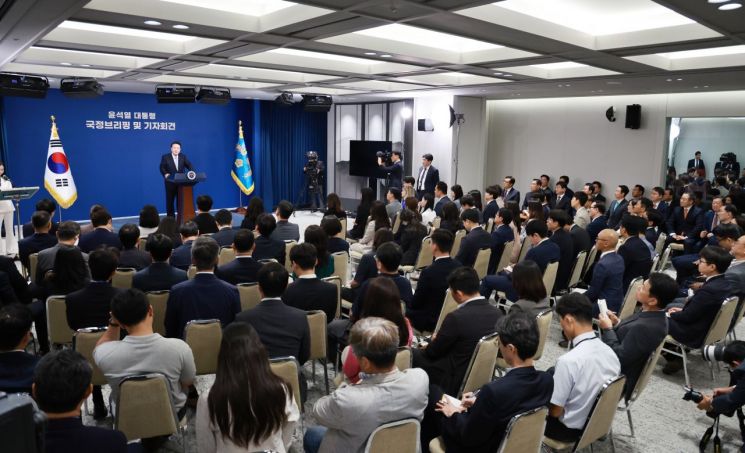 President Yoon Suk-yeol is holding a 'National Briefing and Press Conference' on the morning of the 29th at the Yongsan Presidential Office building in Seoul. [Image source=Yonhap News]
President Yoon also expressed his determination to proceed with healthcare reform, centered on increasing medical school admissions, as planned. Despite various disagreements between ruling and opposition parties regarding the 2026 medical school expansion, he will not stop healthcare reform aimed at revitalizing essential and regional medical services.
President Yoon said, "Healthcare reform is a reform to fairly guarantee the right to life and health of the people without regional discrimination," adding, "Now that the medical school expansion is finalized, we will focus policy efforts on the essence of reform: 'revitalizing regional and essential medical care'." He also stated, "We will transform the structure of tertiary hospitals, which have excessively relied on residents, so that specialists and physician assistant (PA) nurses become the core of medical services."
"Healthcare to be Centered on Specialists and PA Nurses"
President Yoon said, "The recruitment of new medical school students for the 2025 academic year is proceeding smoothly," and added, "We will produce many good doctors through advanced medical education plans and innovations in resident training systems." Although the medical community demands a complete cancellation of the 2025 enrollment quota and recently Han Dong-hoon, leader of the People Power Party, proposed a postponement of the 2026 medical school expansion, President Yoon reaffirmed his stance to continue the expansion.
President Yoon also emphasized strengthening regional medical infrastructure and normalizing medical utilization systems. To this end, he explained, "We will nurture regional core hospitals, secondary hospitals, and essential medical centers, expand regional talent recruitment, and introduce a contract-based regional essential doctor system," and "We will transform the structure of tertiary hospitals so that specialists and physician assistant nurses become the center of medical services."
He also proposed incentives such as establishing a fair compensation system for doctors and building a safety net for medical accidents. President Yoon said, "We will significantly improve fees for essential and regional medical services, including severe and emergency care," and "We will reform non-covered services and indemnity insurance to normalize the distorted compensation structure." He added, "Through mandatory medical liability insurance, victims will be adequately compensated, and by introducing special provisions for criminal punishment, doctors will be able to practice with confidence."
Additionally, President Yoon reaffirmed plans for large-scale financial investment, stating, "We will move away from health insurance-centered funding and strengthen the state's responsibility for medical workforce training and expand regional and essential medical bases by investing 10 trillion won over the next five years."
"Population Strategy Planning Department Establishment Task Force to Launch Next Month"
Regarding the newly announced Population Strategy Planning Department to prepare for low birthrate and aging, he emphasized, "In September, a government-wide 'Population Strategy Planning Department Establishment Task Force' will be launched to thoroughly prepare all related matters such as organization, personnel, and budget."
President Yoon requested cooperation from the National Assembly, saying, "The population crisis response strategy is a multifaceted task linked to education, healthcare, employment, housing, and welfare," and "A control tower, the ‘Population Strategy Planning Department,’ must be launched promptly to comprehensively coordinate these efforts." He particularly noted, "Resolving the concentration in the metropolitan area through balanced regional development is the fundamental solution to the population problem," and "The key to balanced regional development is ultimately to attract people and businesses to the regions, and the key to that is livability conditions." According to President Yoon, the most important aspects of livability conditions are education and healthcare.
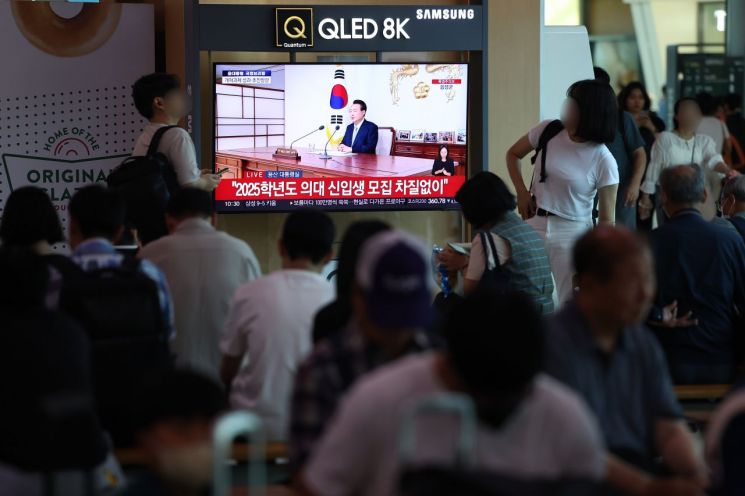 On the morning of the 29th, citizens are watching President Yoon Suk-yeol's national briefing and press conference broadcast in the waiting room of Seoul Station, Yongsan-gu, Seoul. [Image source=Yonhap News]
Regarding education reform, he said he would focus on expanding diversity and choice, ensuring fair education that serves as a ladder of opportunity, and fostering creative talents by alleviating excessive competitive pressure. President Yoon stated, "We will quickly establish ‘public care,’ where the state is responsible for education and childcare," and "Neulbom Schools will be expanded to all elementary school grades by 2026 so that anyone who wishes can participate."
He also emphasized introducing artificial intelligence (AI) textbooks to support personalized and self-directed learning, fostering glocal universities to drive local education innovation, and expanding the major autonomy system that breaks down barriers between departments and majors.
Regarding labor reform, President Yoon said, "Unreasonable practices and outdated, uniform systems cannot enhance economic dynamism nor adequately protect workers," emphasizing labor market flexibility and protection for vulnerable workers.
"I Will Personally Oversee the Successful Finalization of the Czech Nuclear Power Plant Contract"
Introducing efforts to restore the nuclear power ecosystem by resuming construction of Shin Hanul Units 3 and 4 and actively conducting sales diplomacy, President Yoon stated that since Korea was selected as the preferred negotiator for the 24 trillion won Czech nuclear power plant construction project on July 24, he will do his best in follow-up measures. "I plan to visit the Czech Republic soon to personally oversee the successful finalization of the final contract," he explained.
Regarding recent concerns about rising housing prices in the metropolitan area, he said, "We will do our utmost to supply housing in the places where the people want it in a timely manner," and added, "We have prepared a housing supply plan for 427,000 units in the metropolitan area so that people do not have to worry about housing." He emphasized, "We will additionally supply an average of 70,000 units annually in the metropolitan area over the next six years, expanding supply by about 11% compared to the past average."
He also mentioned the difficulties faced by small business owners and self-employed people due to recent sluggish domestic demand, saying, "We will revive domestic demand to provide practical help to small business owners and the self-employed," and added, "We will actively promote traditional market consumption promotion, expansion of Onnuri gift certificate issuance, and discount events such as the Donghaeng Festival, which were announced in the Chuseok livelihood stabilization measures."
© The Asia Business Daily(www.asiae.co.kr). All rights reserved.



















