Statistics Korea Announces 2023 Birth Statistics
Average Childbirth Age in Ulleung-gun '35.6 Years'
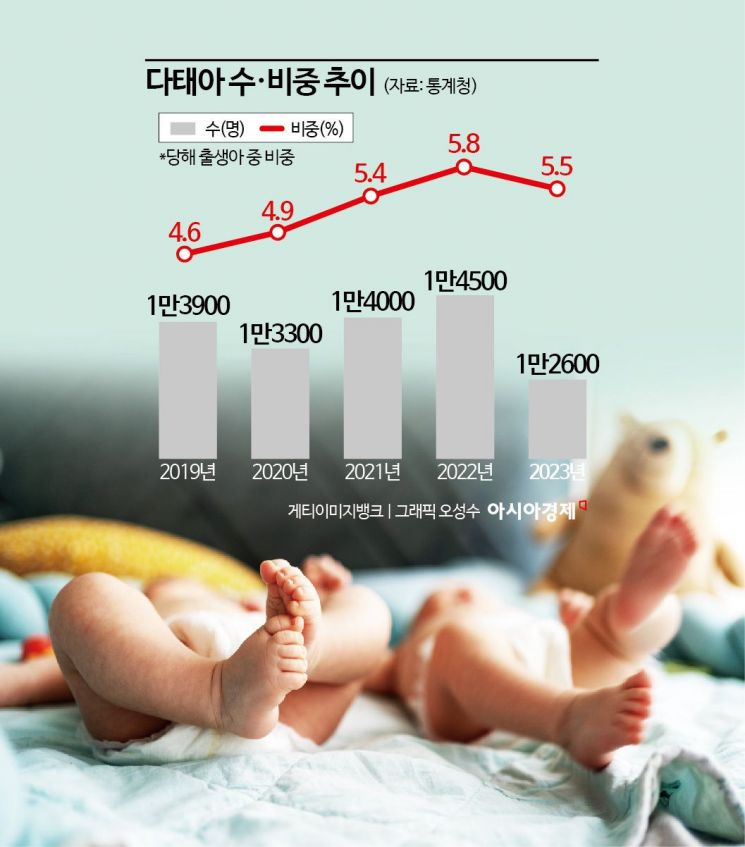
Last year, the proportion of multiple births, including twins, among newborns was 5.5%, showing a decrease compared to the previous year. After more than 10 years of an upward trend, the proportion fell for the first time last year. The average age of mothers of multiple births was 35.2 years, an increase of 0.2 years compared to the previous year.
According to the '2023 Birth Statistics' released by Statistics Korea on the 28th, the number of multiple births last year was 12,600, a decrease of 1,900 (13.1%) compared to the previous year. The proportion of multiple births among the total number of newborns (230,000) last year was 5.5%, down 0.3 percentage points.
The proportion of multiple births had been rising annually from 3.3% in 2013 to 5.8% in 2022, but showed a downward trend for the first time last year. Lim Young-il, head of the Population Trends Division at Statistics Korea, explained, "Although the proportion of multiple births decreased last year, it is difficult to see this as a break in the upward trend because the number of older mothers with infertility continues to increase."
The average age of mothers of multiple births last year was 35.2 years. This was higher compared to the overall average maternal age of 33.6 years and the average age of mothers of single births at 33.5 years. While the average age of mothers of single births increased by 0.1 years compared to the previous year, the average age of mothers of multiple births increased by 0.2 years, showing a relatively larger increase.
Looking at the proportion of multiple births by maternal age, it was relatively high at 8.3% for ages 35-39 and 7.6% for 40 and above. For ages 30-34, the proportion was 4.5%, and for 25-29, it was 2.7%. This is because the higher the maternal age, the more likely multiple births occur due to infertility treatments such as in vitro fertilization.
Regarding the total fertility rate by city, county, and district, Yeonggwang-gun in Jeollanam-do (1.65), Gangjin-gun in Jeollanam-do (1.47), and Uiseong-gun in Gyeongsangbuk-do (1.41) ranked highest. Meanwhile, Jung-gu in Busan (0.32), Gwanak-gu in Seoul (0.39), and Jongno-gu in Seoul (0.41) ranked lowest. The bottom 10 regions in total fertility rate were mostly in Seoul.
Looking at the average maternal age by city, county, and district, the average maternal age in Ulleung-gun, Gyeongsangbuk-do (35.6 years) was the highest among all regions nationwide. This was higher than major Seoul districts such as Seocho-gu (35.2 years), Gangnam-gu (35.1 years), and Yongsan-gu (34.8 years).
Director Lim explained, "Ulleung-gun was not among the top ranks before 2019, but recently the average maternal age has increased. Since the number of mothers in the area is not large, the impact of older mothers may have been greater." He added, "It is also necessary to examine whether children born to older mothers are second or third children."
The number of newborns by city, county, and district was highest in Hwaseong-si and Suwon-si in Gyeonggi-do. Among the top 10 regions, six were in Gyeonggi-do. The newborns in the top 10 regions (47,000) accounted for 20.4% of all newborns.
The number of newborns last year was 230,000, a decrease of 19,200 (7.7%) compared to the previous year. The total fertility rate was 0.72, marking the lowest since birth statistics began in 1970. The crude birth rate, the number of births per 1,000 population, was also 4.5, down 0.4 from the previous year.
© The Asia Business Daily(www.asiae.co.kr). All rights reserved.
![Clutching a Stolen Dior Bag, Saying "I Hate Being Poor but Real"... The Grotesque Con of a "Human Knockoff" [Slate]](https://cwcontent.asiae.co.kr/asiaresize/183/2026021902243444107_1771435474.jpg)











