Additional Increase in Emergency Room Specialist Consultation Fees
The government has decided to operate more than 4,000 on-duty hospitals and clinics in preparation for a surge of patients in emergency rooms during the holiday period. It will raise emergency room consultation fees and provide additional personnel expenses support to regional centers, while also operating at least 29 specialized emergency rooms for severe cases. Regarding the health and medical workers' union, which has announced a general strike on the 29th, the government urged cooperation to minimize medical service gaps.
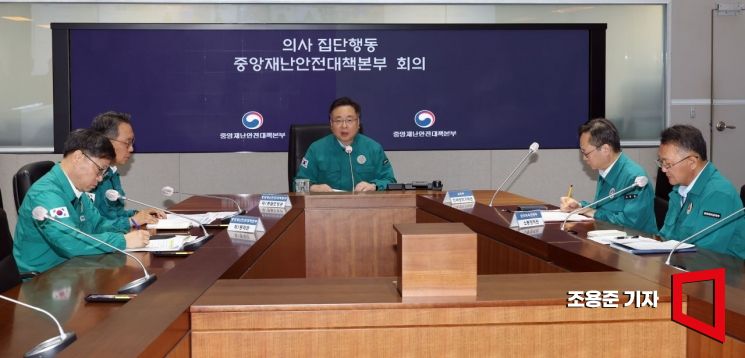 Health and Welfare Minister Cho Kyu-hong is attending and speaking at the Central Disaster and Safety Countermeasures Headquarters meeting for the doctors' collective action held on the 28th at the Government Seoul Office in Jongno, Seoul. The medical blank crisis, which began with the collective departure of residents, is escalating as the Health and Medical Workers' Union will also go on strike starting at 7 a.m. on the 29th if labor-management negotiations are not settled. Photo by Jo Yong-jun jun21@
Cho Kyu-hong, First Deputy Head of the Central Disaster and Safety Countermeasures Headquarters (Minister of Health and Welfare), chaired a meeting of the Central Disaster and Safety Countermeasures Headquarters (CDSCH) on collective medical action at the Government Seoul Office on the 28th and discussed measures to maintain the emergency medical system in preparation for the Chuseok holiday.
The government first designated the approximately two-week period from October 11 to 25, before and after the holiday, as the "Chuseok Holiday Emergency Response Week" and decided to operate more than 4,000 on-duty hospitals and clinics, which is more than usual during holiday periods. Military hospitals, public medical institutions, and specialized hospitals will also focus on operating emergency medical systems intensively. The "temporary additional emergency consultation fee," which previously applied only to 408 emergency medical institutions, will be expanded to 112 emergency medical facilities to help distribute patients with mild symptoms.
Deputy Head Cho said, "We will actively promote information about hospitals and clinics open during the holiday period, about 160 COVID-19 cooperative hospitals and fever clinics, and pharmacies, and make it easy to check through the Emergency Medical Portal and call centers of the Ministry of Health and Welfare and local governments." He requested, "We ask the public to use other medical institutions instead of emergency rooms for minor symptoms."
Support for personnel to enhance emergency room treatment capacity will also be strengthened. During the Emergency Response Week, emergency room specialist consultation fees will be increased further from the existing 150% increase, and personnel expenses support will be expanded to stabilize the operation of regional centers. Additionally, when patients are admitted for follow-up treatment after emergency room care, fees for surgery, procedures, and anesthesia will be raised to improve the capacity to accommodate severe emergency patients, and measures to activate transfers to other hospitals will also be pursued.
Along with this, to intensively manage severe patients, some regional and local centers will be designated to operate at least one "severe specialized emergency room" per 29 regions on a temporary basis, treating only severe emergency patients (KTAS levels 1?2). To allow emergency centers to focus on treating severe patients, the copayment for mild and non-emergency patients will also be increased and implemented within September.
Deputy Head Cho emphasized, "Despite the prolonged departure of residents and concerns about the health and medical workers' union strike, the government will mobilize all capabilities to minimize disruptions in emergency and severe patient care," and added, "While actively responding to immediate issues, we will also steadily push forward medical reforms for fundamental solutions."
Deputy Head Cho also addressed the health and medical workers' union, which has announced a general strike on the 29th, saying, "We fully understand the difficulties faced by healthcare workers on the front lines, but now is a critical time when everyone must unite to minimize medical service gaps," and warned, "If the strike becomes a reality, the meaning of the dedication and sacrifice shown so far may be diminished."
© The Asia Business Daily(www.asiae.co.kr). All rights reserved.
![Clutching a Stolen Dior Bag, Saying "I Hate Being Poor but Real"... The Grotesque Con of a "Human Knockoff" [Slate]](https://cwcontent.asiae.co.kr/asiaresize/183/2026021902243444107_1771435474.jpg)
















