2025 R&D Budget Up 16%
Expanded Investment in Energy Technology Development
Support for Science and Engineering Research and International Cooperation
The Ministry of Science and ICT's budget proposal for next year has been set at a record high of 19 trillion won. The focus is on supporting research and development (R&D) in advanced technologies such as artificial intelligence (AI), biotechnology, and quantum technology. In particular, following criticism from the scientific community due to this year's R&D budget cuts, next year's R&D budget has been increased by about 16% compared to the previous year.
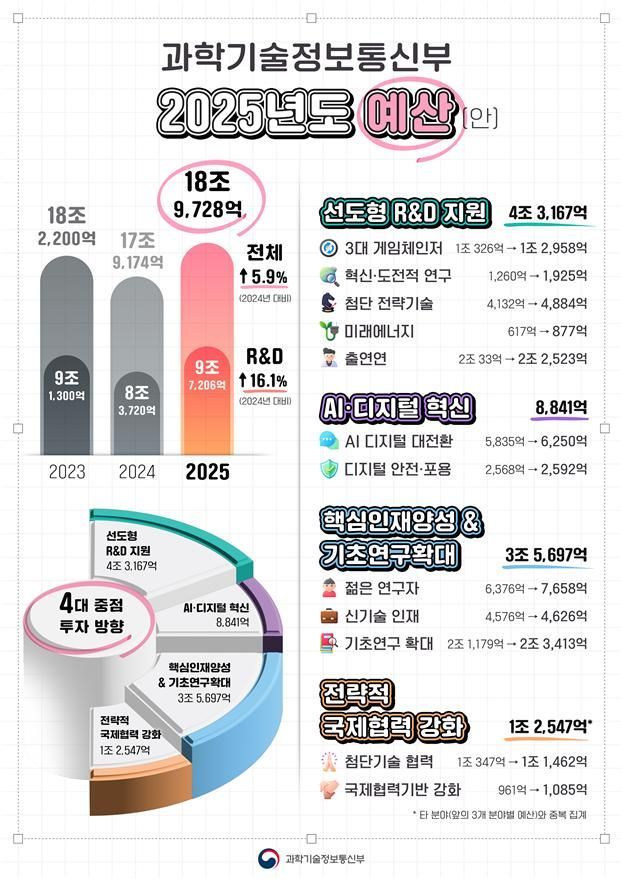
The Ministry of Science and ICT announced on the 28th that the budget proposal and fund operation plan for 2025 total 18.9728 trillion won, marking a 5.9% increase from the previous year and the largest scale ever.
Among this, the R&D budget has been set at 9.7 trillion won, a 16.1% increase compared to 8.4 trillion won in 2024. This exceeds the 9.1 trillion won allocated in 2023 before the R&D budget cuts by 6.5%. Of the R&D budget, 4.3 trillion won will be concentrated on innovation in advanced technologies such as AI, semiconductors, biotechnology, and quantum technology.
370 billion won (new) has been allocated for the development of K-Cloud utilizing AI semiconductors, 25.2 billion won (new) for the Quantum Science and Technology flagship project, and 368.4 billion won for the bio-medical technology development project.
Investment will continue in national advanced strategic fields such as next-generation nuclear power, advanced mobility, and hydrogen, and technology development investments to secure future energy will be expanded. The government-funded research institutes will receive 183.3 billion won, an 83% increase from this year, to be invested in the 'Global TOP Strategic Research Group' to break down barriers between institutes and support them in fulfilling their role as R&D hubs.
Additionally, the plan is to spread AI throughout industry and daily life to increase productivity and improve the quality of life for citizens. Investments will be expanded by discovering AI convergence services based on inter-ministerial collaboration, and support will be strengthened to establish AI-based information security response systems.
Investment in nurturing core talents in new technologies and basic research will also be expanded. In particular, a research living allowance of 60 billion won has been newly established for graduate students in science and engineering fields. 'Pioneering research,' which supports bold research in new fields, and 'National Agenda Basic Research,' based on government policy strategies and national and social demands, have been newly introduced.
The budget for international cooperation in science and technology has been increased to 1.2547 trillion won. The scale of international joint research projects will be expanded, and new international joint research projects will be established in the carbon neutrality field. In November next year, coinciding with the APEC summit to be held in the Republic of Korea, a pilot project (2.55 billion won) will be launched to support exchanges among scientists in Asia-Pacific countries.
The budget proposal, which was approved at the Cabinet meeting the day before, will be submitted to the National Assembly on the 2nd of next month. Minister Yoo Sang-im of the Ministry of Science and ICT said, "We will boldly invest in promising technologies that are difficult for the private sector to develop and nurture core talents, the source of national competitiveness, to make next year the first year of Korea's future leap."
© The Asia Business Daily(www.asiae.co.kr). All rights reserved.

















