The Supreme Court has ruled that items discarded or denied ownership by a suspect during the arrest process can be used as evidence in separate investigations, and that it is not illegal to do so without guaranteeing the suspect's right to participate.
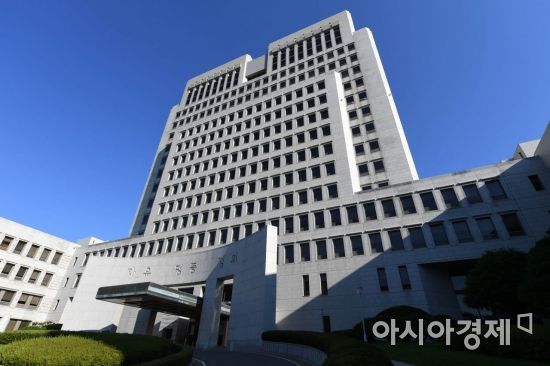
According to the legal community on the 28th, the Supreme Court's First Division (Presiding Justice Kim Seon-su) overturned the lower court's ruling that partially acquitted Mr. A, who was indicted for violating the Sexual Violence Punishment Act and the Youth Protection Act, on the 25th of last month, and remanded the case to the Seoul High Court.
Mr. A was indicted on charges of engaging in prostitution with female adolescents from 2017 to 2019, illegally filming such acts, and producing obscene materials featuring children and adolescents. Additionally, Mr. A's wife, Mrs. B, accidentally discovered photos secretly taken of women's bodies on a computer and reported this to the police during a consultation with acquaintances. The police obtained a search warrant and seized the hidden camera photos from Mr. A's computer.
However, just before the search, Mr. A threw an SSD card, a file storage medium, outside the house inside a shoe bag. The police found it, but Mr. A denied ownership. The police regarded the SSD card as abandoned property and seized it without a warrant in accordance with the Criminal Procedure Act.
Besides the reported content, additional videos showing nude or sexual acts involving children, adolescents, and women were found on Mr. A's PC and SSD card. The prosecution used all of this as evidence when bringing Mr. A to trial.
During the subsequent trial, the admissibility of evidence seized without a warrant as abandoned property became a key issue. In principle, investigative agencies must obtain a new warrant if they discover a separate crime during a search and seizure. The suspect's right to participate must also be guaranteed during the search and examination of storage media.
The first-instance court recognized the evidence's admissibility, found most charges guilty, and sentenced Mr. A to 2 years and 6 months in prison. In contrast, the second-instance court ruled that abandoned property seized without a warrant could not be used as evidence, only recognizing the prostitution charge as guilty, and sentenced him to 1 year in prison with a 2-year probation.
However, the Supreme Court overturned the second-instance ruling, stating that the SSD card was abandoned property, and that seizing unrelated content without guaranteeing the defendant's right to participate was not illegal.
The Supreme Court stated, "Article 218 of the Criminal Procedure Act, which is the basis for seizing abandoned property, does not require obtaining a warrant before or after seizure," and added, "In the case of voluntary submission of items, the submitter can individually specify or limit the scope of submission and seizure, but in the case of abandoned property, it is difficult to even consider the presence of the submitter."
It continued, "If a person possessing an information storage medium has abandoned or is deemed to have abandoned rights related to it, the scope or target of seizure by investigative agencies without a warrant is limited to what is recognized as related to the case, and it cannot be considered that the participation of the right-holder is essential." The court also noted, "The lower court misinterpreted the legal principles regarding the seizure of abandoned property and failed to conduct necessary hearings, which affected the judgment," and thus remanded the case to the Seoul High Court.
However, the Supreme Court agreed with the second-instance court that files on the PC seized arbitrarily by the police without obtaining a new warrant have no evidentiary value.
© The Asia Business Daily(www.asiae.co.kr). All rights reserved.

















