Hankyung Association 'New Industry Proposal Series'
"Food Security, a Core National Security Task, Not Just Economic"
A survey revealed that South Korea relies on imports for more than 90% of its major grains. It is advised that food security should be approached as a core national security issue rather than an economic matter.
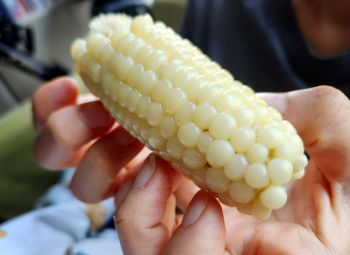 The image shows freshly steamed hot corn barely held at the fingertips. In the midsummer worn out by the monsoon and heatwave, is there any delicacy better than fresh corn? Photo by Hyunmin Kim kimhyun81@
According to the 'New Industry Proposal Series' released by the Korea Economic Association on the 27th, South Korea depends on imports for over 90% of major grains such as corn, wheat, and soybeans.
In the Food Security Index ranking published by the Economist Intelligence Unit (EIU) in 2022, South Korea ranked lower than Japan and China. From 2012 to 2022, South Korea remained between 37th and 44th place, while Japan ranked within the top 10. China jumped from 49th to 25th during the same period. In the 2022 rankings by detailed evaluation indicators, among 113 countries, South Korea ranked 51st in food purchasing capacity, 11th in supply capacity, and 50th in quality and safety, falling behind Japan and China in three out of four evaluation categories.
South Korea's competitiveness in the global grain distribution market supply chain was also found to be lower than that of Japan and China. While four major companies, including the US-based ADM, form an oligopoly in the global grain distribution market, Japan and China have established themselves as strong players in Asia. In terms of grain procurement, domestic demand is lower compared to large grain-importing countries. South Korea is at a disadvantage in international bidding markets when purchasing grains. The structure is such that agricultural product prices also respond sensitively to international grain price fluctuations.
The Korea Economic Association pointed out that the Domestic Agriculture, Rural, and Food Industry Basic Act lacks a specific concept of food security. It criticized that the reality of unstable food supply due to supply chain risks is not clearly reflected in the law. Unlike South Korea, Japan and China revised or enacted laws last year to secure their own food security. These laws all came into effect this year. They manage risks by treating domestic food supply and stockpiling as matters of national security.
Lee Sang-ho, head of the Economic and Industrial Headquarters at the Korea Economic Association, said, "Food is an essential good directly related to the survival of the people, so food security is connected to national security," adding, "To stabilize food supply, we must actively support and nurture leading companies and make vigorous efforts to secure overseas grain supply chains and stockpiles."
© The Asia Business Daily(www.asiae.co.kr). All rights reserved.
!["I'd Rather Live as a Glamorous Fake Than as a Poor Real Me"...A Grotesque Success Story Shaking the Korean Psyche [Slate]](https://cwcontent.asiae.co.kr/asiaresize/183/2026021902243444107_1771435474.jpg)
















