Qualcomm Supplies Premium LPDDR4X for Automotive Solutions
Plans for Long-Term Supply to Global OEMs and Auto Parts Customers
LPDDR5 Supply in Second Half... Aiming to Become No.1 in Automotive Semiconductors
Samsung Electronics is expanding its collaboration with global major client Qualcomm into the automotive semiconductor sector. Following mobile phone chips and extended reality (XR) headsets, the partnership is being further solidified. Through Qualcomm, Samsung Electronics has opened the door to long-term supply of automotive DRAM to major automakers such as Mercedes-Benz.
 Samsung Electronics automotive memory LPDDR4X (Low Power Double Data Rate 4X) product image. [Photo by Samsung Electronics]
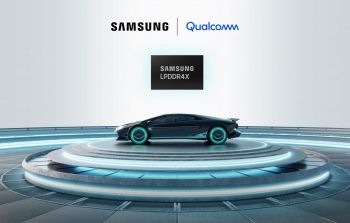
On the 27th, Samsung Electronics announced that it has officially started product supply after obtaining certification for automotive memory LPDDR4X (Low Power Double Data Rate 4X) used in Qualcomm's premium automotive platform, the 'Snapdragon Digital Chassis' solution.
Samsung Electronics' LPDDR4X guarantees stable performance in extreme environments ranging from minus 40 degrees Celsius to plus 105 degrees Celsius, meeting the automotive semiconductor quality standard 'AEC-Q100' set by the Automotive Electronics Council. It supports premium automotive infotainment (IVI) systems by supplying up to 32 gigabytes (GB) of LPDDR4X.
Samsung Electronics cited its high reliability in 'stability,' the most critical factor in autonomous vehicles, as the reason for strengthening collaboration with Qualcomm. Since producing automotive memory in 2017, Samsung Electronics became the world's first to mass-produce automotive eUFS (embedded Universal Flash Storage) in September of the same year. Automotive eUFS is memory used in next-generation advanced driver-assistance systems (ADAS), infotainment, and dashboard systems in high-spec vehicles such as luxury sedans and sports cars. In July last year, Samsung began mass production of ultra-low power automotive memory semiconductor UFS 3.1.
Over the past decade, Samsung Electronics has supported automotive electronics (vehicle electrical and electronic equipment) clients without disruption despite various global disasters such as earthquakes, fires, power outages, cold waves, and COVID-19. It has enhanced production efficiency by possessing the capability to carry out one-stop development and supply of automotive memory products.
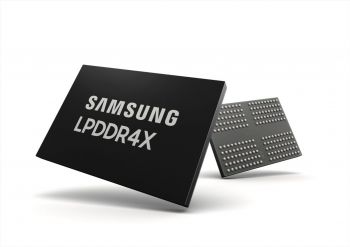 Samsung Electronics automotive memory LPDDR4X (Low Power Double Data Rate 4X) product image.
 [Photo by Samsung Electronics]
This collaboration has laid the foundation for Samsung Electronics to actively target the automotive memory market. According to market research firm IHS, the current global automotive memory market is led by U.S.-based Micron with a 44% share, followed by Samsung Electronics with 32%, ranking first and second respectively. Through cooperation with Qualcomm, Samsung Electronics is expected to aggressively chase Micron, the market leader, by enabling long-term supply to global automakers and automotive parts companies.
Samsung Electronics regards the automotive memory market as a key business area and plans to strengthen competitiveness through optimized product development and timely supply. In addition to automotive LPDDR4X, it plans to mass-produce the next-generation product LPDDR5 this year. This product will be supplied to Qualcomm's next-generation Snapdragon Digital Chassis.
Cho Hyun-duk, Executive Director of Product Planning at Samsung Electronics' Memory Business Division, stated, "Based on competitive memory design and manufacturing capabilities, we have established an optimized lineup of automotive DRAM and NAND products for customers. Through continuous collaboration with Qualcomm, we will provide long-term support to automotive electronics companies and actively target the growing automotive semiconductor market."
According to market research firm Omdia, the global automotive semiconductor market is expected to grow at an average annual rate of 8% from 2023 to 2028, while the automotive DRAM market is projected to grow at over 16% annually. In particular, the automotive semiconductor market is expected to exceed 100 billion dollars (approximately 133 trillion won) by 2027.
As major global automakers shift production from internal combustion engine vehicles to electric and autonomous vehicles, the market size is expected to increase even more steeply. While an internal combustion engine vehicle contains about 200 to 300 semiconductor chips, electric vehicles have about 1,000, and autonomous vehicles are known to contain more than 1,000 to 2,000 chips.
Earlier, SK Hynix announced that it will supply high-performance memory semiconductors, high bandwidth memory (HBM), to Waymo, a subsidiary of Google, for autonomous vehicles. The HBM2E supplied to Waymo is the third-generation HBM developed prior to the current main product, the fifth-generation HBM3E.
© The Asia Business Daily(www.asiae.co.kr). All rights reserved.
![User Who Sold Erroneously Deposited Bitcoins to Repay Debt and Fund Entertainment... What Did the Supreme Court Decide in 2021? [Legal Issue Check]](https://cwcontent.asiae.co.kr/asiaresize/183/2026020910431234020_1770601391.png)
















