The French political scene is once again embroiled in conflict over political issues, including the nomination of a new prime minister, which had been in a temporary truce due to the Paris Olympics. French President Emmanuel Macron rejected the prime minister candidate proposed by the left-wing coalition New Popular Front (NFP), the largest party in the National Assembly, and the deadlock is expected to continue for the time being.
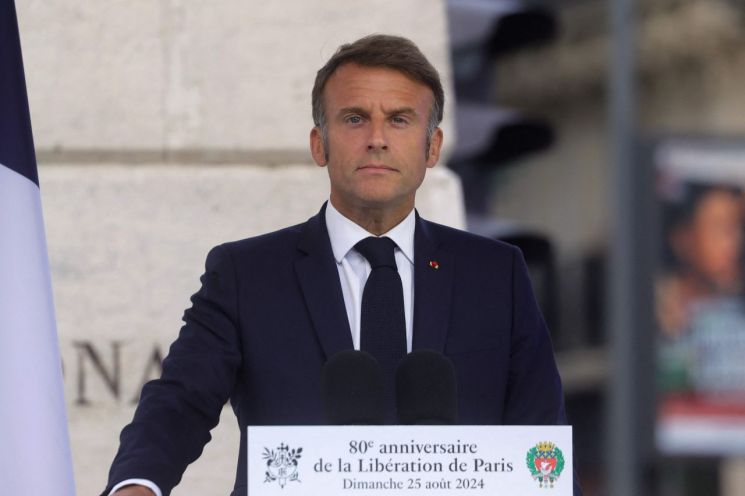
The ?lys?e Palace, the French presidential office, stated on the 26th (local time) that after President Macron held successive meetings with the leaders of major political factions over the past few days regarding the prime minister nomination, he decided "not to choose the (NFP) option for the institutional stability of the nation." This means that the card of appointing Lucie Castet, the current Director of Finance for the City of Paris and the candidate pushed by the NFP, which became the largest party in the lower house in the recent general election, has been finally excluded.
The statement released that day included the content that "the president mentioned that a government based on the NFP would immediately collapse due to a vote of no confidence from all other parliamentary groups." This is linked to the earlier strong message delivered during a roughly one-hour meeting between President Macron and Marine Le Pen, the National Assembly floor leader of the far-right National Rally (RN), and Jordan Bardella, the RN leader, that if a left-wing prime minister takes office, they would push for a no-confidence vote against the cabinet. In France, the National Assembly holds the power to pass a vote of no confidence against the prime minister and the cabinet.
Accordingly, the ?lys?e confirmed that President Macron plans to initiate new consultations centered on moderates, excluding the political extremes, to nominate a prime minister who can support stable governance.
In France, political turmoil has continued since the formation of a 'Hung Parliament' after the second round of the early general election held on the 7th of last month, where no party secured an outright majority. The left-wing coalition NFP, which holds 182 seats as the largest party in the lower house, as well as the ruling Renaissance party-led centrist Ensemble coalition and the far-right RN, with 168 and 143 seats respectively, all failed to surpass the majority threshold of 289 seats out of 577. Consequently, President Macron had postponed all pending issues, including the appointment of a prime minister, until after the Paris Olympics amid concerns that the appointment of a left-wing prime minister could plunge the political situation into chaos.
However, with the Olympics concluded, the political issues can no longer be deferred. With President Macron’s domestic approval rating hovering in the mid-20% range, forecasts predict that political conflicts over the nomination of a new prime minister will intensify. Moreover, France is also facing upcoming parliamentary votes on next year’s budget. Politico Europe reported that "France remains mired in a political deadlock." Another foreign media outlet noted, "Seven weeks have passed since the general election, yet a new government has not been formed," adding, "President Macron’s refusal to nominate the left-wing coalition’s candidate as the new prime minister has thwarted the coalition’s ambitions to govern."
The NFP strongly opposes this. They have stated that unless President Macron appoints Director Castet as prime minister, they will not participate in further talks. C?cile Chatelain, leader of the Green Party, wrote on X (formerly Twitter) that day, "The president has decided not to respect the election results he demanded," and asserted, "We will not give up. Lucie Castet, nominated by the left-wing coalition, is the legitimate candidate."
The NFP, the largest party in the National Assembly, is composed of four parties: the Socialist Party, the Green Party, the Communist Party, and the far-left La France Insoumise (LFI). The most hardline LFI faction had previously argued that if President Macron does not appoint Director Castet as prime minister, the parliament should move to dismiss the president.
Meanwhile, a recent public opinion poll in France named former Prime Minister Gabriel Attal as the most suitable candidate for the next prime minister. Attal topped the list of 35 candidates with a support rate of 40% (multiple responses allowed). He was followed by RN leader Jordan Bardella (39%), former minister Xavier Bertrand (32%), Christine Lagarde, President of the European Central Bank (ECB) (30%), and former Interior Minister G?rald Darmanin (29%). Director Castet, the candidate put forward by the left-wing coalition, ranked 21st with a support rate of 17%.
© The Asia Business Daily(www.asiae.co.kr). All rights reserved.
![Clutching a Stolen Dior Bag, Saying "I Hate Being Poor but Real"... The Grotesque Con of a "Human Knockoff" [Slate]](https://cwcontent.asiae.co.kr/asiaresize/183/2026021902243444107_1771435474.jpg)
















