Over 100 Fighter Jets Exchange Rocket and Drone Strikes
Escalation Risk Remains... Experts Say "No Gains"
Israel-Hamas Ceasefire Uncertain
Israel and the Lebanese Shiite militant group Hezbollah exchanged large-scale airstrikes in the early hours of the 25th (local time), raising concerns of an escalation in the Middle East. After the Israeli military launched a preemptive strike on Hezbollah targets in Lebanon with about 100 fighter jets, Hezbollah retaliated by firing over 300 rockets into Israel, declaring the start of its counterattack.
According to AP News and others, the Israeli military detected signs of a Hezbollah rocket attack and at around 4:30 a.m. dispatched about 100 fighter jets to carry out preemptive strikes on 40 locations, including Hezbollah rocket launch sites in southern Lebanon. The New York Times (NYT) reported that the Israeli military identified the start of Hezbollah’s attack 15 minutes in advance and launched the preemptive strike. Hezbollah immediately responded by attacking northern Israel with approximately 320 rockets and drones.
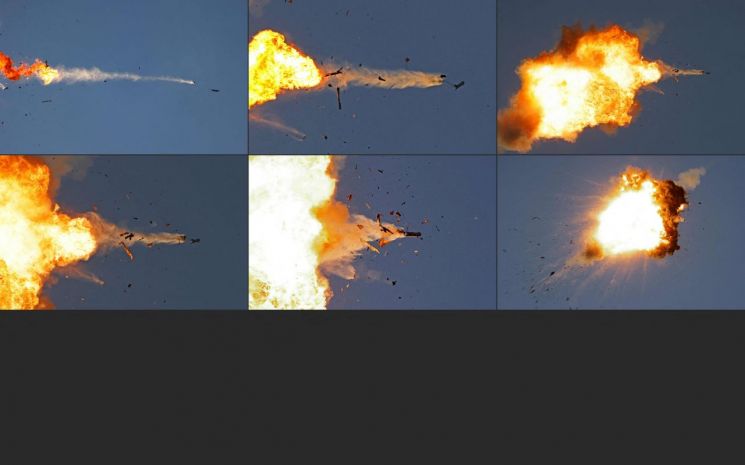 On the 25th (local time), a Hezbollah drone was intercepted by the Israeli Air Force over northern Israel. After detecting Hezbollah's preparations for a large-scale airstrike, Israel launched a preemptive strike, and Hezbollah retaliated. [Image source=AFP Yonhap News]
The airstrikes from both sides resulted in three deaths in Lebanon and one death in Israel. Both Israel and Hezbollah claimed their attacks were successful and have temporarily ceased airstrikes, leading analysts to suggest that the worst-case scenario of a full-scale war has been avoided for now.
However, both sides warned that a second round of airstrikes could follow. Israel declared a nationwide state of emergency for 48 hours, anticipating further strikes. Israeli Prime Minister Benjamin Netanyahu convened an emergency security cabinet meeting and warned of a tough response, stating, "This is not the end."
Hezbollah leader Hassan Nasrallah also confirmed that the recent attacks were retaliation for the death of senior commander Fouad Shukr last month, stating, "If we assess the operation’s results and find them insufficient, we will retaliate again," hinting at the possibility of additional strikes. Shukr was killed in an Israeli bombing in Beirut, the capital of Lebanon, on the 30th of last month.
If the conflict between Israel and Hezbollah escalates, it could expand into a large-scale confrontation involving Israel’s ally, the United States, and Iran, which supports Hezbollah.
Currently, experts say the Middle East situation remains uncertain, but both sides seem reluctant to engage in a full-scale war that would bring no benefits. Since the outbreak of the Gaza war in October last year, Israel and Hezbollah have been engaged in a tedious military standoff along their border for over ten months, expressing a willingness to escalate to full-scale war if necessary. However, such a war is considered an undesirable option for both Israeli leadership, including Prime Minister Netanyahu who is politically cornered domestically, and Hezbollah, whose position in Lebanon is rapidly weakening.
Ehud Yaari, a researcher at the Washington Institute for Near East Policy, said, "There are stages before a war breaks out. Gradual escalation is possible. Israel decided to preemptively block Hezbollah’s attack but chose not to go beyond that." He added, "Hezbollah also seems to be signaling that it is over for now, but by calling this the first stage of retaliation and receiving a green light from Iran, they are keeping the option open to do more."
Orna Mizrahi, a Lebanon expert at the National Security Institute in Tel Aviv, analyzed that Hezbollah lowered its response level out of concern over possible U.S. military involvement.
On the other hand, Chuck Freilich, former Israeli Deputy National Security Advisor, expressed concern that if the current situation of routine retaliatory attacks continues unchanged, the conflict could further escalate.
Pro-Iranian armed groups in the Middle East known as the "Axis of Resistance" have unanimously welcomed Hezbollah’s retaliation. The Palestinian militant group Hamas issued a statement saying Hezbollah "slapped the face of the Israeli government." Yemen’s Houthi rebels praised Hezbollah’s attack as excellent and courageous and vowed to retaliate for last month’s airstrike on their stronghold at Hodeidah port.
On the same day, Hamas’s armed wing, the Al-Qassam Brigades, announced that they bombed Tel Aviv, Israel. One minute after the announcement, air raid sirens sounded in Rishon LeZion, a city adjacent to southern Tel Aviv.
Meanwhile, according to foreign media reports citing multiple sources, no agreement was reached at the ceasefire talks held in Cairo, Egypt, on the same day regarding the Israel-Hamas war. Both sides rejected the compromise proposals presented by mediators, leaving the talks at an impasse.
© The Asia Business Daily(www.asiae.co.kr). All rights reserved.

















