5.6% Drop in a Week... Back to 3,000s After Three Months
Prolonged Honghae Crisis... Limited Impact of Middle East Risks
Rising Oversupply Effects... Concerns Over Economic Recession Increase
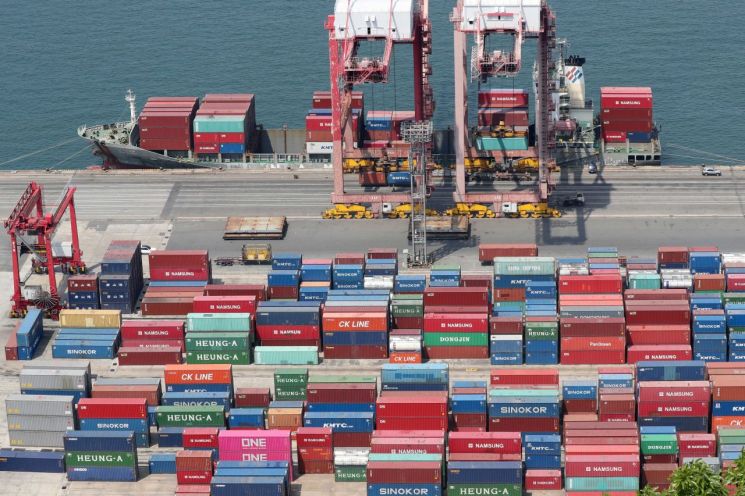
The Shanghai Containerized Freight Index (SCFI), which represents global maritime freight rates, has recently shown a downward stabilization trend. Despite the sudden clashes between Israel and the Lebanese militant group Hezbollah, analyses suggest that the impact of the Middle East situation is limited.
According to industry sources on the 26th, the SCFI recorded 3097.63 as of the 23rd. This is a 5.6% (183.73 points) decrease compared to the previous week. Compared to the yearly high of 3733.80 recorded on the 5th of last month, it has dropped by about 17%.
Most routes showed a downward trend. The East Coast of the Americas was recorded at $8,546 per 1 FEU (one 12m container), down $751 from the previous week. The West Coast route also fell by $626 to $5,955 during the same period. The Mediterranean route recorded $4,523 per 1 TEU (one 6m container), down $122. The European route also dropped $210 to $4,400. The Middle East and South America routes fell by $170 and $168 per 1 TEU, respectively.
The lack of significant reaction in maritime freight rates despite the sudden armed conflict in the Middle East is attributed to the prolonged blockage of the Suez Canal route due to the Red Sea crisis. Since rerouting around the Red Sea has been in place since the end of last year, changes in the regional situation have not had a major effect.
A shipping industry official explained, "If war creates unstable factors, uncertainties may increase due to concerns about reduced volumes from exporting companies," adding, "However, since rerouting around the Red Sea and Suez Canal has been ongoing for several months, the recent escalation has had little impact."
Rather, analyses suggest that the oversupply of ships forecasted last year and the possibility of a global economic recession have had more influence. Even before the Red Sea crisis broke out, the industry expected a significant oversupply of ships starting this year. According to Clarkson Research, a UK-based shipbuilding and shipping market analysis firm, global shipping capacity was expected to increase by 15% from last year through this year. An industry insider said, "In the second quarter alone, ship supply increased by nearly 1 million TEU, significantly alleviating supply shortages," and added, "With many newly ordered vessels accumulating, concerns about oversupply are growing."
If international bottlenecks are resolved, the downward trend in freight rates is expected to deepen. An industry official advised, "While increased ship supply will affect freight rate declines, reduced supply chain disruptions will allow exporting companies to manage logistics more stably," and recommended, "Considering the anticipated US interest rate cuts and inflation recovery in the second half of the year, which could stimulate cargo volume growth, flexible responses are necessary."
© The Asia Business Daily(www.asiae.co.kr). All rights reserved.
![Clutching a Stolen Dior Bag, Saying "I Hate Being Poor but Real"... The Grotesque Con of a "Human Knockoff" [Slate]](https://cwcontent.asiae.co.kr/asiaresize/183/2026021902243444107_1771435474.jpg)
















