"Cooling Off the Rural Migration Boom"... Accelerating 'Population Outflow'
Increase in Young Generation Leaving, Slowing Population Growth Trend
Lee Hyori and Lee Sangsoon couple are ending their 11-year life in Jeju and moving to Pyeongchang-dong, Jongno-gu, Seoul next month, amid a cooling trend in the once nationwide Jeju migration craze. Last year, the number of people leaving Jeju exceeded 1,000, indicating a rapid decline in the enthusiasm for relocating to Jeju. Various practical barriers are cited as the main reasons for significantly reducing the appeal of 'living in Jeju.'
 Lee Hyori and Lee Sangsoon couple are concluding their 11-year life in Jeju and will settle in Pyeongchang-dong, Jongno-gu, Seoul next month. Meanwhile, over 1,000 people who moved to rural areas have left Jeju in the past year. [Image source=Singer Lee Hyori's SNS]
According to the '2023 Status of Return-to-Farming and Return-to-Village Population' by the Honam Regional Statistics Office on the 25th, the population relocating to Jeju last year was 10,690, a 9.2% decrease compared to the previous year (11,767). The number of households also dropped by 614, or 7.1%, from 8,661 households to 8,047 households. The decrease rate of migrants to Jeju was much higher than the national average decrease rate of 3.9% (excluding Seoul, Gwangju, and Daejeon). The number of migrants coming from regions outside Jeju was 6,199, down 15.9% (1,171 people) from the previous year (7,370). The proportion of migrants from other cities and provinces was 58%, higher than the national average of 53.6%. Excluding Jeju (42%), the main previous residences of migrants were Seoul (17.7%) and Gyeonggi (17.4%).
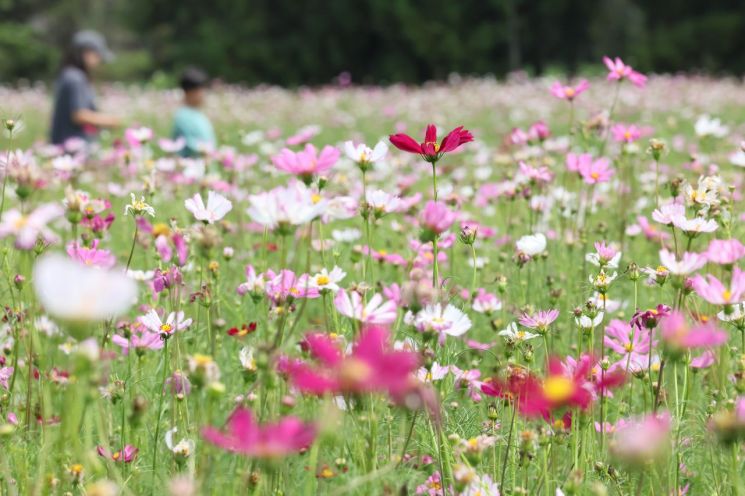 On the afternoon of the 25th, visitors who came to the Hangmong Historic Site in Aewol-eup, Jeju-si, are strolling through a cosmos flower field.
 [Photo by Yonhap News]
The average household size per migrant household was 1.33 persons, a 2.2% decrease, but still higher than Jeonbuk (1.29 persons) and Jeonnam (1.23 persons). Among migrant households, single-person households accounted for the highest proportion at 76.3%. The age distribution was 40s (22.6%), 30s (21.4%), 20s and below (20.9%), 50s (18.3%), 60s (12%), and 70s and above (4.8%). The gender ratio was 49.4% male and 50.6% female, with a slightly higher female proportion. The average age of migrants was 42.5 years, and the average age of accompanying household members was 32.9 years.
Soaring Real Estate Prices Greatly Reduce the Appeal of Living in Jeju
The reasons for migration were job (33%), family (22.6%), housing (19.6%), education (8%), natural environment (5.7%), residential environment (3%), and others (8.1%). Among the top five regions by the number of migrants in Jeonbuk, Jeonnam, and Jeju in 2023, Wanju-gun in Jeonbuk ranked first with 8,158 people. Jeju City ranked second with 6,445 people, and Seogwipo City ranked fourth with 4,245 people. Suncheon City in Jeonnam ranked second, and Muan-gun in Jeonnam ranked fifth with 3,311 people. However, the previously major reasons for migration, 'job' (33%) and 'family' (22.6%), are now interpreted as no longer promoting migration to Jeju.
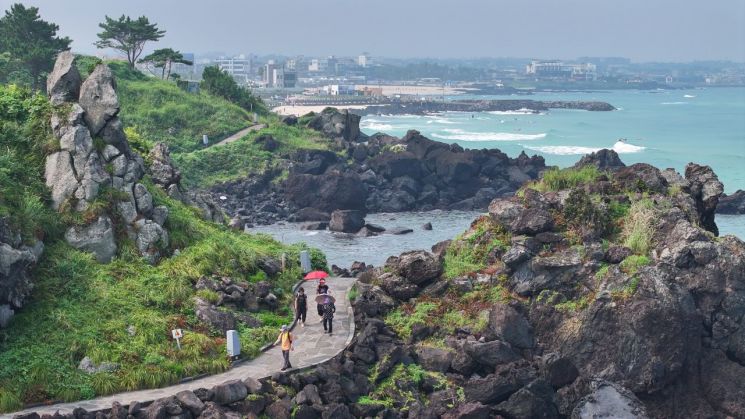 On the morning of the 23rd, tourists are taking a walk at Handam Beach in Aewol-eup, Jeju City.
 [Photo by Yonhap News]
High living costs, limited job opportunities, and soaring real estate prices are greatly reducing the appeal of living in Jeju. The fact that the proportion of migrants citing natural environment and residential environment as reasons for moving was only 5.7% and 3%, respectively, suggests that Jeju is no longer perceived as an ideal place for rural living. Additionally, for return-to-farming migrants moving from cities to rural areas for agricultural purposes, Jeju saw 236 households last year, a 2.5% decrease from the previous year (242 households). The number of return-to-fishing households engaged in fisheries increased by 46.7% from 15 households to 22 households.
In particular, Jeju's net population outflow has exceeded 2,000 people in just half a year. According to the Jeju office of Statistics Korea, the net outflow population in Jeju reached 2,192 in the first half of this year alone. This far exceeds last year's net migration population of -1,687, with 81,508 people moving in and 83,195 moving out. Looking at the first half of the year, net population outflow continued for 11 consecutive months from August last year (-230 people) to June this year (-233 people).
Last year, the net outflow scale of 1,687 people, which was the first net outflow in 14 years since 2009 (-1,015 people), was surpassed in April this year. By region, 1,634 people left Jeju City and 558 left Seogwipo City. Especially, the net outflow of people in their 20s was 1,391, accounting for 63% of the total outflow population. This acts as a factor lowering regional productivity and vitality and is pointed out as casting a dark shadow on Jeju's future.
© The Asia Business Daily(www.asiae.co.kr). All rights reserved.
![Clutching a Stolen Dior Bag, Saying "I Hate Being Poor but Real"... The Grotesque Con of a "Human Knockoff" [Slate]](https://cwcontent.asiae.co.kr/asiaresize/183/2026021902243444107_1771435474.jpg)













