"Timing of Policy Adjustment"
Declaration of Victory in Inflation War... "Do Not Want Further Cooling of Labor Market"
Employment Report on the 6th Next Month to Determine Interest Rate Cut Extent
Jerome Powell, Chairman of the U.S. Federal Reserve (Fed), expressed confidence in winning the war against inflation during his speech at Jackson Hole on the 23rd, signaling the start of interest rate cuts in September. This stance is a complete reversal from two years ago at the same venue, when he declared a high-intensity tightening due to inflation concerns. With Powell leaving the possibility of a big cut (0.5 percentage point rate cut) open, analysts suggest that the pace of future rate cuts will depend on how quickly the labor market cools down.
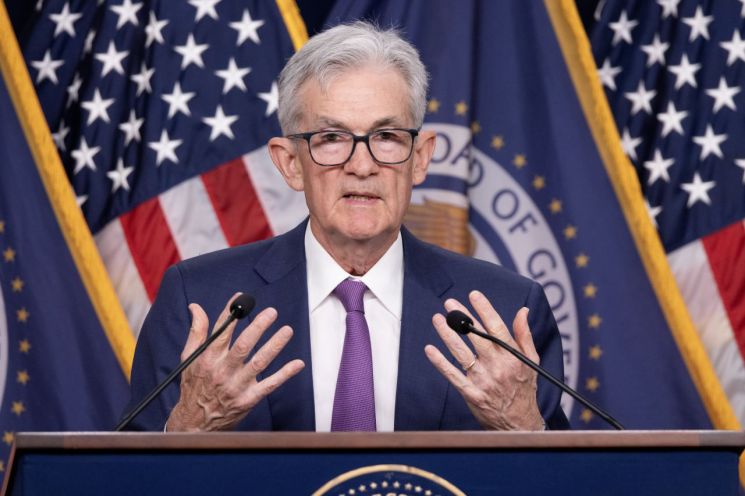
In his speech at the Jackson Hole meeting held in Wyoming on the 23rd, Chairman Powell stated, "The time has come to adjust policy."
The background to this shift in monetary policy is the judgment that inflation is no longer an obstacle. He said, "Inflation has fallen significantly," and "We are increasingly confident that inflation is sustainably slowing to 2%."
On the other hand, he assessed that concerns about a slowdown in the labor market have increased. Powell said, "The labor market is unmistakably slowing, and we do not want labor market conditions to cool further," adding, "Our goal is to maintain a strong labor market while avoiding a sharp rise in unemployment." While the focus had been solely on price stability until now, this indicates that going forward, monetary policy will place more emphasis on full employment.
Notably, while clearly signaling a rate cut in September, Powell did not rule out the possibility of a big cut. He said, "The timing and pace of rate cuts depend on incoming data, changing outlooks, and the balance of risks." This contrasts with the tone of Patrick Harker, President of the Philadelphia Fed, and Susan Collins, President of the Boston Fed, who mentioned "systematic and gradual rate cuts" at the same Jackson Hole meeting.
Accordingly, the pace of Fed rate cuts is expected to be influenced by the speed of labor market cooling. The key will be the August employment report released by the U.S. Department of Labor on the 6th, ahead of the Federal Open Market Committee (FOMC) meeting on the 17th-18th of next month. The report will include the unemployment rate and nonfarm payroll employment figures for the month. The unemployment rate surged from 4.1% in June to 4.3% in July. Given that rapid labor market cooling concerns and recession fears had spread in the market, if the August unemployment rate rises further, it is expected to strengthen the case for a big cut by the Fed.
Inflation is expected to continue on a stable trend and not be a major variable. The Personal Consumption Expenditures (PCE) price index, which the Fed prioritizes most, will be released on the 30th. The July PCE price index is expected to rise 0.2% month-over-month and 2.5% year-over-year, similar to or slightly higher than the previous month (0.1% month-over-month, 2.5% year-over-year).
John Velis, Foreign Exchange and Macroeconomic Strategist at BNY Mellon, analyzed, "There is still debate over whether the September rate cut will be 25 basis points (1bp = 0.01 percentage point) or 50 basis points. The recent employment report was weaker than expected, and if the next employment report continues this trend, a 50bp cut could come into the picture."
Cameron Crise, Bloomberg strategist, said, "Powell said what we already knew, but more strongly than his (Fed) colleagues. All of this is focused on the employment report that will come out in a few weeks."
© The Asia Business Daily(www.asiae.co.kr). All rights reserved.
![Clutching a Stolen Dior Bag, Saying "I Hate Being Poor but Real"... The Grotesque Con of a "Human Knockoff" [Slate]](https://cwcontent.asiae.co.kr/asiaresize/183/2026021902243444107_1771435474.jpg)
















