With the strong performance of LG Display and Samsung Display, South Korea is dominating the LTPO OLED panel technology sector. These companies hold a global market share of 86.8% in the LTPO OLED panel field, supplying the majority of LTPO OLED panels worldwide.
LTPO technology is recognized as the next-generation OLED panel technology and is mainly applied to high-spec smartphones equipped with artificial intelligence. LTPO involves complex manufacturing processes and low yield, resulting in high costs. However, it offers advantages such as reducing power consumption by 10-40% and maintaining consistent screen brightness. Due to these low-power characteristics, it is primarily used in smartwatches that maintain black backgrounds or static screens, as well as high-spec smartphones.
As of last year, the global sales revenue of LTPO OLED panels was $17.6 billion, and this year, a growth of 26.1% compared to the previous year (sales revenue of $22.2 billion) is expected. For the same reasons, patent applications for low-power display LTPO OLED panel technology have been actively increasing worldwide. South Korea has ranked first globally in both the number of patent applications and the growth rate of applications in this field over the past decade.
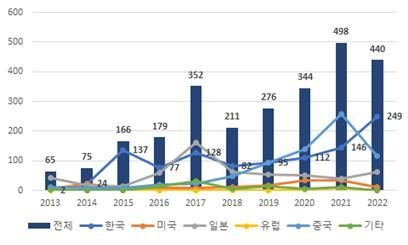 Patent application trends by applicant nationality in the LTPO field from 2013 to 2022. Provided by the Korean Intellectual Property Office
According to the Korean Intellectual Property Office on the 25th, the number of global patent applications for LTPO OLED panel technology filed in the IP5 countries (South Korea, the United States, China, the European Union, and Japan) increased from 65 in 2013 to 440 in 2022. The cumulative number of applications from 2013 to 2022 totaled 2,606, with an average annual growth rate of 23.7%.
During the same period, South Korea filed a total of 1,052 patent applications. This accounts for 40.4% of the total cumulative applications, with an average annual growth rate of 70.9%.
Following South Korea, China filed 728 applications (27.9%, average annual growth rate 29.9%), Japan 568 applications (21.8%, average annual growth rate 4.3%), the United States 156 applications (6.0%, average annual growth rate 9.2%), and the European Union 16 applications (0.6%, average annual growth rate 0%).
South Korea leads in both the number of applications and the growth rate of applications. The top five domestic applicants include LG Display (649 applications, 24.9%), Samsung Display (376 applications, 14.4%), China’s BOE (Jingdongfang) (373 applications, 14.3%), Japan’s Semiconductor Energy Laboratory (SEL) (355 applications, 13.6%), and the United States’ Apple (116 applications, 4.5%).
Among these, LG Display and Samsung Display’s LTPO OLED panel-related patent applications account for about 40% of the total applications, confirming that South Korea is leading the research and development of global LTPO OLED panel technology.
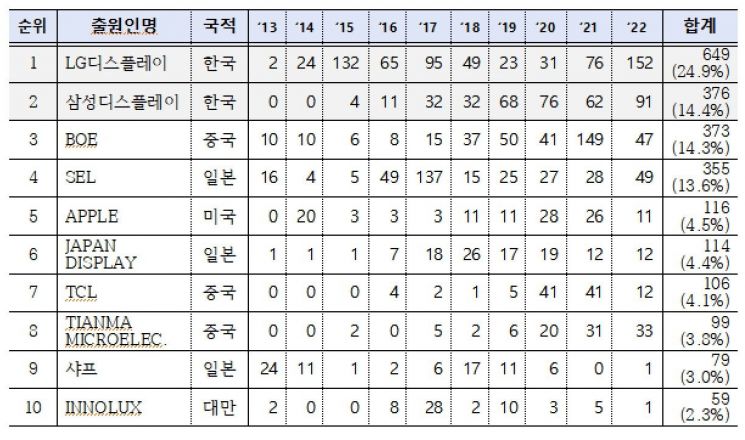 Top 10 Applicants in the LTPO Field from 2013 to 2022. Provided by the Korean Intellectual Property Office.
In particular, when examining the technology influence index by applicant based on U.S. patent counts, LG Display scored 6.1, surpassing Apple (4.4) and Japan’s Semiconductor Energy Laboratory (2.7). The Korean Intellectual Property Office explained that this indicates that despite Apple and others holding foundational or key patents for LTPO OLED panel technology, domestic companies are rapidly expanding their technological influence through research and development.
Inch Bok, Director of the Semiconductor Manufacturing Process Examination Division, emphasized, “Currently, Apple is the largest customer for LTPO OLED panels, and LG Display and Samsung Display are included in Apple’s supply chain.”
He added, “For domestic companies to further expand their global market share of OLED panels, continuous research and development to enhance cost competitiveness is essential. To this end, the Korean Intellectual Property Office will strive to promptly provide global patent information related to LTPO OLED panels based on high-quality examinations.”
© The Asia Business Daily(www.asiae.co.kr). All rights reserved.
![Clutching a Stolen Dior Bag, Saying "I Hate Being Poor but Real"... The Grotesque Con of a "Human Knockoff" [Slate]](https://cwcontent.asiae.co.kr/asiaresize/183/2026021902243444107_1771435474.jpg)

















