Temporary Rebound in July Prices Due to Rising International Oil Prices
Stabilization at Low 2% Range in August-September
Long-term Convergence to Around 2% Expected
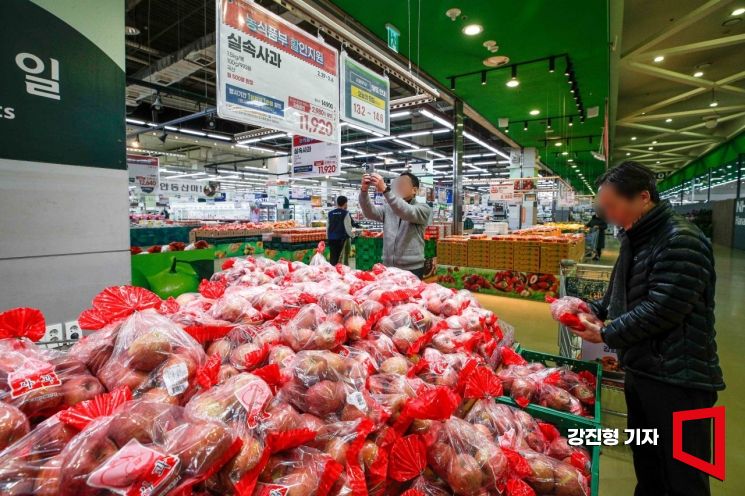
Although consumer prices rebounded to 2.6% last month, this is considered a temporary phenomenon due to rising oil prices, and it is expected to stabilize again in the low 2% range in August. Analysis suggests that the inflation rate will continue to converge toward the Bank of Korea's target level of 2% even after August.
According to the Bank of Korea's report titled "Evaluation of Price Conditions by Sector and Short-term Price Trend Forecast Using Machine Learning" on the 26th, the consumer price index in South Korea rose by 2.6% year-on-year last month. Compared to the 2.4% recorded in the previous month, the increase in the price index raised concerns about renewed price instability.
However, the report assessed that the July inflation rebound was partly due to temporary factors such as the rise in international oil prices and the reduction in the fuel tax cut rate. International oil prices rose to the high $80 range since mid-June, driven by expectations of increased seasonal demand during the summer. Due to the rise in petroleum prices, non-core inflation remains volatile above 3%, while core inflation excluding agricultural products and petroleum is aligned with the 2% target convergence path.
The report judged that the recent momentum of price increases is somewhat clearly slowing down. In particular, it diagnosed that the inflation momentum centered on core inflation is approaching pre-COVID-19 levels, showing a stable trend. Although non-core inflation fluctuates widely, it is observed that momentum is decreasing recently, supported by a slowdown in agricultural product prices.
Inflation Rate Expected to Be in the Low 2% Range in August
The Bank of Korea predicted consumer prices using a bottom-up machine learning method that forecasts the overall index based on item-level predictions. It forecasted that the inflation rate, which slightly rebounded in July, will decrease again to the low 2% range in August and slow down to around 2.0% in September. This aligns with the Bank of Korea's inflation target of 2.0%.
The bottom-up machine learning forecast first predicts prices of sub-items of the consumer price index and then aggregates them with weights to predict the overall index. This method is evaluated to have 20-60% lower prediction errors compared to directly forecasting the overall index.
Regarding core inflation, the increase rate is estimated to stabilize downward in the low 2% range during August and September. By item, with recent declines in oil prices and a slowdown in agricultural, livestock, and fishery product prices, the deceleration trend in non-core inflation is expected to continue.
Core inflation is expected to stabilize at a low level due to sluggish demand recovery. The rise in core goods prices is predicted to remain in the high 1% range for the time being, while core service prices excluding rent are expected to show a gradual deceleration trend in the mid-2% range.
However, the background of this forecast also involves a base effect caused by the sharp rise in oil and agricultural product prices in August last year. Lee Dong-jae, head of the Bank of Korea Incheon branch, said, "By item, petroleum will show a significant base effect in August and September, and agricultural, livestock, and fishery products in August and October," adding, "After November, the decline in oil prices at the end of last year will act as a base effect in the opposite direction, somewhat limiting the deceleration of the consumer price inflation rate."
Lee Seung-ho, head of the price trend team at the Bank of Korea's Research Department, said, "Although the consumer price inflation rate recently rebounded temporarily," he added, "Based on the evaluation of sectoral price conditions, machine learning, and base effects for short-term forecasts, the price trend will steadily converge toward the target level unless a significant supply shock occurs."
© The Asia Business Daily(www.asiae.co.kr). All rights reserved.
!["The Woman Who Threw Herself into the Water Clutching a Stolen Dior Bag"...A Grotesque Success Story That Shakes the Korean Psyche [Slate]](https://cwcontent.asiae.co.kr/asiaresize/183/2026021902243444107_1771435474.jpg)
















