Byproduct Gas Once Discarded Transformed into High-Value 'Aldehyde'
Recycling Industrial Waste, Achieving Self-Sufficiency in High-Value Chemical Materials and Products
The UNIST research team has developed a technology that produces high-value-added aldehydes using by-product gases.
This technology is expected to play a crucial role in the self-reliance of the domestic chemical industry by reducing dependence on overseas chemical materials and ensuring stable responses to supply chain crises.
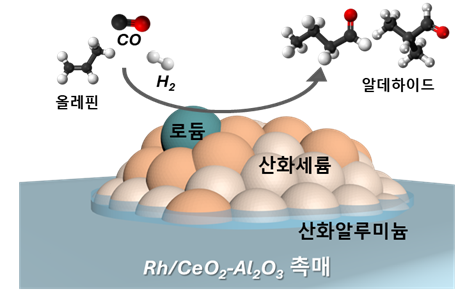
The team led by Professor Ahn Kwangjin from the Department of Energy and Chemical Engineering at UNIST (President Park Jongrae) and Professor Han Jeongwoo from Seoul National University, in collaboration with the Korea Institute of Energy Research, developed a high-performance rhodium-based catalyst. This catalyst efficiently converts olefins contained in by-product gases into high-value-added aldehydes. Olefins are unsaturated hydrocarbon compounds with double bonds and, along with paraffins, are important raw materials in the chemical industry.
 Professor Kwangjin Ahn.
The research team proposed a new method for recycling by-product gases that were previously discarded. They also developed a technology that converts by-product gases generated during the process of turning carbon dioxide and hydrogen into fuel into high-value-added products.
To enhance the performance of the rhodium catalyst, cerium oxide was introduced to improve the chemical properties of the catalyst. The team successfully converted olefins in by-product gases into aldehydes, a high-value-added chemical, using a heterogeneous catalyst with high reaction performance comparable to existing technologies.
By-product gas is a by-product generated from chemical reactions that convert synthesis gas into liquid, and it has not received much attention until now. The rhodium catalyst developed by the research team has improved performance by reducing its size and increasing its dispersion, making it reusable and enabling a new assessment of the industrial value of by-product gases.
Professor Ahn Kwangjin explained, "This technology will play an important role in enhancing the value of by-products from chemical reactions," adding, "It can also be applied to technologies that protect the environment by converting carbon dioxide into fuel." Professor Han Jeongwoo from Seoul National University evaluated, "The catalyst developed in this research has maximized the efficiency and stability of rhodium."
The research was supported by the Ministry of Trade, Industry and Energy and the Ministry of Science and ICT, and the results were published in the international journal 'Chemical Engineering Journal.'
© The Asia Business Daily(www.asiae.co.kr). All rights reserved.
![From Hostess to Organ Seller to High Society... The Grotesque Scam of a "Human Counterfeit" Shaking the Korean Psyche [Slate]](https://cwcontent.asiae.co.kr/asiaresize/183/2026021902243444107_1771435474.jpg)
















