High Inflation, High Interest Rates, and Income Stagnation Hinder Consumption Recovery
Nominal Wages Rise, Improvement Expected in the Second Half of the Year
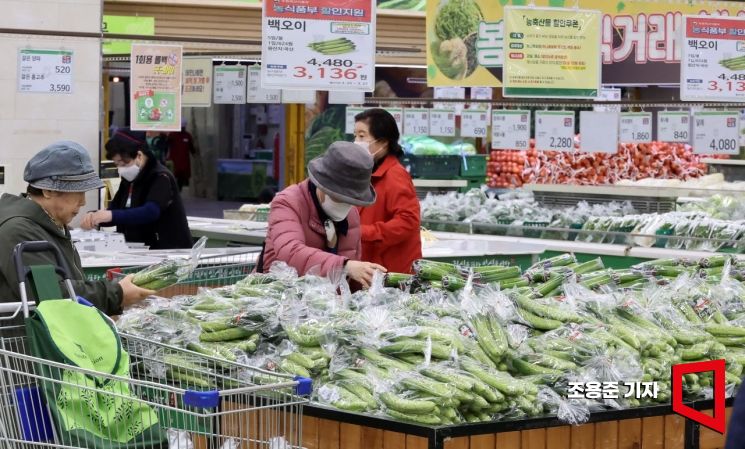
High inflation, high interest rates, and income stagnation due to worsening corporate earnings are delaying the recovery of private consumption in South Korea, according to an analysis. However, consumption is expected to recover gradually in the second half of the year, supported by rising wage growth and falling prices.
On the 23rd, the Bank of Korea cited high price levels, principal and interest repayment burdens caused by high interest rates, and delayed income improvement as reasons for the recent sluggishness in private consumption in its report titled 'Recent Trends in Private Consumption.' In the first half of this year, South Korea's private consumption growth rate was 1.0% year-on-year, somewhat lagging behind the economic growth rate of 2.8%.
Inflation Since COVID-19 Restricts Consumption Recovery
Regarding prices, the Bank of Korea analyzed that the accumulated price increases since the COVID-19 pandemic have acted as a factor delaying the recovery of private consumption. In particular, the Bank estimated that the effective inflation rate faced by vulnerable groups, who have a high proportion of essential goods expenditure, is higher than that of other groups, leading to a greater contraction in their purchasing power. Looking at consumption types, the recovery of nondurable goods such as food, which have a high share of essential goods, was delayed.
In a situation where household debt has significantly increased, the burden of principal and interest repayments due to high interest rates also restricts the improvement of consumption capacity, especially among those who suffer losses from rising interest rates. The group suffering losses from interest rate hikes consists mainly of households in their 30s and 40s, middle to upper-middle income earners, and higher consumption level households.
Joonho Lee, head of the Economic Trend Team at the Bank of Korea's Research Department, explained, "Micro data from credit cards shows that in the middle to upper income groups, the higher the debt level, the lower the growth rate of card usage. If the consumption decrease among those suffering losses from interest rate hikes exceeds the consumption increase among those benefiting from the rate hikes, the negative impact of rising interest rates on consumption will be amplified."
Sluggish corporate earnings and poor business conditions for self-employed individuals have also delayed household income improvements, contributing to weak private consumption. Early this year, as corporate bonuses decreased, real labor income of households was sluggish, and the deteriorating profitability of the self-employed also constrained consumption.
Changes in population structure, such as aging and low birth rates, have structurally delayed consumption recovery. In particular, the consumption propensity of the elderly aged 60 and above has significantly declined due to insufficient retirement preparation, and the increasing proportion of this age group in the total population has also lowered the overall consumption propensity in the economy.
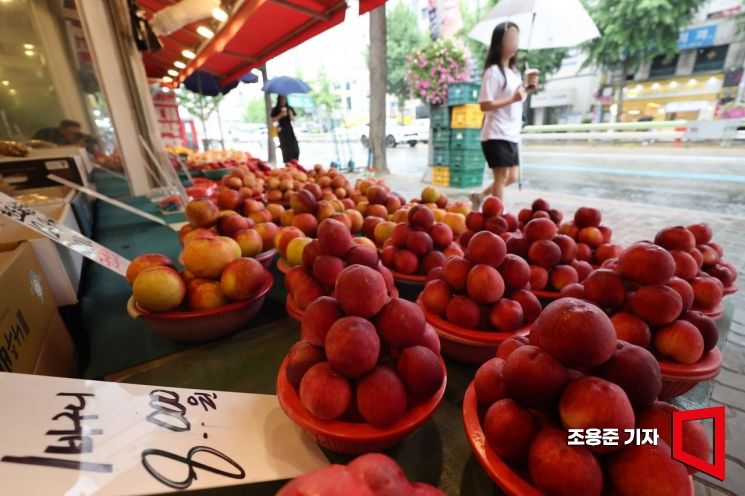 Fruits are displayed at a store near the Cheonggye Market in Yeongdeungpo-gu, Seoul. Photo by Jo Yongjun jun21@
Nominal Wage Increase from Corporate Earnings Improvement Aids Consumption Recovery
However, the Bank of Korea expects private consumption to gradually recover due to the expansion of nominal wage growth supported by improved corporate earnings. Notably, the nominal wage growth rate, which was 1.3% in the first quarter, recovered to 3.8% in April and May, and is expected to improve further in the second half of the year. As the inflation rate slows, the real wage growth per capita is also predicted to turn positive from the third quarter onward.
Additionally, with financial conditions easing and the gradual arrival of replacement periods for durable goods such as IT devices, the sluggishness in durable goods consumption is expected to ease. Lee emphasized, "Going forward, our economy will show a more balanced growth trend as private consumption recovers amid continued strong exports, gradually narrowing the gap between exports and domestic demand."
© The Asia Business Daily(www.asiae.co.kr). All rights reserved.


















