Seminar on Establishing Drainage and Low-Noise Technology Standards
"Institutional Foundation Established for Technology Activation but No Technical Standards Yet"
The government is initiating standardization efforts for road paving technology that prevents slipping and reduces noise.
The Ministry of Land, Infrastructure and Transport announced that it will hold a seminar at 2 p.m. on the 23rd in Seoul to discuss permeable and low-noise road paving technology, analyze the market status, and explore ways to promote the construction methods. Experts and related company representatives from the Korean Society of Road Engineers, the Permeable Pavement Association, and the Ascon Cooperative will attend the seminar.
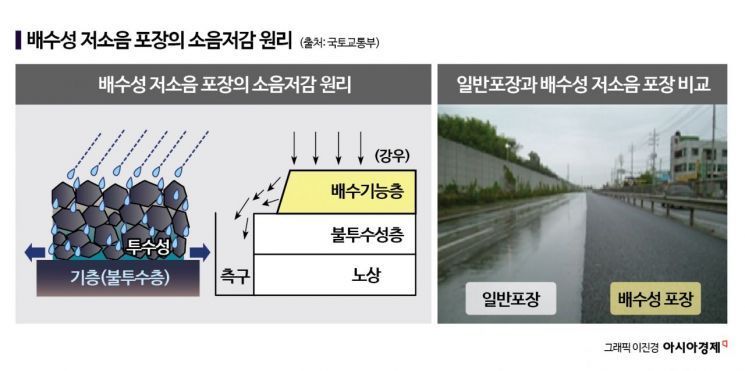
Permeable and low-noise paving is a technology that prevents slipping on rainy days and absorbs noise caused by tires. The core of this technology is to use coarser aggregates than those in regular asphalt to increase the void ratio, which is the gap inside the road. The void ratio of regular asphalt is 4%. Roads with this technology applied have a void ratio increased up to 16%. Roads with a high void ratio can drain surface water faster than regular roads and reduce noise caused by tires.
The Ministry of Land, Infrastructure and Transport will begin standardization work on permeable and low-noise paving technology through this seminar. Until now, different standards have been applied by each company at road construction sites.
In January, the ministry established a legal foundation for standardization by adding provisions to the Road Act that prioritize permeable and low-noise paving. Last month, through amendments to enforcement regulations and the establishment of administrative rules, facility standards and installation criteria for such paved roads were created.
Oh Su-young, head of the Road Construction Division at the Ministry of Land, Infrastructure and Transport, said, "Although an institutional foundation for permeable and low-noise paving technology has been established, there are no technical quality standards or maintenance criteria." He added, "We plan to listen to industry opinions through this seminar and create such technical standards." He further stated, "We plan to conduct related planning research and research and development (R&D) in the future through this seminar."
© The Asia Business Daily(www.asiae.co.kr). All rights reserved.

















