Ministry of Trade, Industry and Energy Announces 'Trade Policy Roadmap'
The government has decided to expand South Korea's Free Trade Agreement (FTA) network to cover up to 90% of the world's Gross Domestic Product (GDP), reaching a world-leading level. While working to achieve outcomes from Economic Partnership Agreements (EPA) with key emerging countries in Asia and Africa, the government will also ensure the smooth implementation of agreements already concluded with the Middle East and Latin America.
On the 22nd, the Ministry of Trade, Industry and Energy held a National Policy-Related Ministers' Meeting chaired by Prime Minister Han Duck-soo, where they reviewed the achievements of trade policies over the past two years and discussed the 'Trade Policy Roadmap' outlining directions to respond to future global environmental changes. The roadmap was jointly announced by related ministries.
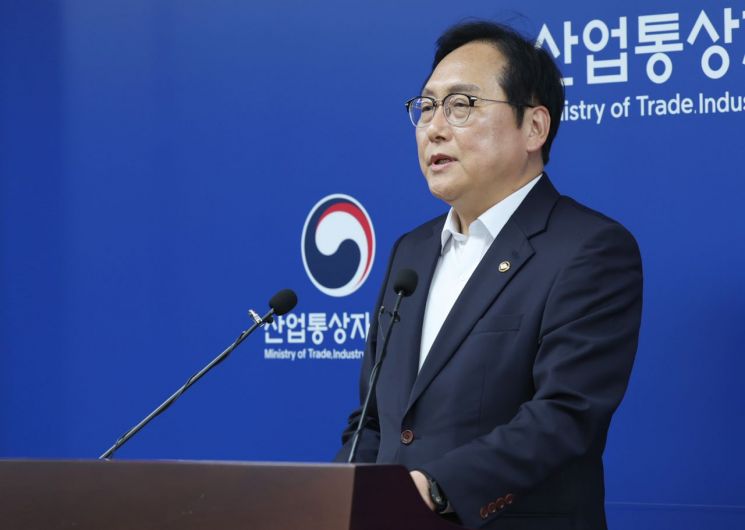 Jung In-kyo, Head of the Trade Negotiations Office at the Ministry of Trade, Industry and Energy, is answering reporters' questions after briefing on the trade policy roadmap at the Ministry of Trade Industry press room in the Government Sejong Complex on the 22nd.
That afternoon, Jung In-kyo, Director-General for Trade Negotiations at the Ministry of Trade, Industry and Energy, met with reporters at the Government Complex Sejong and emphasized, "Addressing new trade issues and supply chains as important policy matters is a challenge faced not only by our country but by the entire world," adding, "Even if the World Trade Organization (WTO) system is restored, these issues will undoubtedly require policy management."
The government has actively responded to legislative and economic policy changes in major countries, significantly reducing uncertainty for businesses, and conducted comprehensive diplomatic sales efforts. Despite difficult circumstances, it achieved record-high exports ($683.6 billion in 2022) and foreign direct investment attraction ($32.72 billion in 2023). Notably, five trade agreements were concluded last year alone, and the trade and investment promotion framework was expanded to 23 cases, broadening the economic playing field. The government has also strengthened its active role in forming new trade norms such as supply chains, digital economy, and clean economy, including serving as the chair country of the Indo-Pacific Economic Framework (IPEF) supply chain crisis response network.
However, with the multilateral trade system significantly weakened and major countries increasingly integrating industrial and trade policies under the guise of economic security to strengthen protectionist measures, geopolitical uncertainties are rising amid the 'super election year' in the United States, leading to a major shift in the global international trade order paradigm. An official from the Ministry of Trade, Industry and Energy explained, "In response, the government has established the roadmap after gathering opinions from industry and academia and consulting with related ministries to systematically and long-term pursue our trade policy."
Expanding FTA Network from 85% to 90% of Global GDP
First, South Korea will expand its FTA network, currently covering about 85% of global GDP and ranking second after Singapore, to a world-leading level covering 90% of global GDP. The government plans to prioritize signing EPAs with key hub countries in Asia and Africa that have core mineral resources and high growth potential, then expand the trade network to neighboring untapped countries. It will establish a South Asia trade belt through EPA negotiations with Mongolia, one of the world's top 10 resource-rich countries, as well as Pakistan and Bangladesh, and lay the foundation for cooperation with Africa through EPA negotiations with Tanzania and Morocco. FTAs with the Gulf Cooperation Council (GCC) and Ecuador in the Middle East and Latin America, where negotiations have already been concluded, will be promptly implemented. The Korea-GCC FTA concluded in December last year is expected to raise the FTA network coverage by about 2 percentage points to approximately 85% of global GDP upon its enforcement.
In the Indo-Pacific region, South Korea's key market, the government will build a denser trade network through multilayered FTA agreements and upgrades of existing FTAs. Negotiations for the Korea-Japan-China FTA will resume, and bilateral FTA talks with Malaysia and Thailand will be accelerated. Regarding the Comprehensive and Progressive Agreement for Trans-Pacific Partnership (CPTPP), efforts will focus on building social consensus through communication with various domestic stakeholders.
South Korea will also pursue diversification of export, production bases, and core mineral supply chains by strengthening cooperation with global South countries such as ASEAN, India, the Middle East, Central Asia, Africa, and Latin America, which are emerging as strategic balancing poles. Economic and industrial cooperation will be enhanced through multilateral platforms such as the first-ever Korea-Africa Summit and the Korea-Central Asia K-Silk Road Cooperation Initiative. Additionally, the government will promote 'K-industry linked Official Development Assistance (ODA)' that maximizes mutual benefits between South Korea and global South countries, establishing a mutually beneficial cooperation foundation.
Focused Management of Trade Risks with Major Countries Including the US, Japan, China, and EU
The government will also thoroughly prepare for trade risks from major countries. While strengthening strategic cooperation with the United States, Japan, the European Union (EU), and China, it plans to intensively manage trade risks to minimize negative impacts on Korean companies. Regarding the United States, the government will expand advanced industry partnerships based on the strong Korea-US alliance, establish a collaborative system with businesses to prepare for the US presidential election, and conduct detailed analyses of impacts on Korean companies to carry out outreach efforts toward the US.
With Japan, as a country with similar positions, the government will strengthen strategic coordination on global agendas in multilateral trade forums and build a future-oriented economic and trade relationship across industry, trade, and energy sectors based on improved Korea-Japan relations. Furthermore, cooperation will continue to link early warning systems (EWS) among Korean, US, and Japanese overseas missions for joint responses to supply chain disruptions and crises.
With the EU, the government will expand cooperation platforms such as supply chain and industrial policy dialogues linked to digital and green transitions, and pursue tangible cooperation outcomes with individual countries like the Netherlands, Poland, and the Czech Republic in advanced semiconductor technology development, nuclear power, and defense projects. It will also strengthen communication channels regarding the EU's simultaneous economic legislation and support Korean companies in actively utilizing opportunities.
Regarding China, the government will accelerate follow-up negotiations on the Korea-China FTA services and investment chapters, strengthen mutually beneficial economic cooperation through multilayered channels involving central and local governments, and focus on supply chain stability through economic joint committees, supply chain hotlines, and export control dialogues. In particular, cooperation will be promoted to create a predictable business environment for Korean and Chinese invested companies.
The government will also enhance economic security by strengthening supply chains and technology protection. Alongside multilateral supply chain cooperation such as the IPEF supply chain agreement, it plans to conclude bilateral supply chain cooperation agreements (SCPA) with 5 to 6 key partners including Australia and Indonesia by 2027, establishing a cooperative system for rapid joint responses to supply chain disruptions. As the inaugural chair country of the IPEF supply chain crisis response network, South Korea will lead the early establishment of a rapid response system for supply chain disruptions in the Indo-Pacific region.
Additionally, the government will engage in international cooperation activities to stabilize supply chains of critical minerals, whose importance is rising as essential resources for advanced industries such as semiconductors, batteries, and electric vehicles, and for achieving global net-zero goals. As chair country of the Mineral Security Partnership (MSP), which includes 14 countries such as the US, UK, Japan, Canada, Australia, and the EU, South Korea will lead efforts to stabilize and diversify global supply chains while actively promoting expansion of related business opportunities for Korean companies.
Alongside this, the government will strategically attract foreign investment aimed at securing advanced domestic technologies and expanding supply chains, and promote the reshoring of core industries in advanced strategic sectors and supply chains. To firmly protect Korea's core technologies and capabilities, the government plans to amend the Industrial Technology Protection Act to strictly punish leakage of national core technologies, add mergers and acquisitions (M&A) of domestic companies holding national advanced strategic technologies to the scope of foreign investment reviews for national security concerns, and introduce an ex officio review system by administrative agencies to strengthen foreign investment screening. Furthermore, in line with international trends, the government will revise export control systems and consider strengthening a Korea-style industrial security organization similar to the US Department of Commerce's Bureau of Industry and Security (BIS) to comprehensively respond to trade, investment, and technology security issues.
An official from the Ministry of Trade, Industry and Energy stated, "Going forward, the government will closely collaborate among related ministries to implement policy tasks according to the roadmap, including managing the outcomes of diplomatic sales efforts, to maximize national interests and minimize negative impacts on our economy and companies amid the severe global trade environment. We also plan to actively pursue measures to expand trade infrastructure, such as strengthening the expertise of trade personnel domestically and internationally, to effectively support these efforts."
© The Asia Business Daily(www.asiae.co.kr). All rights reserved.

![Clutching a Stolen Dior Bag, Saying "I Hate Being Poor but Real"... The Grotesque Con of a "Human Knockoff" [Slate]](https://cwcontent.asiae.co.kr/asiaresize/183/2026021902243444107_1771435474.jpg)















