Nature Index Evaluates 2024 Korea Special Edition
R&D Analysis Released for the First Time in 4 Years Since 2020
Need to Increase Female Participation, Diversify International Collaboration, and Support Expansion of Overseas Workforce
The international academic journal Nature released a special Korean edition for the first time in four years, pointing out that South Korea's research and development (R&D) performance is low relative to its investment. This confirms the so-called "Korea Paradox" internationally, where the return on investment is low. Nature also advised that, amid declining birth rates and a decrease in science and engineering students, South Korea should increase international collaboration and female participation to avoid factors that threaten its status in the scientific community.
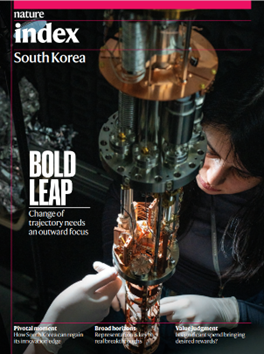 Nature Index 2024 Korea Edition Special Cover
On the 21st, Nature published the "Nature Index 2024 South Korea" special edition, issued by its affiliated research data analysis organization. This is the first such publication in over four years since 2020.
According to the Nature Index, South Korea ranked among the top OECD member countries in terms of the growth rate of government R&D expenditure. This was due to continuous increases in R&D spending from 2007 through 2022.
The problem lies in the outcomes relative to the investment. When comparing South Korea with other countries based on an indicator that divides the proportion of top-tier natural science papers by population, South Korea, despite investing nearly 5% of its gross domestic product (GDP) in R&D, scored around 30 on this indicator, placing it in the lower tier compared to major countries.
Beck Crew, senior editor of the Nature Index, diagnosed in the preface of this Korean special edition that "South Korea has a higher researcher-to-population ratio and enormous R&D expenditure compared to other major countries, but the research output relative to spending measured by the Nature Index is surprisingly low."
Nature identified the biggest challenges facing Korean science as population decline, gender imbalance, maintaining its status as a research innovation hub, and instability in the connection between industry and academia. Senior editor Crew analyzed that the relationship between Korea's industry and academia is somewhat unstable, and combined with adverse factors such as the world's lowest birth rate and a decrease in student numbers, South Korea is facing a difficult situation.
Nature suggested that these weaknesses could be opportunities to reignite innovation potential, highlighting that addressing the career discontinuation issue among women, who make up only 23% of the research workforce, could be one way to establish a global leadership position in science.
Additionally, Nature analyzed that Korean researchers desire more collaboration beyond existing partners such as the United States and China, and that environmental factors hindering foreign researchers from staying long-term in Korea?such as language barriers and cultural differences?need improvement. Senior editor Crew also noted that these issues are affecting talent recruitment in universities and companies.
Senior editor Crew stated, "South Korea's strong investment in science and its reputation for technological innovation are very impressive, but the discrepancy between spending and outcomes needs to be addressed." He added, "By fostering more diverse international partnerships and empowering women in research fields, South Korea can fully realize its potential in the scientific community and solidify its status as a global science leader."
There are also counterarguments to this evaluation. Some claim that the assessment is overly focused on basic science fields and does not consider that domestic universities and science and technology institutes are concentrating on engineering and applied science fields.
The Ministry of Science and ICT also responded to the announcement, stating that since it includes analyses explaining international collaborative efforts such as Horizon Europe and Brain Pool, and the potential for success, it cannot be viewed as entirely negative.
Meanwhile, this special edition included a ranking of the top 50 Korean research institutions selected by the 2023 Nature Index. Seoul National University ranked first, followed by the Korea Advanced Institute of Science and Technology (KAIST), Yonsei University, Sungkyunkwan University, and Pohang University of Science and Technology (POSTECH).
The Institute for Basic Science (IBS), which leads international collaboration among Korean government-funded research institutes, ranked sixth. The Quantum Nano Science Research Group operated by IBS was also featured with photos and articles in this special edition as a representative example of Korea's global research collaboration.
© The Asia Business Daily(www.asiae.co.kr). All rights reserved.
![Clutching a Stolen Dior Bag, Saying "I Hate Being Poor but Real"... The Grotesque Con of a "Human Knockoff" [Slate]](https://cwcontent.asiae.co.kr/asiaresize/183/2026021902243444107_1771435474.jpg)















