Hankyup-CCIA Joint Seminar
U.S. Corporate Discriminatory Policies May Cause Trade Disputes
Concerns Over Negative Impact on Trade and Security Sectors
Claims have been raised that Chinese platforms such as Baidu and Alibaba will gain indirect benefits from the Digital Markets Act (DMA), commonly referred to as the 'Big Tech Abuse Prevention Act.'
There are concerns that the DMA effectively discriminates against American companies, potentially leading to trade disputes, and that it will increase corporate costs, resulting in reduced employment and the collapse of small and medium-sized enterprises (SMEs) and startup ecosystems.
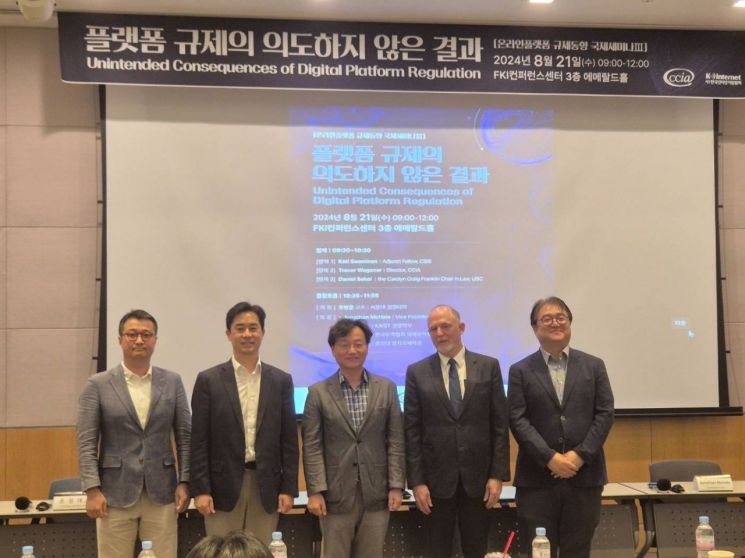 Participants are taking a commemorative photo at the International Seminar on Online Platform Regulation Trends held on the 21st at the FKI Conference Center in Yeouido, Seoul. (From left) Seongdae Cho, Korea International Trade Association International Trade and Commerce Research Institute; Yongwook Baek, KAIST Professor; Seongho Park, President of Korea Internet Corporations Association; Jonathan McHale, Vice President of CCIA; Byeongjun Yoo, Seoul National University Professor.
On the 21st, the Korea Internet Corporations Association and the Computer & Communications Industry Association (CCIA) of the United States held an international seminar titled "Unintended Consequences of Platform Regulation" at the FKI Conference Center in Yeouido, Seoul.
The seminar examined the impact of the DMA, which was implemented by the European Union (EU) in March, on the market and explored the potential outcomes for the digital ecosystem and the global economy. Experts also shared their opinions in light of similar preemptive regulatory bills being promoted in the 22nd National Assembly of Korea.
Jonathan McHale, Vice President of CCIA, who attended the event, stated, "If Korea adopts the EU's approach, it could hinder the economic partnership between the two countries," adding, "It may work to the disadvantage of Korea, which has achieved remarkable success in the internet era."
Kati Suominen, a visiting researcher at the Center for Strategic and International Studies (CSIS) in the U.S., who participated via video conference, predicted, "The regulatory compliance costs that companies must bear under the DMA will increase, and as a result, up to 70,000 jobs could be lost."
The 'gatekeepers' subject to DMA regulation must meet criteria including: an average net profit of 6.5 billion euros over the past three years; an average market capitalization of 7.5 billion euros in the previous year; operations in at least three EU countries; at least 45 million monthly active users; and a minimum of 1,000 B2B customers within the EU.
Gatekeepers mainly include American big tech companies such as Amazon, Apple, Alphabet, Microsoft, and Meta. Gatekeepers are prohibited from promoting their own products and services within their platforms, as well as from tying and bundling sales.
 Jonathan McHale, Vice President of CCIA, is delivering a welcome speech at the international seminar held on the 21st.
They are also obligated not to restrict users from installing third-party applications or software. Additionally, they must allow B2B users such as advertisers and publishers to access the raw data related to advertisements and content they execute.
Researcher Kati Suominen said, "While the five major U.S. companies are subject to the DMA, many Chinese companies are excluded, making it discriminatory," and added, "A rebound effect is expected for Chinese platforms such as Baidu, Alibaba, Tencent, and Xiaomi."
Professor Lee Seung-joo of the Department of Political Science and International Studies at Chung-Ang University expressed concerns about security, stating, "China will try to expand the influence of its domestic platforms by exploiting regulatory gaps in U.S. big tech, and the U.S.-China competition will not remain merely an industrial issue."
Trevor Wegner, Director of the CCIA Research Center, predicted, "The EU will suffer losses due to delays in the adoption of artificial intelligence (AI) technologies worth hundreds of billions of dollars and will lag behind in labor productivity."
He noted that since gatekeepers are the companies that help SMEs adopt new AI technologies and enter the market, European SMEs could fall behind and be adversely affected by DMA regulations.
He said, "If Korea, where 29% of exports are ICT exports, adopts a law similar to the DMA, the economic impact will be greater than in the EU, where ICT exports account for 6% of total exports."
Professor Baek Yong-wook of KAIST Business School also warned, "There is a significant risk that the competitiveness of numerous SMEs and startup ecosystems connected to platform companies will be weakened."
Cho Sung-dae from the Korea International Trade Association's Institute for International Trade and Commerce, who participated in the discussion, said, "Although the DMA does not explicitly discriminate against specific countries, companies meeting certain criteria such as revenue are regulated as gatekeepers, which raises concerns."
He pointed out, "In practice, foreign companies are not treated the same as domestic companies, effectively resulting in discrimination, which could lead to disputes."
© The Asia Business Daily(www.asiae.co.kr). All rights reserved.
![Clutching a Stolen Dior Bag, Saying "I Hate Being Poor but Real"... The Grotesque Con of a "Human Knockoff" [Slate]](https://cwcontent.asiae.co.kr/asiaresize/183/2026021902243444107_1771435474.jpg)

















