Impact Assessments Including Natural Ecological Environment Survey to Begin This Month
KDI Private Investment Feasibility Study Results Expected Early Next Year
Parliament Report and Final Selection of Priority Negotiation Candidate Planned
The strategic environmental impact assessment for 'Seoulling,' the world's largest ring-shaped Ferris wheel to be built in Sangam-dong, Mapo-gu, Seoul, has begun. Although the project cost has significantly increased from the original plan, the project is expected to accelerate as it passed the private investment project review last year and the government has decided to provide administrative support by shortening the period required for the eligibility investigation.
According to the Seoul Metropolitan Government on the 21st, the city recently started the strategic environmental impact assessment for the project to build a Ferris wheel and a complex cultural facility in the Peace Park within World Cup Park in Sangam-dong, and has completed the selection of a company to conduct a detailed natural ecological environment survey. This process reviews the appropriateness of the project plan and the feasibility of the location, and passing this is necessary to establish a detailed plan.
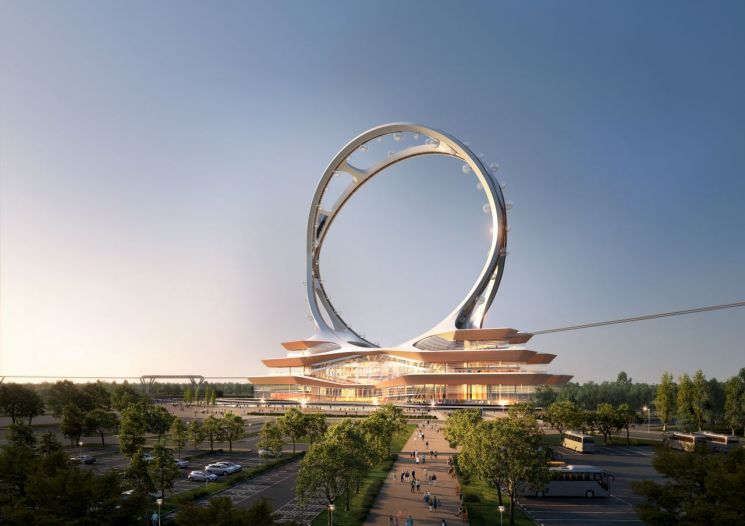
The Ferris wheel 'Seoulling' is a project initiated last year by Seoul Mayor Oh Se-hoon as part of the 'Great Hangang Project,' aiming to build a ring-shaped Ferris wheel with a spokeless design in the Sangam-dong area.
During discussions, the design changed from a single ring structure to two intersecting rings, and the project site was moved from Sky Park to Peace Park. This change resulted from the basic plan being revised during discussions between SH Corporation (Seoul Housing and Communities Corporation), the project owner, and a consortium including The REITs. Currently, the two rings, each 180 meters in diameter, intersect in an 'X' shape, making it the largest spokeless ring-shaped Ferris wheel in the world.
The project cost nearly doubled from 400 billion KRW to over 900 billion KRW, sparking controversy. The increase was due to SH Corporation participating as an investor to encourage private sector involvement. This led to criticism that Seoul citizens' taxes were indirectly being used.
However, the project secured a legal basis for stable promotion by passing the Ministry of Economy and Finance's private investment project review committee last year, and earlier this year, it obtained benefits such as administrative procedure shortening, including fast-track and regulatory improvements. Considering that administrative procedures like private investment eligibility investigations usually take nearly three years, the project's feasibility has greatly improved.
The newly started strategic environmental impact assessment is also expected to yield results within this year. The private investment eligibility investigation conducted by the Korea Development Institute (KDI), which began earlier this year, is expected to be completed by early next year, with a report to the council likely in the first half of next year. Once the project's eligibility is verified, the final preferred negotiator will be selected through a third-party announcement. The third-party announcement is a legally mandated public competitive process under the Private Investment in Social Overhead Capital Act, where proposals for the development plan are solicited from entities other than the initial proposer, and the best project plan is selected. According to the current plan, construction could begin as early as 2026.
A Seoul city official stated, "Although it is still an early stage to establish detailed plans, now that the strategic environmental impact assessment has started, we plan to actively cooperate to ensure the ongoing eligibility investigation proceeds smoothly," adding, "We will continue to consider various administrative supports at the city level going forward."
© The Asia Business Daily(www.asiae.co.kr). All rights reserved.

















