"Access to Apartment Parking Lots Restricted When Charge Rate Exceeds 90%"
Seoul City's Policy Challenged Using Hyundai Motor's Technology Arguments
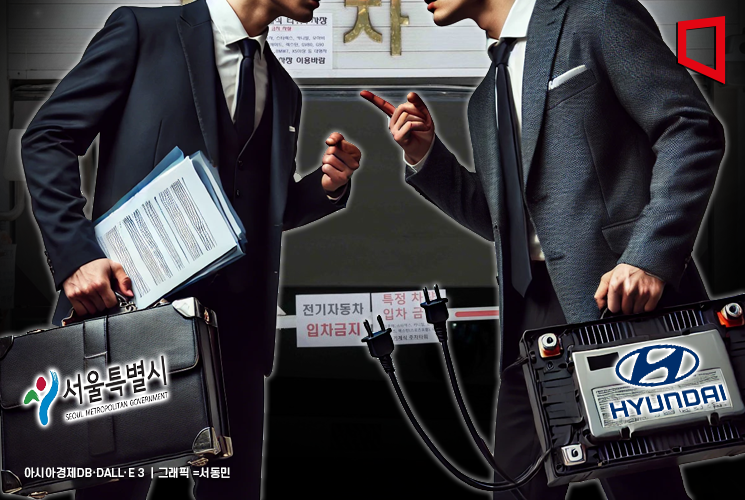
After a fire broke out in an electric vehicle in an underground parking lot of an apartment in Incheon, causing significant damage, Seoul city decided to push for a policy to limit electric vehicle charging to 90%. This idea originated from the notion that fully charging the battery is a fire risk.
The newly proposed policy also includes a provision for automakers to issue certification. If an electric vehicle owner requests, the manufacturer must provide a "charging limit certificate (tentative name)" confirming that the 90% charging limit has been applied.
Seoul city presented a concrete plan to revise the standard apartment management regulations, which contain rules residents must follow, by the end of next month. These standard regulations serve as a reference for apartment resident representative meetings when creating rules applicable to their complexes.
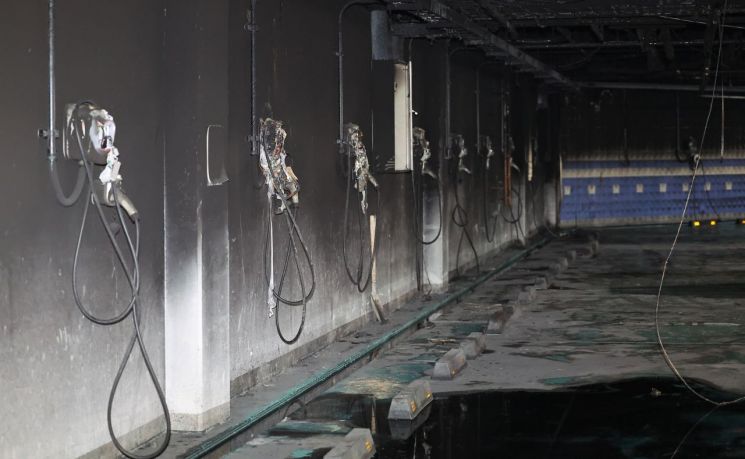 On the morning of the 14th, a melted electric vehicle charger is visible in the electric vehicle charging area of the underground parking lot of an apartment in Cheongna, Seo-gu, Incheon, where an electric vehicle fire occurred.
 [Photo by Yonhap News]
Although each apartment complex can voluntarily apply these rules, Seoul city appears to be strongly pushing for the 90% charging limit by directly recommending it at the city level or supporting resident representative meetings to adopt it before revising the standards. Public chargers managed in public parking lots will have their charging rate limited to 80%.
The city stated, "While electric vehicle owners can set their target charging rate at any time, it is difficult to continuously verify or manage whether the 90% limit is being applied, as it depends on voluntary compliance."
Both electric vehicle users and automakers, as well as experts, have expressed negative opinions about these measures. Although Seoul city claimed that "many experts say it is effective for fire prevention and improving durability and safety," the policy is being pushed without clear evidence.
Hyundai Motor Company and Kia released reference materials on the 20th, pointing out the flaws in Seoul city's proposed policy. They explained that electric vehicles are originally designed with extra buffer space in the battery even when fully charged.
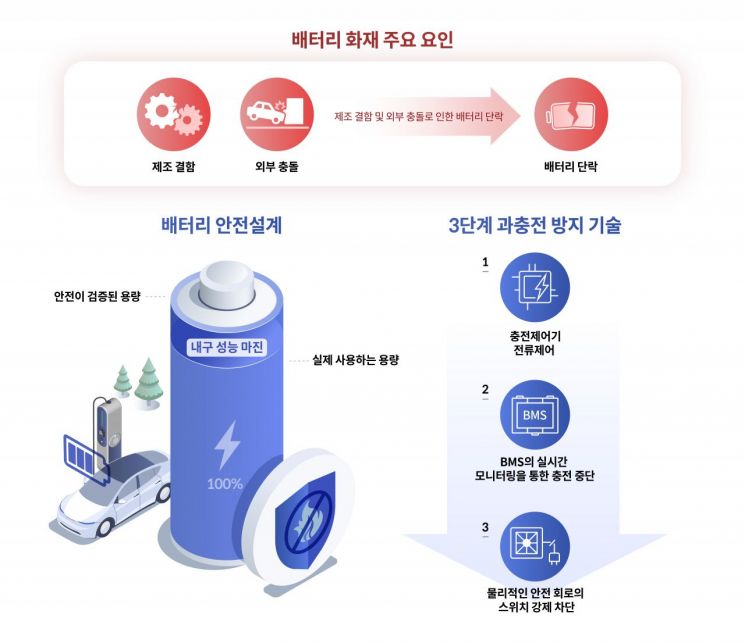
The ternary (NCM) battery can store 275 mAh per gram. Battery manufacturers design the battery to use only 200-210 mAh per gram. Additionally, electric vehicle manufacturers add further buffer space. Even if the navigation screen shows 100%, it does not mean the battery is fully charged to its maximum capacity.
During the process of recalibrating usable capacity in the Battery Management System (BMS), additional buffer space is created. When voltage differences occur among the numerous cells in a battery pack, cell balancing control is performed to reduce these differences. The cell with the lowest remaining capacity is used as the reference. Charging beyond the battery capacity could cause problems, but multiple safety devices prevent this from happening in advance.
Hyundai Motor explained, "While the amount of charge can affect the scale or duration of a fire, it is not a key factor in determining internal physical short circuits or shorts. Battery fires mostly occur due to internal physical shorts caused by manufacturing defects or external impacts, where high current flows and heat is generated, leading to ignition from oxygen or flammable byproducts produced by chemical decomposition."
Professor Yoon Won-seop of Sungkyunkwan University's Department of Energy Science also told reporters recently, "Charging rate is related to fires but is not the dominant cause," adding, "The concept of 100% charge is very relative."
 Professor Yoon Won-seop, a leading battery expert in Korea from the Department of Energy Science at Sungkyunkwan University, met with Yonhap News reporters in Suwon on the 16th to give an interview regarding the recent electric vehicle fire that occurred in an underground parking lot of an apartment complex in Incheon.
 [Photo by Yonhap News]
It has long been widely known that not charging beyond 80-90% helps maintain the battery in good condition over a long period. Hyundai Motor also informed that electric vehicles have a function allowing owners to control the charging rate themselves after this fire incident.
Nevertheless, Hyundai clearly opposed the indiscriminate implementation of measures such as issuing 90% certificates or restricting parking lot access. It is reported that Hyundai conveyed negative opinions about the charging limit policy to Seoul city through various channels.
If charging limits are forcibly applied in actual apartment complexes, controversy is expected to arise. Currently, electric vehicle sellers provide driving range based on a full charge. There is a possibility of claims that property rights are being infringed or that manufacturers should compensate.
© The Asia Business Daily(www.asiae.co.kr). All rights reserved.



















