Yoon Administration's Successive 'Pro-Japanese' Controversies
Also Ban Pro-Japanese Figures from Public Office Entry
The opposition is escalating its 'pro-Japanese offensive' against the Yoon Suk-yeol administration, starting from the August 15 Liberation Day.
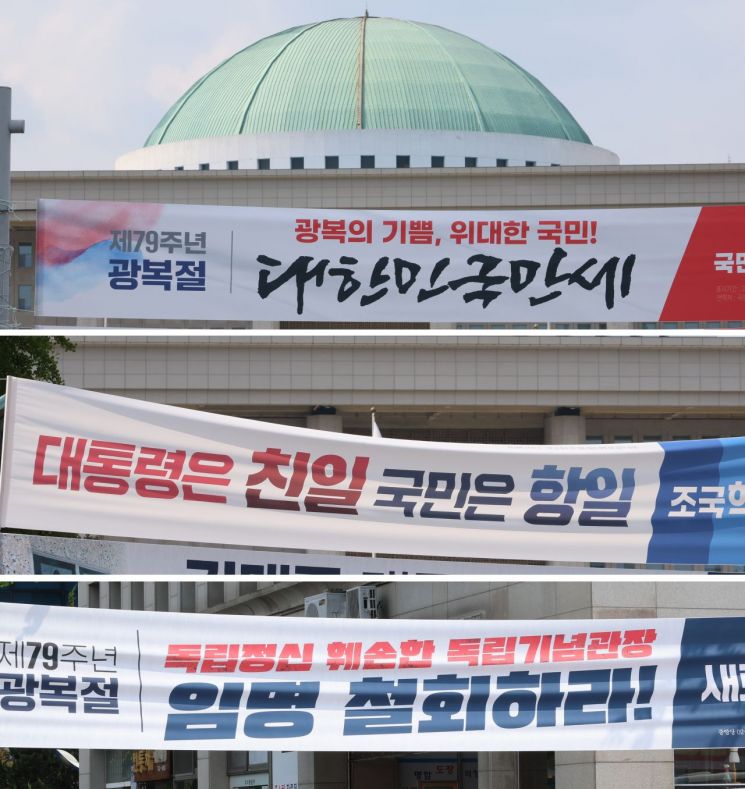
According to political circles on the 20th, the leadership of the Democratic Party of Korea has been focusing its efforts on the 'pro-Japanese regime' offensive by continuously criticizing the Yoon Suk-yeol administration's view of history. Park Chan-dae, the floor leader of the Democratic Party, said at the party's floor countermeasure meeting that day, "Why does the president, who represents the Republic of Korea and all its people, repeatedly make statements that incite national division at the slightest provocation?" He criticized, "President Yoon has repeatedly hurled baseless and unfounded curses such as 'communist totalitarian forces,' 'opportunistic followers,' and 'anti-state forces' whenever he feels cornered over the past two and a half years."
The Democratic Party has strongly criticized the appointment of Kim Hyung-seok as director of the Independence Hall, which sparked the recent 'New Right controversy,' and the placement of New Right and far-right figures in history and history education-related institutions under the Yoon Suk-yeol administration. Furthermore, when the appointment of Director Kim triggered conflict between the Presidential Office and the Liberation Association, the Democratic Party directly called the Presidential Office "the worst pro-Japanese traitorous regime."
When President Yoon did not mention historical issues in his Liberation Day congratulatory speech, the criticism intensified with remarks such as "Has the Government-General of Korea been resurrected as the Yongsan Presidential Office?"
Moreover, on Liberation Day, when KBS aired 'Kimigayo' and viewers flooded with complaints, the Democratic Party launched a full-scale offensive.
In particular, regarding Kim Tae-hyo, the first deputy director of the National Security Office, who said in an interview with KBS on the 16th, "What matters is Japan's heart. When you force an apology from someone who has no heart, is that truly sincere?" the Democratic Party fiercely criticized it as "beyond pro-Japanese to pro-Japan worship."
The Democratic Party holds the position that a series of 'pro-Japanese controversies' have accumulated over the past two years of the Yoon Suk-yeol administration, including the agreement on the discharge of Fukushima contaminated water, the relocation of General Hong Beom-do's bust, the Ministry of National Defense textbook labeling Dokdo as a 'territorial dispute,' the non-response to the Line Yahoo incident, the reduction of Dokdo defense drills, the third-party compensation proposal for forced labor by Japan, and the agreement on the registration of Japan's Sado Mine as a World Heritage Site with the forced labor content deleted.
The Democratic Party is also accelerating the establishment of institutional measures. First, they plan to promote legislation that prohibits individuals who glorify Japanese colonial rule or praise and encourage pro-Japanese anti-national acts from entering public office and punishes acts that deny sovereignty over Dokdo.
Jin Sung-jun, the policy chief of the Democratic Party of Korea, said at the floor countermeasure meeting held at the National Assembly that day, "We will legislate to prevent people who glorify Japanese colonial rule or praise and encourage pro-Japanese anti-national acts from holding public office or entering public institutions," and "The Policy Committee is currently drafting such a bill and will soon begin the process of making it the party's official stance."
Jin also stated, "We will legislate to strictly prohibit and punish acts that deny and damage Korea's sovereignty over Dokdo," even suggesting a strong position that acts denying Dokdo's sovereignty could be considered treason.
Earlier on the 13th of this month, Seo Young-kyo, a member of the same party, jointly proposed the partial amendment bill to the Act on the Protection, Support, and Commemoration of Victims of Japanese Military Sexual Slavery during the Japanese Colonial Period (hereinafter the 'Comfort Women Grandmothers Defamation Punishment Act') with 64 lawmakers from the Democratic Party and the Progressive Party. The bill stipulates that defamation such as spreading false information about comfort women victims will be punishable by imprisonment of up to five years or a fine of up to 50 million won.
Kim Jun-hyuk, also from the same party, recently introduced a partial amendment to the Independence Hall Act as the main proposer. The amendment states that if the director or director candidate of the Independence Hall justifies or glorifies Japanese imperialist colonial rule and colonial historiography, the board of directors may recommend dismissal or withdrawal of nomination to the appointing president even after appointment. This amendment directly targets Director Kim, who has been embroiled in the New Right controversy.
An opposition official said, "Issues such as the appointment of Kim Hyung-seok as director of the Independence Hall, the appointment of pro-Japanese figures to historical institutions, the poor negotiation on the Sado Mine, and the non-response to the Line Yahoo incident are not settled but ongoing," adding, "The controversy over the pro-Japanese view of history is expected to continue until the upcoming national audit."
© The Asia Business Daily(www.asiae.co.kr). All rights reserved.
![User Who Sold Erroneously Deposited Bitcoins to Repay Debt and Fund Entertainment... What Did the Supreme Court Decide in 2021? [Legal Issue Check]](https://cwcontent.asiae.co.kr/asiaresize/183/2026020910431234020_1770601391.png)
















