First Half Regional Employment Survey Announcement
Regional Employment Rates Reach All-Time Highs
Population movement during working hours shows opposite trends between the Seoul metropolitan area and non-metropolitan areas. In the metropolitan area, many people living in Gyeonggi-do commute to Seoul for work, whereas in non-metropolitan areas, residents of major cities often travel to nearby counties and districts for work.
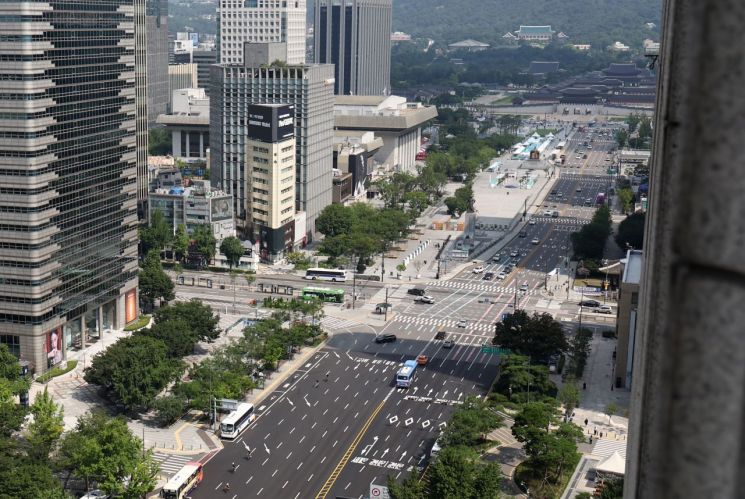
Statistics Korea announced the '2024 First Half Regional Employment Survey' on the 20th, which includes an analysis of key employment indicators across 228 cities, counties, and districts nationwide.
In this first half survey, Statistics Korea newly included the regional active population, which comprises employed persons, unemployed persons, and economically inactive population based on the workplace (business location). This indicator allows a quick view of the proportion of the population active during main working hours in a specific area. A value above 100 means that the population active during working hours exceeds the resident population aged 15 and over in that area.
The regional active population in the urban areas of 9 provinces was 21,829,000, representing 97.1% of the resident population aged 15 and over. Areas such as Pocheon-si in Gyeonggi-do (123.0%), Gimje-si in Jeonbuk (114.6%), and Yeongcheon-si in Gyeongbuk (111.7%) showed relatively high figures. The regional active population in rural areas was 3,341,000, accounting for 109.8% of the resident population aged 15 and over. Yeongam-gun in Jeonnam (138.7%) and Goryeong-gun in Gyeongbuk (133.7%) recorded relatively high values.
The regional active population in the districts of 7 metropolitan cities was 20,074,000, which is 102.0% of the resident population aged 15 and over. Jung-gu in Seoul (334.6%), Jung-gu in Busan (221.5%), and Jung-gu in Daegu (152.4%) had the highest figures. The relatively prominent numbers centered around the old downtown districts (Jung-gu), where major urban functions such as finance are concentrated.
Im Kyung-eun, head of the Employment Statistics Division at Statistics Korea, said, "Looking at the regional active population marked on the map, the Seoul metropolitan area and non-metropolitan areas are moving in opposite directions." She added, "In the metropolitan area, many people live in Gyeonggi-do and commute to Seoul for work, whereas in non-metropolitan areas, people live in cities and commute to nearby counties and districts for work." She also noted, "The map shows active population inflows and outflows occurring vigorously along roads."
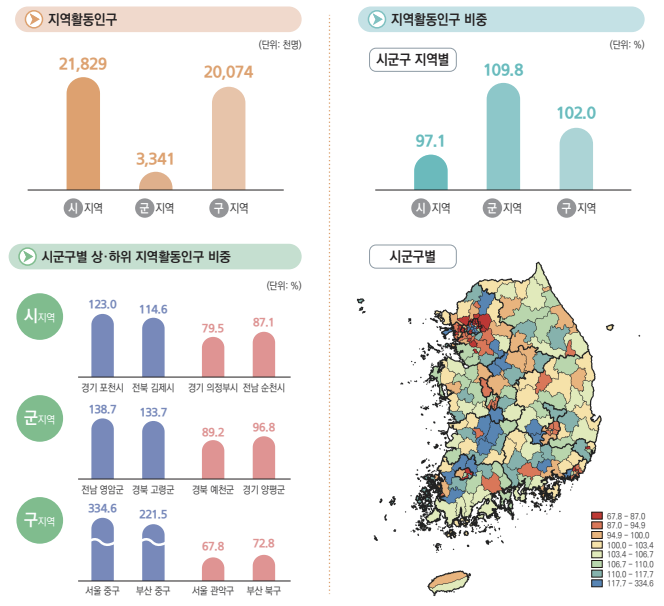 Infographic of Local Active Population in Si/Gun/Gu Areas for the First Half of 2024 / [Image provided by Statistics Korea]
Regional employment indicators reached record highs for the first half of the year. The number of employed persons in urban areas of 9 provinces increased by 161,000 from the same period last year to 14,013,000. The employment rate rose by 0.4 percentage points to 62.3%, the highest since related statistics began in 2013. Specifically, high employment rates were observed in areas such as Seogwipo-si in Jeju (72.0%), Dangjin-si in Chungnam (70.9%), and Namwon-si in Jeonbuk (68.9%).
The number of employed persons in rural areas of 9 provinces was 2,108,000, an increase of 3,000. The employment rate rose by 0.6 percentage points from the previous year to 69.3%, marking a record high. Notably, high employment rates were recorded in Ulleung-gun in Gyeongbuk (82.5%), Sinan-gun in Jeonnam (79.0%), and Jangsu-gun in Jeonbuk (78.6%).
The number of employed persons in the districts of 7 metropolitan cities increased by 180,000 to 11,612,000. The employment rate rose by 0.7 percentage points to 59.0%, the highest since the first survey in 2021. Relatively high employment rates were recorded in Ongjin-gun in Incheon (75.9%), Gunwi-gun in Daegu (73.6%), and Gangseo-gu in Busan (69.3%).
The number of unemployed persons in urban areas of 9 provinces was 447,000, an increase of 62,000 from the same period last year. The unemployment rate rose by 0.4 percentage points to 3.1%. The number of unemployed persons in rural areas increased by 1,000 to 28,000. The unemployment rate rose by 0.1 percentage points to 1.3%. Areas with high unemployment rates included Dongducheon-si in Gyeonggi-do (5.1%), Geoje-si in Gyeongnam (4.7%), and Gumi-si in Gyeongbuk (4.5%). Low unemployment rates were seen in Bonghwa-gun in Gyeongbuk (0.1%) and Haenam-gun in Jeonnam (0.1%).
The number of unemployed persons in the districts of 7 metropolitan cities was 483,000, an increase of 56,000. The unemployment rate rose by 0.4 percentage points to 4.0%, the second highest for the first half of any year. Relatively high unemployment rates were observed in Yeongdo-gu in Busan (5.8%), Gyeyang-gu in Incheon (5.6%), and Dobong-gu in Seoul (5.6%). Ongjin-gun in Incheon (1.0%) and Gunwi-gun in Daegu (1.2%) had relatively low unemployment rates.
© The Asia Business Daily(www.asiae.co.kr). All rights reserved.
![Clutching a Stolen Dior Bag, Saying "I Hate Being Poor but Real"... The Grotesque Con of a "Human Knockoff" [Slate]](https://cwcontent.asiae.co.kr/asiaresize/183/2026021902243444107_1771435474.jpg)

















