One Month of Public Opinion Collection... 59% Support National Symbol Space
Seoul Mayor Oh Se-hoon "40% Opposition, Questioning If It's a High Rate"
'Memory Space' for Freedom and Peace for Veterans
Plan to Be Released Through September Design Competition... Continuous Opinion Collection
The Seoul Metropolitan Government is creating Gwanghwamun Square as a space to honor the sacrifices of the countries that participated in the Korean War. This decision reflects the incorporation of public opinions following controversy over the proposed construction of a 100-meter-high Taegukgi flagpole. Seoul Mayor Oh Se-hoon stated, "The background behind South Korea's ability to flourish while confronting communism was the sacrifice and dedication of these individuals." He also reiterated his intention to create a symbol that would demonstrate the intangible value of liberal democracy to citizens.
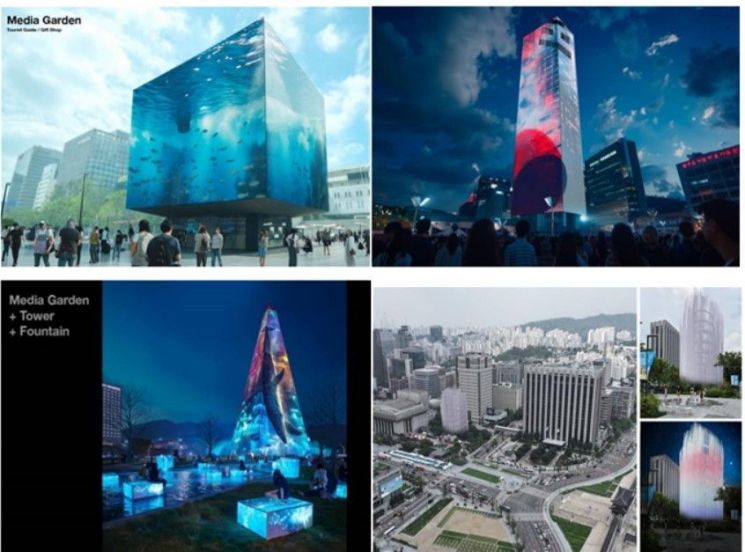
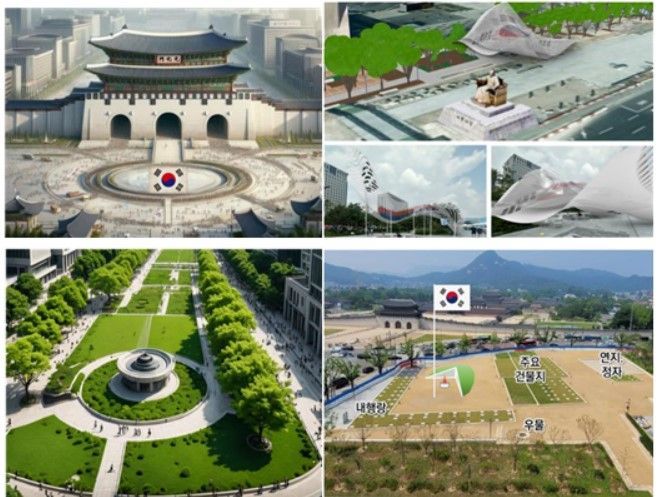
On the 20th, Seoul announced that it had set the direction for establishing the national symbolic space at Gwanghwamun Square by collecting public opinions over a month-long period starting from the 15th of last month, aiming to make the space reflect the wishes of the people. Attending the announcement in person, Mayor Oh said, "It is our duty to directly explain the results of the month-long opinion gathering to the citizens," and added, "Regarding the principles of the design competition, both analog and digital approaches are acceptable. We have decided to open up all possibilities, including the traditional flagpole method and the use of cutting-edge media technology."
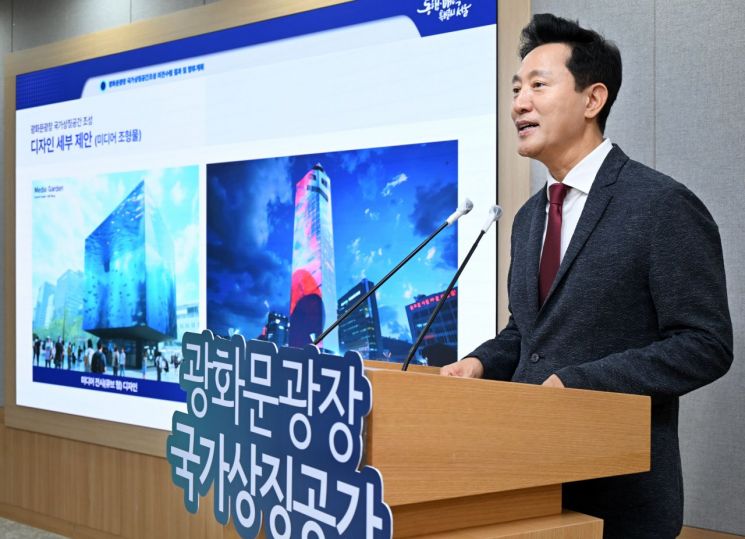
On that day, Mayor Oh addressed the controversy over the Taegukgi flagpole construction, saying, "Statues like Admiral Yi Sun-sin or King Sejong at the Sejong Center are insufficient to represent South Korea's national identity," and added, "How to visualize and show the invisible concept of liberal democracy is not an easy matter, so the simplest idea was to use the Taegukgi." He reiterated his stance.
Regarding the symbol to be created in the square in the future, he said, "The Taegukgi may or may not be included," but evaluated, "When creating a sculpture that can maintain symbolic significance even 10 or 50 years from now by utilizing cutting-edge science and technology, the symbolism can be preserved and enhanced."
In response to the criticism that 40% of citizens oppose creating a national symbolic space in Gwanghwamun Square based on public opinion, he said, "In today's era of polarized political views, I question whether 40% is such a high ratio," and added, "There was also a flow of opinions that arose because the initial explanation was about a tall Taegukgi flagpole. I think misunderstandings will be considerably resolved once sufficient explanations are provided."
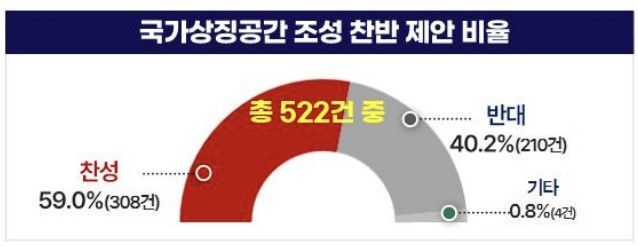
According to Seoul City, a total of 522 citizen proposals were received, with 59% (308 cases) supporting the creation of the national symbolic space, 40% (210 cases) opposing it, and 1% (4 cases) categorized as others. Among the citizen proposals, the most suitable symbol for the national symbolic space was the Taegukgi with 215 cases (41%), followed by the Mugunghwa flower with 11 cases, the national emblem and the official seal with 2 cases each, and the national anthem with 1 case. Other suggestions included Hunminjeongeum, pine trees, historical gardens, flags of the countries that participated in the Korean War, and Dokdo Island.
There were also opinions to express the five major national symbols of South Korea recognized by the government (national flag, national anthem, national flower, national emblem, official seal) as a composite sculpture, to create a symbolic space with Mugunghwa landscaping (Mugunghwa Square) and Mugunghwa pattern sculptures, and to produce video works and sculptures inspired by the four verses of the national anthem.
Various ideas were proposed regarding the design of the symbol. Suggestions included using media art works or light sculptures to make Gwanghwamun Square a space combining artistic value, creating a media pole in the form of a flagpole, and making artistic sculptures such as kinetic (moving) art.
Based on these citizen proposals, Seoul plans to focus on three main aspects?meaning of the symbolic space, communication with citizens, and diversity in design combined with cutting-edge technology?to actively promote the establishment of the national symbolic space at Gwanghwamun Square. The aim is to reflect universal human values such as 'freedom' and 'peace,' conveying the significance of warriors from around the world of different skin colors and nationalities who dedicated themselves together to make today’s South Korea possible.
The core is to honor the noble sacrifice of the soldiers from around the world who willingly participated in the Korean War to protect freedom and peace. The space will symbolize the prosperous South Korea, which has become a symbol of liberal democracy and human peace, and embody the sacrifices of soldiers from 22 countries who laid the foundation for South Korea’s prosperity, passing on this meaning to future generations. The space will also be used to reflect on the significance of national holidays and commemorative days beyond the Korean War.
The sculpture to be installed in the square will be carefully reviewed for durability, ease of maintenance, whether it has a permanent structure and form, and whether it incorporates advanced technology to allow content compatibility and conversion. Specific construction plans will be established during the design competition process starting in September. First, expert advice and review by the Open Square Operation Citizens Committee will be conducted regarding the results of the public opinion gathering. After the design competition concludes at the end of the year, basic and detailed designs will begin, with full-scale construction starting in May 2025. Completion is scheduled for September 2025.
Seoul also revealed plans to broadly listen to diverse voices from citizens, experts, and related organizations throughout the process?from preparing design competition guidelines to completing the national symbolic space. It will closely cooperate with related institutions such as the National Architecture Policy Committee and the Ministry of Land, Infrastructure and Transport. Although the plan to build the national symbolic space at Gwanghwamun Square has not yet been concretely included in the plans of these institutions, Seoul intends to work through consultations so that it can be included in future national symbolic space plans and jointly announced.
© The Asia Business Daily(www.asiae.co.kr). All rights reserved.



















