Ahead of September's Stage 2 Stress DSR Implementation...Stricter Loan Regulations in the Seoul Metropolitan Area
All Household Loans in September Must Calculate Management Purpose DSR
From Next Year, Banks to Establish and Implement DSR Management Plans
Financial Services Commission Chairman Kim Byung-hwan Holds Meeting with Banks...Financial Sector Relay Meetings for the Next Month
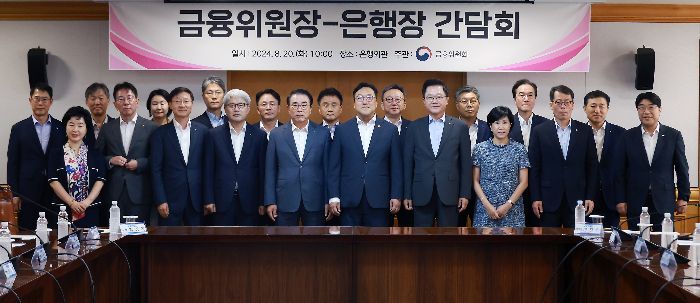
The government plans to raise the stress interest rate applied to metropolitan area mortgage loans by banks from 0.75 percentage points (P) to 1.2 percentage points ahead of the implementation of the second phase of the stress Debt Service Ratio (DSR) on September 1. Additionally, banks will be required to calculate an internally managed DSR for all household loans starting in September, and from next year, each bank must establish and implement a DSR management plan based on this calculation.
On the 20th, Kim Byung-hwan, Chairman of the Financial Services Commission, raised key discussion points at a meeting with banks held at the Bankers’ Hall in Jung-gu, Seoul, including whether there is sufficient competition among banks, whether banks have innovated as fiercely as general corporations, and whether banks have adequately conveyed their willingness to coexist during difficult times for the public. He announced these measures in response to the recent surge in household loans. Sharing the perception that household debt has shifted to an increasing trend centered on mortgage loans in Seoul since the second quarter due to rising housing prices and expectations of interest rate cuts, he urged banks to establish a household debt management system based on DSR.
The government will implement the second phase of the stress DSR from next month, applying a stress interest rate of 1.2 percentage points instead of 0.75 percentage points for metropolitan area mortgage loans by banks. From September, banks will calculate an internally managed DSR for all household loans, and from next year, they will be required to establish and implement DSR management plans based on this. Furthermore, the government will closely monitor household loan trends and consider additional measures such as expanding the scope of DSR application or raising risk weights on bank mortgage loans if necessary.
The approach to supporting small business owners by banks will also shift from one-time support to embedding debt management based on repayment capacity into the system. Chairman Kim stated, "The outstanding loans to small business owners increased by about 380 trillion won compared to the end of 2019 before the COVID-19 outbreak." Although the government has taken measures such as maturity extensions, repayment deferrals, and the New Start Fund in cooperation with the financial sector, he analyzed that small business debt could affect not only our economy but also the soundness of banks. He then proposed to participants, "Let us jointly devise a plan to internalize the approach to supporting small business owners by banks as ‘debt management considering the borrower’s repayment capacity’ into the system."
He also announced plans to promote regulatory improvements to support innovation in the banking sector. Chairman Kim urged, "Banks should break away from the traditional business model reliant on interest margins and the domestic market, actively respond to new era demands such as the transition to a digital and data economy and demographic changes, and strive to create a sustainable growth model." He added, "If there are regulations that hinder banks’ innovation efforts, we will boldly remove them."
Amid the widespread expansion of the scandal involving improper loans amounting to around 35 billion won to relatives of former Woori Financial Group Chairman Sohn Tae-seung, he emphasized the need to strengthen internal controls to restore trust in the banking sector. Chairman Kim said, "Banks should always be at the pinnacle of trust, but given the recent trust issues, please thoroughly reexamine the internal control system with a mindset of radical reform." He stressed, "The accountability structure to be implemented in January next year should be used as a turning point."
He further cited examples of financial companies such as banks being re-evaluated in the market following the recent announcement of corporate value-up support measures, which had been relatively undervalued. He added, "For this trend to continue, it is important that the growth of the financial sector is based on the trust and support of the public," emphasizing the importance of trust.
In response, Cho Yong-byeong, Chairman of the Korea Federation of Banks, said, "Alleviating the difficulties of small business owners is the most urgent task at present, and when banks first show innovation for consumers, favorable systems and environments for banks can be created." He added, "If we revisit discussions on improving the scope of banks’ operations and strengthening digital competitiveness from the perspectives of the national economy and consumers, good cases like recent innovations in network separation will emerge."
CEOs of commercial banks mentioned ongoing new business cases and conveyed the need for regulatory improvements such as easing restrictions on acquiring shares in non-financial companies and allowing data sharing among affiliates within financial holding companies to activate innovative services. CEOs of regional banks also proposed promoting collaboration between relocated public institutions in innovation cities and regional banks to revitalize local economies.
Meanwhile, Chairman Kim plans to meet sequentially with CEOs and field officials from various financial sectors starting from this meeting to discuss the four major risks currently facing our economy?household debt, small business debt, real estate project financing (PF), and the soundness of the small and medium financial sector?as well as current issues and financial industry development plans.
© The Asia Business Daily(www.asiae.co.kr). All rights reserved.

















