From Battery Design and Shipment to Securing Extra Space
Battery Has Margin Even When Dashboard Shows 100% Charge
Hyundai Motor and Kia: "Zero Fire Risk from Overcharging"
Hyundai Motor Company and Kia emphasized that there is no correlation between the electric vehicle battery charge level and fire incidents, stating that charging the electric vehicle battery to 100% does not pose any safety issues.
On the 20th, Hyundai and Kia explained the relationship between battery charge levels and fires through reference materials. Even if the electric vehicle battery is charged to 100%, there is already a safety margin secured in the battery design.
They also added that if a problem occurs in the battery, the Battery Management System (BMS), which acts as the brain of the battery, blocks and controls overcharging. At the same time, a real-time alert system is in place to notify the vehicle owner via text message if an error occurs in the battery cells, and for corporate vehicles where the owner and actual user differ, they plan to strengthen the registration of the actual owner.
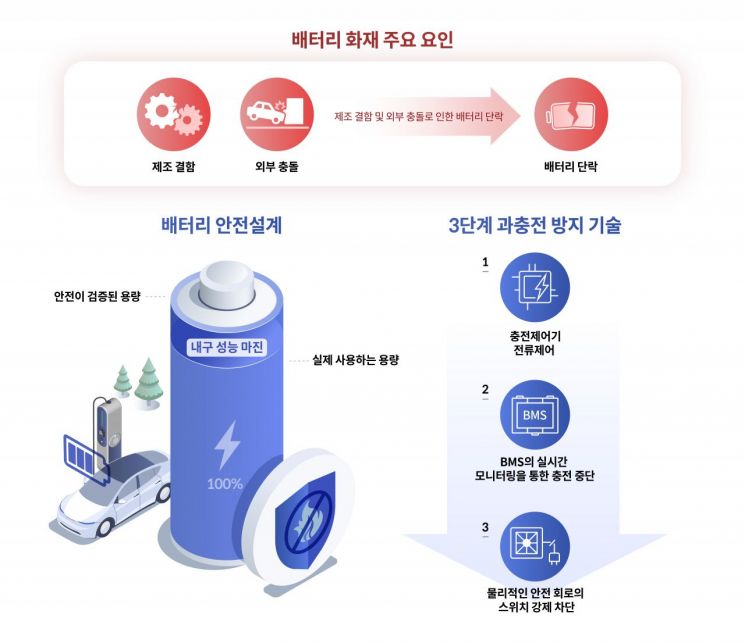
Hyundai and Kia explained that even if the driver confirms a 100% charge of the electric vehicle battery through the dashboard, an additional safety margin (reserve space) is actually secured for charging.
This margin is determined by reflecting three figures. The first is the margin set by the battery manufacturer. For example, in the case of NCM (Nickel-Cobalt-Manganese) batteries, energy can be stored up to a maximum of 275 mAh per gram, but the battery manufacturer designs it to be used at a lower level of about 200-210 mAh per gram.
The second is the margin left by the automobile manufacturer. The charge level visible to the driver on the navigation or dashboard is displayed excluding the margins set by both the battery cell manufacturer and the automobile manufacturer.
Lastly, the 'battery brain' BMS leaves some margin during the process of recalculating the usable capacity. The automobile manufacturer bundles numerous battery cells into a battery pack. If the performance of one cell deteriorates, the overall battery performance also declines. Therefore, to reduce voltage differences between battery cells, the BMS performs 'cell balancing control.' It recalculates the total chargeable capacity based on the cell with the least remaining capacity, securing additional battery capacity margin.
A Hyundai and Kia official said, "The '100% charge status' shown to the driver means the charge level within a thoroughly verified safe range, so there is no need to worry about full charging." He added, "We will continue to advance battery pre-diagnosis and fire propagation prevention technologies so that customers can drive electric vehicles with confidence."
Hyundai and Kia have a system that notifies the vehicle owner via text message of any abnormal signs detected by the BMS in the cells. They are also working to eliminate blind spots in alerts, such as for corporate vehicle actual owners who do not receive text notifications. Hyundai and Kia promote registering corporate vehicles operated by large corporations and enterprises under the actual user's name. Registration under the actual user's name can be easily completed through the connected service application.
© The Asia Business Daily(www.asiae.co.kr). All rights reserved.

















