Decision to Increase Dam Discharge at Hangang Flood Control Office
Soyanggang Dam Raised from 44.4㎡/s to 200.0㎡/s
Aimed at Resolving Algal Bloom in Paldangho Connected to Water Source
Environmental Groups Take Independent Action, Distrusting Government
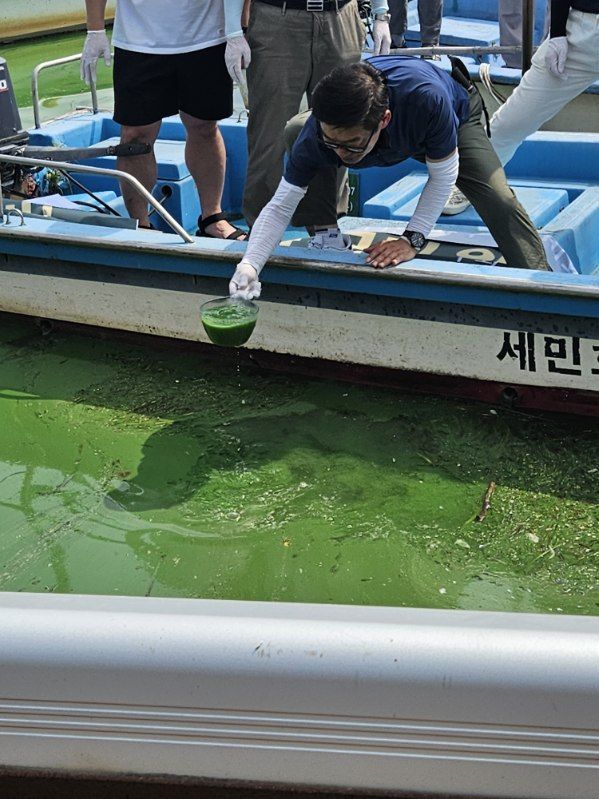 On the 19th, an environmental organization official is collecting seawater affected by algal bloom at Daedong Ferry Terminal in Daedong-myeon, Gimhae-si, Gyeongnam. Photo by Korea Federation for Environmental Movements
The government has begun increasing dam discharge volumes to curb the severe spread of green algae. If the water sources are damaged, serious problems could arise with the public's drinking water. Environmental groups say the government's delayed response is preventing the green algae issue from being resolved and have announced plans to conduct their own inspections.
According to the Ministry of Environment on the 19th, the Hangang Flood Control Office increased dam discharge volumes in the Bukhang River basin as of 3:30 PM on the 16th. The discharge from Soyanggang Dam in Chuncheon, Gangwon Province, was increased from 44.4㎡/s to about five times that amount, reaching 200.0㎡/s. Nearby Uiam Dam's discharge was raised from 95.0㎡/s to 270.0㎡/s, and Cheongpyeong Dam in Gapyeong County, Gyeonggi Province, was increased from 150㎡/s to 300㎡/s.
The increase in dam discharge is a measure to address the green algae in Paldang Lake. Paldang Lake is located at the point where the main stream of the Han River begins and is connected to the Han River water source. However, on the 12th, 8,236 harmful cyanobacteria cells per 1ml were found in front of the Paldang Lake dam. Although a green algae warning has not yet been issued, the amount of algae is the highest since August 17, 2015. With record-breaking heatwaves continuing, if swift action is not taken, the green algae could spread rapidly.
Green algae are already spreading in some water sources. At the Inje Bridge area, 58 km upstream of Soyanggang Dam, which serves as a water source for residents of the Seoul metropolitan area, green algae began appearing on the 25th of last month. Although the Environmental Agency and local governments have established response systems and installed containment barriers, they have been unable to stop the spread caused by the heatwave. As a result, the Hangang River Basin Headquarters under the Korea Water Resources Corporation has even deployed autonomous green algae removal robots.
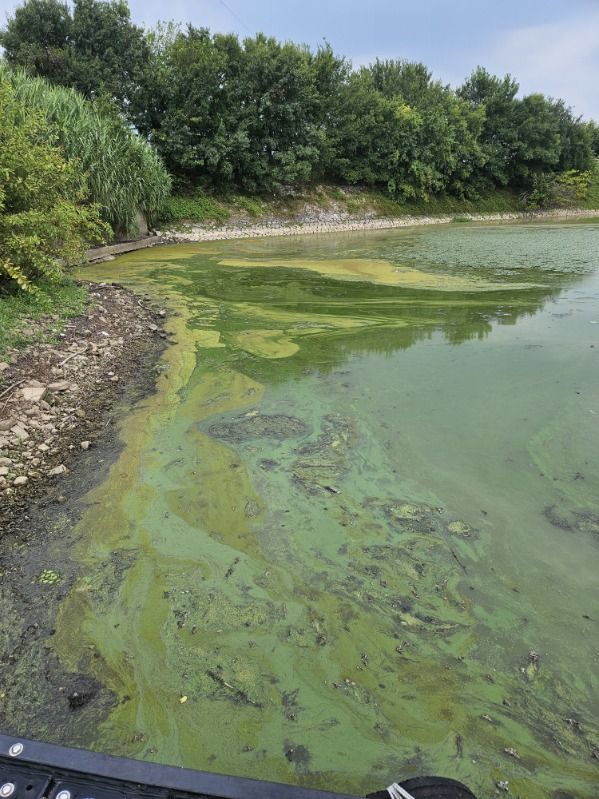 Near Daedong Ferry Terminal, Daedong-myeon, Gimhae-si. Harmful cyanobacteria cells have surged, causing an algal bloom. Photo by Korea Federation for Environmental Movements
The green algae situation is even more severe in non-metropolitan areas. As of the 14th, harmful cyanobacteria cells in Boryeong Lake and Daecheong Lake were 52,096 and 29,240 per 1ml respectively, prompting a level 3 green algae alert. Interest and caution alerts have also been issued for Yongdam Lake, Haepyeong, Gangjeong·Goryeong, Chilseo, and Mulgeum·Maeri. Particularly in the Nakdong River basin, green algae have spread even at points with water intake facilities, leading to the deployment of algae containment barriers, algae removal vessels, and robots.
Experts point to abnormal climate conditions as the cause of the green algae spread. Cyanobacteria cells that cause green algae typically occur when large amounts of nutrients like nitrogen and phosphorus flow in and water temperatures become hot. This year, there was more monsoon rain than usual, followed by water temperatures soaring to around 30 degrees Celsius, creating an environment favorable for cyanobacteria growth.
Environmental civic groups criticized the government's slow response and have begun their own inspections. On the morning of the same day, environmental organizations including the Nakdong River Network, the Korean Society of River Science, and the Korean Federation for Environmental Movement held a press conference at Daedong Ferry Terminal in Daedong-myeon, Gimhae City, Gyeongsangnam-do, announcing plans to investigate the green algae situation for three days. A representative from the Korean Federation for Environmental Movement explained, “The green algae sites are places that require proper management such as water intake stations and reservoirs,” adding, “We will collect samples and send them to research analysis institutions.”
© The Asia Business Daily(www.asiae.co.kr). All rights reserved.


















