Four Terms Expire by October
Three National Assembly Recommendations Expected to Face Difficulties
Concerns are rising that the Constitutional Court's operations could be paralyzed due to delays in appointing successors as four members, including the Chief Justice and Constitutional Justices, retire upon the expiration of their terms in September and October. In the case of Justice Lee Eun-ae (58, Judicial Research and Training Institute class 19), who retires on September 20, there is expected to be no major issue as the nomination is the prerogative of the Chief Justice of the Supreme Court. However, difficulties are anticipated in the nomination of the three successors recommended by the National Assembly for Chief Justice Lee Jong-seok (63, class 15), who retires on October 17, and Justices Lee Young-jin (63, class 22) and Kim Ki-young (56, class 22).
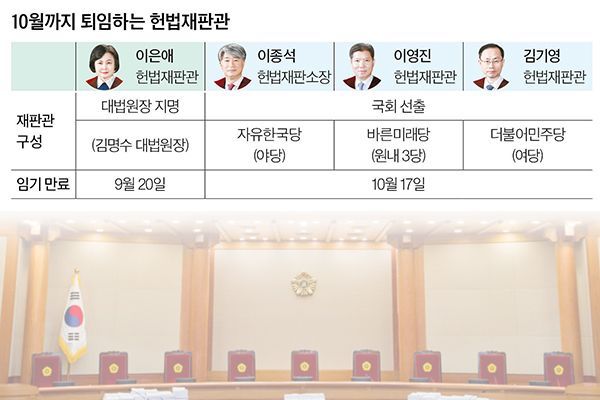
In 2018, Chief Justice Lee Jong-seok and Justices Lee Young-jin and Kim Ki-young were elected through recommendations from the parliamentary negotiation groups: the Liberty Korea Party (opposition party), the Bareunmirae Party (the third-largest party and second opposition party), and the Democratic Party (ruling party), respectively. Currently, there are only two negotiation groups, and neither the Constitution nor the Constitutional Court Act provides separate regulations on the nomination or election methods for the National Assembly's share of justices. Therefore, controversy is inevitable in deciding whether the ruling party will recommend the remaining one seat, excluding the one seat each recommended by the ruling and opposition parties, or whether it will be recommended through bipartisan agreement. Given the current confrontational stance between the ruling and opposition parties, it is unlikely that a compromise will be reached anytime soon.
The problem is that, according to the Constitutional Court Act, a hearing cannot be held without the attendance of at least seven justices. Therefore, if the appointment of three or more justices is delayed, an unprecedented 'justice vacancy state where deliberations cannot be held' could continue for a considerable period.
All deliberations on pending cases, including those related to the death penalty provisions in the Criminal Act and the Act on Decisions on Life-Sustaining Treatment, as well as impeachment trials of Prosecutors Son Jun-sung and Lee Jeong-seop and Broadcasting and Communications Commission Chairperson Lee Jin-sook, and various jurisdictional disputes, will be suspended. In particular, in impeachment cases, the authorities of those involved are suspended until the Constitutional Court's decision is made, necessitating acceptance of operational gaps.
Among the nine justices constituting the Constitutional Court, three are appointed by the President upon nomination, three are elected by the National Assembly, and three are appointed by the President upon nomination by the Chief Justice of the Supreme Court. Constitutional Court justices are appointed or elected after undergoing personnel hearings by the National Assembly.
The issue with the National Assembly's election method arises because the Constitution and the Constitutional Court Act only stipulate that 'three of the nine justices are elected by the National Assembly,' without separate provisions on the election method for the National Assembly's share of justices.
In the past, the recommendation method for the National Assembly's share of Constitutional Court justices was flexible depending on the parliamentary situation. The first term bench was formed under a four-party system, with the top three parties each recommending one justice. However, when forming the second term bench, the ruling Democratic Liberal Party had nearly twice the number of seats, so the party recommended two justices, and the opposition Democratic Party recommended one.
Subsequently, when forming the third to fifth term benches, the ruling and opposition parties each recommended one justice, and the remaining one was recommended through bipartisan agreement. When forming the sixth term bench in 2018, the National Assembly was structured as a multi-party system, with the ruling and opposition parties each recommending one justice, and the Bareunmirae Party, the third-largest party and second opposition party, recommending one.
However, currently, the third-largest party, the Joguk Innovation Party, has only 12 members and does not meet the parliamentary negotiation group requirement (at least 20 members), making it impossible to recommend one candidate per negotiation group as in 2018.
Justice Lee Eun-ae, who retires a month earlier, was nominated and appointed six years ago by former Chief Justice Kim Myung-soo.
The candidates to succeed Justice Lee were finally narrowed down on the 14th to Kim Jeong-won (59, class 19), Secretary General of the Constitutional Court, and Seoul High Court Chief Judges Yoon Seung-eun (57, class 23) and Kim Bok-hyung (56, class 24). Chief Justice Cho Hee-dae plans to respect the recommendation of the nomination committee and designate one new justice candidate around late this month.
Park Soo-yeon, Legal Times Reporter
※This article is based on content supplied by Law Times.
© The Asia Business Daily(www.asiae.co.kr). All rights reserved.

















