UNIST Research Team Introduces Bidirectional Coordination Molecules to Minimize Sub-Layer Defects
High-Efficiency and High-Stability Perovskite Achieved, Raising Expectations for Future Commercialization
The UNIST research team has solved the defect issues of perovskite solar cells, dramatically improving both their efficiency and stability.
The prospects for the commercialization of perovskite solar cells are now even brighter.
A joint research team led by Jin Young Kim and Dong Seok Kim from the Department of Energy and Chemical Engineering, and Keun Sik Lee from the Department of Chemistry at UNIST (President: Park Jongrae), has succeeded in precisely controlling ion arrangement and reducing structural irregularities by introducing a bidirectional tuning molecule between the perovskite photoactive layer and the electron transport layer.
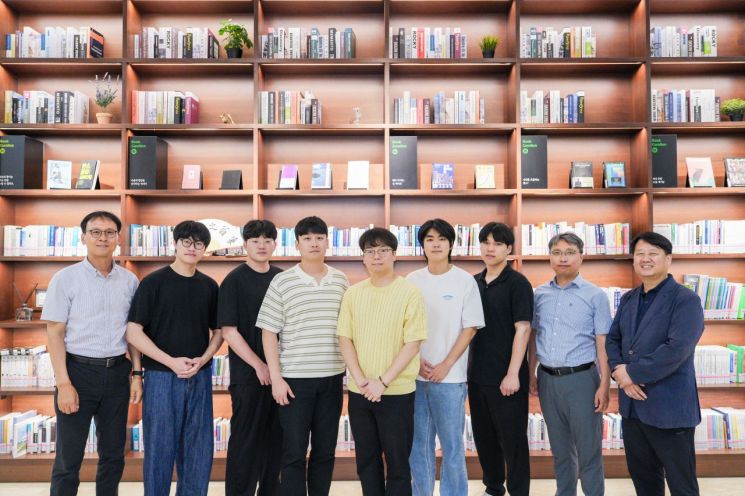 Research team. (From left: Professor Jinyoung Kim, Researcher Changhyun Yoon, Researcher Jiwon Song, Dr. Yunseop Shin (first author), Researcher Jaehwi Lee (first author), Researcher Dongmin Lee, Researcher Minseong Kim, Professor Geunsik Lee, Professor Dongseok Kim).
Perovskite solar cells have attracted attention due to their high efficiency and low manufacturing costs, but commercialization has been difficult because of various defect issues. To address these defects, the research team inserted a special ion called trifluoroacetate (TFA-) between the perovskite and the tin oxide thin film, which acts as the electron transport layer.
The carboxylate group (-COO-) of TFA- firmly attaches to the tin oxide, stabilizing the structure. At the same time, the -CF3 group, through the bidirectional tuning molecule that interacts with the perovskite layer, effectively reduced defects.
The team successfully controlled the irregular structure of the perovskite thin film and greatly improved the characteristics of charge transport. Solar cells produced with this technology achieved a high efficiency of 25.60% and maintained excellent stability even under prolonged exposure to light.
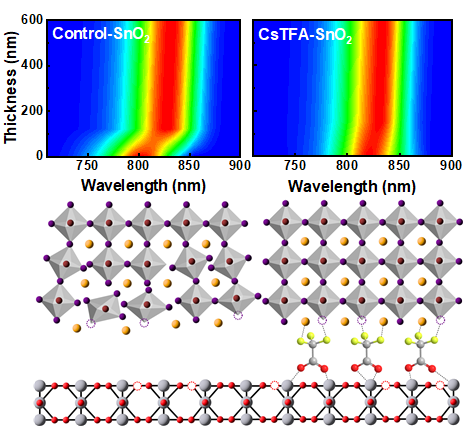 Schematic of Perovskite Crystallinity Change and Thickness-Based Photoluminescence Analysis through Introduction of Bidirectional Coordination Molecules.
Professor Dong Seok Kim stated, "We have established a crucial breakthrough in overcoming the lower-level defects of perovskite thin films," adding, "This achievement will further enhance the commercial viability of perovskite solar cells."
The research was conducted with Jae Hwi Lee (integrated master's and doctoral program researcher), Yoon Seob Shin (Ph.D.), and Elham Oleiki (Ph.D.) as co-first authors, and was supported by the Ministry of Science and ICT and the National Research Foundation of Korea (NRF). The results were published in the July online edition of 'Energy & Environmental Science.'
© The Asia Business Daily(www.asiae.co.kr). All rights reserved.
![Clutching a Stolen Dior Bag, Saying "I Hate Being Poor but Real"... The Grotesque Con of a "Human Knockoff" [Slate]](https://cwcontent.asiae.co.kr/asiaresize/183/2026021902243444107_1771435474.jpg)












