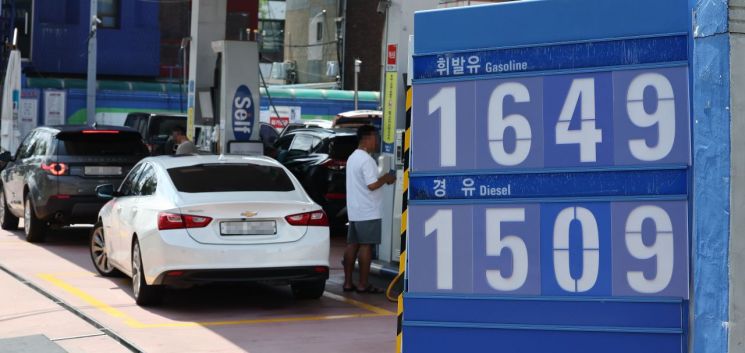
As volatility in international oil prices expands, there are expectations that domestic fuel prices could surge again, drawing attention to whether the fuel tax reduction measure, scheduled to end at the end of this month, will be extended. Stabilizing fuel prices is essential to achieve the inflation target of the low to mid 2% range in the second half of the year, but there is also considerable concern about continuing tax cuts for an extended period amid two consecutive years of tax revenue shortfalls.
According to government sources on the 19th, the Ministry of Economy and Finance will decide as early as the 21st whether to extend the fuel tax reduction on gasoline and diesel, which is set to expire this month. The government has extended the fuel tax reduction measure, first introduced in November 2021 during the COVID-19 pandemic, ten times and continues to maintain it. Ahead of the scheduled end in late June, the government reduced the fuel tax cut on gasoline from 25% to 20% and extended it for two months until the end of this month. The diesel tax cut was reduced from 37% to 30%. Currently, the fuel tax stands at 656 won per liter for gasoline and 407 won per liter for diesel.
International oil prices have rebounded sharply due to heightened tensions in the Middle East and easing concerns about the U.S. economy. The U.S. government's decision to deploy an aircraft carrier strike group and guided missile submarine units to the Middle East has escalated the risk of war, and reports of Iran striking Israel caused West Texas Intermediate (WTI) crude oil futures to surge more than 4% on the 12th (local time).
Although the likelihood of full-scale war between Iran and Israel is low at 5% (according to Bloomberg estimates), growing anxiety is expected to push international oil prices higher. The planned production cuts by Russia and other major oil-producing countries in the OPEC+ coalition starting in October are also cited as factors that could drive prices up. Since international oil prices are reflected in domestic gasoline and diesel prices with a lag of about 2 to 3 weeks, domestic fuel prices are likely to continue rising for the time being.
The impact of oil price instability on inflation has already begun. Last month, the consumer price inflation rate (2.6%) increased as petroleum product prices rose by 8.4%, the largest increase since October 2022, expanding from the previous month’s 2.4%. The government intends to minimize managed price increases such as public utility fee hikes and reductions in fuel tax cuts, but concerns remain that supply shock risks centered on food products due to heatwaves and typhoons could limit price stabilization.
The government forecasts that inflation will gradually slow to the low to mid 2% range in the second half of the year. However, if the fuel tax reduction measure disappears, the rate of increase in oil prices could accelerate, potentially pushing the consumer price inflation rate, which had stabilized, back up close to 3%. This is why there is growing weight behind the possibility of continuing the fuel tax reduction measure. The government remains cautious. A Ministry of Economy and Finance official stated, "We will comprehensively review oil prices and inflation and announce the decision on whether to extend the fuel tax reduction measure within this week."
There is also considerable concern about the reduction in tax revenue caused by the prolonged fuel tax reduction measure. National tax revenue in the first half of this year decreased by 10 trillion won compared to a year ago, making a tax revenue shortfall likely to continue following last year. The managed fiscal balance deficit, which reflects the government's actual fiscal condition, also ballooned to 103.4 trillion won, the second-largest ever. Initially, the government expected traffic, energy, and environmental tax revenue to increase by more than 41% from last year's settlement to 15.3 trillion won this year, assuming a phased normalization of the fuel tax reduction measure, but the progress rate was only 34.9% by the first half of this year, falling far short of half the target.
© The Asia Business Daily(www.asiae.co.kr). All rights reserved.
![A Woman Who Jumps Holding a Stolen Dior Bag... The Mind-Shaking, Bizarre Con of a "Human Knockoff" [Slate]](https://cwcontent.asiae.co.kr/asiaresize/183/2026021902243444107_1771435474.jpg)
















