Criticism from the opposition: "Fatigue over apologies for colonial rule has accumulated"
"Must be seen as a strong competitor to create tension"
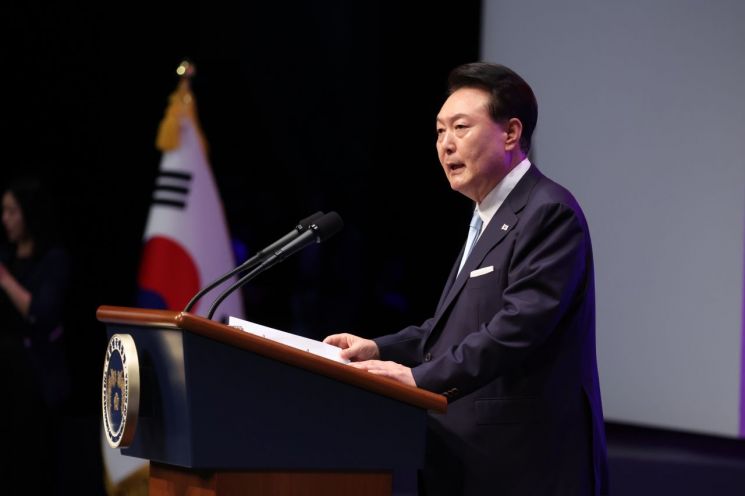 President Yoon Suk-yeol delivers a congratulatory speech and announces the '8.15 Unification Doctrine' at the 79th Liberation Day Celebration held at the Sejong Center for the Performing Arts in Jongno-gu, Seoul on the 15th.
 [Image source=Yonhap News]
Kim Tae-hyo, the First Deputy Director of the National Security Office, stated that "the important thing is Japan's mindset" regarding Korea-Japan relations, drawing strong criticism from opposition parties. On the 18th, the Presidential Office clarified that this meant "Japan should be moved to respect Korea and voluntarily cooperate."
A senior official from the Presidential Office met with reporters at the Yongsan Presidential Office that afternoon and responded to related questions by saying, "If you understand the context well, you will find it quite agreeable," adding, "Japan should respect us and see us as a strong competitor, creating tension."
On the 16th, Kim appeared on KBS and, when asked why President Yoon Suk-yeol's Liberation Day speech did not mention Japan's past issues, he said, "If Japan again turns away and does not say what is necessary regarding past issues, we must sternly question them, but the important thing is Japan's mindset," adding, "Is it truly sincere to force someone without the right mindset to apologize?"
In response, the Democratic Party of Korea criticized, saying, "Kim has confessed that the Yoon Suk-yeol administration’s national view is pro-Japanese and traitorous," and added, "The Yoon government, which has turned a deaf ear to the demands and voices of the people, is absurdly representing Japan’s mindset. Is it the Yoon government’s sense of justice not to hold perpetrators accountable if they refuse to apologize?"
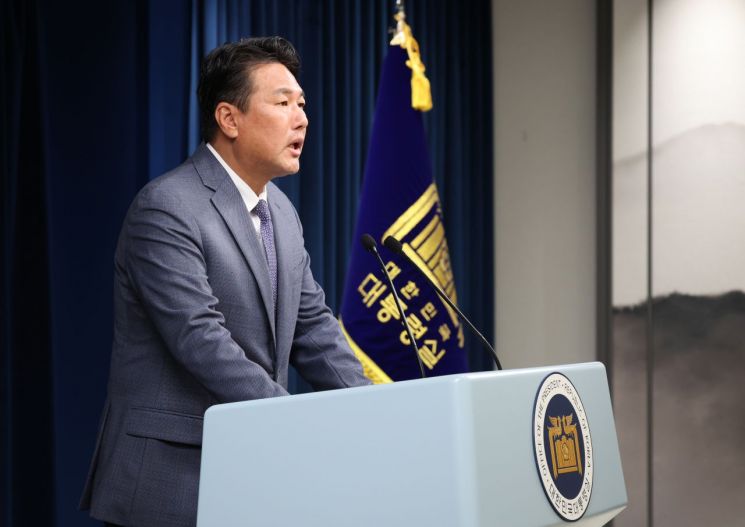 Kim Tae-hyo, First Deputy Director, briefing on the achievements of Korea-US-Japan cooperation on the 1st anniversary of the 'Camp David Summit' [Photo by Yonhap News]
Regarding this, a senior official from the Presidential Office said on the same day, "Since the establishment of diplomatic relations between Korea and Japan in 1965, there have been dozens of official apologies from the Japanese government regarding its past colonial rule, and fatigue over this has accumulated," adding, "The Yoon Suk-yeol administration is actively raising necessary past issues and continuing efforts to resolve them with Japan."
He continued, "Alongside past issues, we must also evaluate the benefits and opportunities that the new era of Korea-Japan and Korea-US-Japan relations bring to Korean companies and citizens," and said, "If there had been no improvement in Korea-Japan relations last March after 12 years, the Camp David summit would not have taken place, and these opportunities would not exist."
The official emphasized, "Japan should respect us, regard us as a newly emerging strong competitor, create tension, lead Camp David in the global order, and admire Korea’s active role in the Indo-Pacific region."
He also added, "Korea and Japan need to create mutual benefits and efforts to induce Japan’s voluntary cooperation with Korea in the international community. I meant that we should be able to move Japan’s mindset so that young people can face Japan with confidence, not ignore our benefits, evaluate them together, and build Korea-Japan relations based on confidence. I hope this is understood in that way."
© The Asia Business Daily(www.asiae.co.kr). All rights reserved.
![Clutching a Stolen Dior Bag, Saying "I Hate Being Poor but Real"... The Grotesque Con of a "Human Knockoff" [Slate]](https://cwcontent.asiae.co.kr/asiaresize/183/2026021902243444107_1771435474.jpg)

















