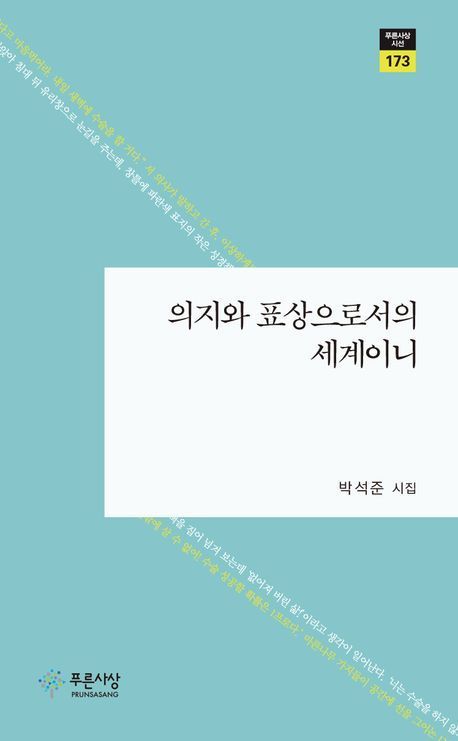
Poet Park Seok-jun's poetry collection The World as Will and Representation (Pureunsasang) has been selected as the winner of the 6th Jo Tae-il Literary Award.
The award-winning work, The World as Will and Representation, depicts the family history of an individual who endured various sufferings throughout Korea's democratization process, as well as the gloomy urban landscapes and the lives of ordinary citizens. Amid the era's hardships, the poet's strong will to live and consciousness of resistance can be felt in the sensibility of life and songs of despair etched into his entire being. Particularly striking are the somber melodies capturing the bleak world and the rough tones stretched to the fullest, which evoke the spirit of this era.
Park Seok-jun was born in 1958 in Gwangju. His older brothers were involved in the South Korean People's Revolutionary Party incident, and in 1983 he wrote a memorandum to the Korean Central Intelligence Agency and became a teacher. In 1989, he chose dismissal to help form the Korean Teachers and Education Workers Union and was reinstated in 1994. He debuted in 2008 with the poetry collection Cafe, Poor Rain. He has published an autobiography, People Living in My Time, and poetry collections including Cafe, Poor Rain, False Poems, in a Show Window World, and The Color of Time Goes Toward the Hue It Aims For.
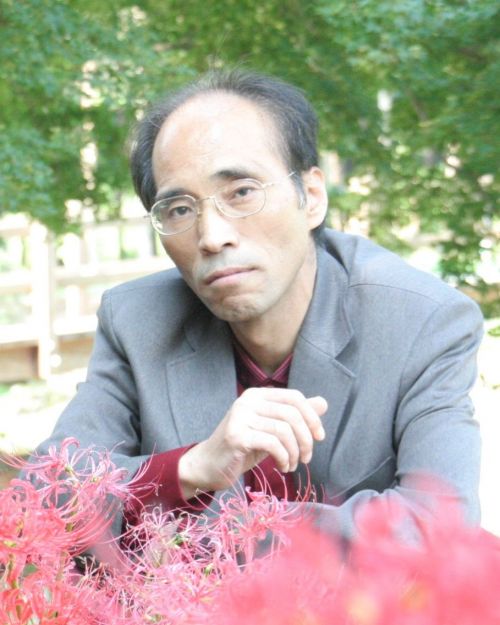
The judging panel stated, "For Park Seok-jun, 'poetry' is synonymous with 'the site of life.' The poor, sickly, and scarred world is filled with unembellished directness. He neither objectifies events nor recklessly employs metaphors. His rugged sites, which are the very contours of existence, are sharp with questions thrown at us and sincere answers. The philosophical terms 'will' and 'representation' resemble the dark nails digging tunnels hundreds of meters underground in his daily life. The somber melodies capturing the bleak world and the rough tones stretched to the fullest, driven by honest sorrow, are the power of despair that awakens us living in the prison of neoliberalism, making us reconsider the responsibilities of poetry."
The preliminary judges included Moon Dong-man (poet), Park So-ran (poet), and Jeong Min-gu (literary critic), while the final judges were Kim Sa-in (poet), Kim Su-woo (poet), and Kim Hyung-soo (poet and literary critic).
Park Seok-jun said, "I left teaching at the age of sixty. Then I began writing in poetic form, and when I turned sixty-five, just after October 8, in a daytime park with autumn wind and morning rain, the rain-soaked fallen leaves made me think of Jeong Yak-yong and reflect deeply. 'Rather than the stimulation from flowering trees, I will pour a deeper heart into the way people live.' 'But even if it is sorrow in life and the world, I will live delicately and cautiously until I disappear from the scene.' When I heard the news of the award from my sickbed, I was filled with feelings of something new flowing inside me that is hard to express in words. After a while, I wondered, is this a dream? Or reality? I was bewildered. I express my gratitude to those who supported me, including my youngest sibling, and to the writers who firmly guided my literary aspirations and gave me much teaching and help," he said in his acceptance speech.
The Jo Tae-il Literary Award is hosted by the Jo Tae-il Poet Memorial Association and Gokseong County, and targets poetry collections published within the last two years. From May 1 to June 30, 143 entries were received. The winner receives a plaque and a prize of 20 million KRW. The award also includes a seal work by the late Jeong Byeong-rye, a seal artist who engraved Jo Tae-il’s representative poem National Territory Prelude. The award ceremony will be held on October 19 at 3 p.m. at the Gokseong Jo Tae-il Poetry Literature Memorial Hall.
The Jo Tae-il Literary Award was established to honor the life and poetic world of Jo Tae-il (1941?1999), a poet who fiercely resisted political contradictions and social realities with sharp language and showed outstanding lyricism in his communion with nature.
Jo Tae-il was born as the fourth of seven siblings of a Buddhist monk family in Taeansa Temple, Gokseong. He graduated from Gwangju Middle School, Gwangju High School, and Kyung Hee University. He debuted in 1964 by winning the Kyunghyang Shinmun New Year's Literary Contest and published poetry collections such as Morning Ship, On the Kitchen Knife, National Territory, Freedom to the Poet, In the Mountains, In the Flowers, Wildflowers Do Not Wither, and Burning Alone. In 1969, he founded the magazine Poet, discovering poets like Kim Ji-ha, Yang Sung-woo, Kim Jun-tae, and Park Nam-jun. In 1980, before the nationwide martial law expansion by the new military regime, he was imprisoned as a preemptive detainee and was a leading ethnic and people's poet advocating freedom of expression and democratization. From 1989, he taught at Gwangju University and passed away from liver cancer on September 7, 1999. He received the Pyeonun Literary Award, Manhae Literary Award, and was posthumously awarded the Bogwan Order of Cultural Merit.
© The Asia Business Daily(www.asiae.co.kr). All rights reserved.


















