The "unused mileage" of Korean Air and Asiana Airlines, which are in the process of merging, has been estimated at around 3.5 trillion KRW.
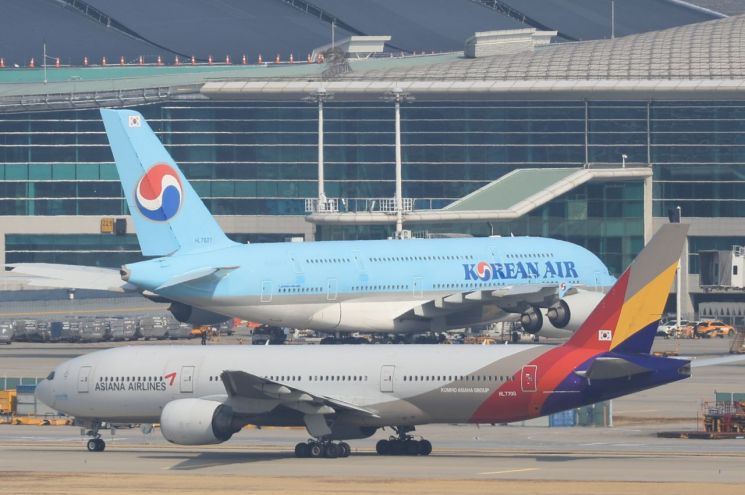
According to the electronic disclosure system of the Financial Supervisory Service on the 18th, based on the recently announced semi-annual reports, Korean Air's deferred mileage revenue stands at 2.5287 trillion KRW, and Asiana Airlines' at 975.8 billion KRW. Combined, the deferred revenue of both companies amounts to 3.5045 trillion KRW. Airlines do not recognize the value of mileage as revenue at the initial point of sale but defer it and recognize it as revenue when the mileage is actually used and the service is provided. The accumulation of deferred revenue corresponds to accumulated mileage, which is considered a liability on the financial statements.
Compared to the end of the first half of last year, Korean Air's mileage increased by 2.6%, and Asiana Airlines' by 3.4%. Compared to the end of the first half of 2019, before the COVID-19 pandemic, Korean Air's mileage increased by 9.9%, and Asiana Airlines' by 38.3%. Combined, this represents a 2.9% increase compared to the same period last year and a 16.5% increase compared to before the COVID-19 pandemic. This is analyzed as an effect of extending the validity period of expiring mileage by up to three years due to flight restrictions during the COVID-19 period. Both companies have set a 10-year validity period for mileage accumulated since July 2008, but due to difficulties in using mileage during the pandemic, they extended this period.
As both companies increased the supply of mileage seats, the bonus passenger kilometers (BPK), which can gauge the trend of mileage used for purchasing airline tickets, also steadily increased. BPK is the total sum of the number of passengers using mileage tickets (bonus passengers) multiplied by the distance of the flight segments. This includes passengers who purchased tickets using 100% mileage as well as those who upgraded their seats using mileage after purchasing a seat.
In the first half of this year, Korean Air's BPK was 4.107 billion passenger kilometers, an 8.8% increase compared to the first half of last year. Compared to the first half of 2019 (3.11 billion passenger kilometers), it increased by 32.1%. Asiana Airlines recorded 1.7 billion passenger kilometers in the first half of this year, a 26.4% increase over one year. Compared to the first half of 2019, it increased by 28.4%. Although the international passenger recovery rate compared to the first half of 2019 is about 85% for Korean Air and 81% for Asiana Airlines, BPK has actually increased.
Both companies have recently expanded mileage usage by forming strategic partnerships with retailers and introducing "mileage shopping malls." This is also analyzed as an effort to reduce liabilities that could burden the financial structure during the merger process of the two companies.
Korean Air explains that even if the merger accelerates after passing the U.S. antitrust review, there will be no sudden changes in the mileage operation methods of the two airlines. Asiana Airlines will be operated as a separate independent company for the next two years, and the conversion rate of unused Asiana Airlines mileage during this period will be determined later through a review by the Fair Trade Commission.
© The Asia Business Daily(www.asiae.co.kr). All rights reserved.

















