Control of Charging Rate via PLC Modem
New Products Subsidized with 400,000 Won Each
Additional Support Not Available for Existing Products
Urgent Budget Support and Regulatory Improvement Needed
As concerns about electric vehicle safety spread, the government is promoting the distribution of slow chargers equipped with fire prevention functions, but there appears to be no concrete plan for the 320,000 slow chargers previously installed. It is practically impossible to retrofit existing slow chargers, so they must be replaced with new chargers, which requires costs and manpower. Experts advise that it is time for the government to show proactive administration, such as emergency budgeting and regulatory improvements.
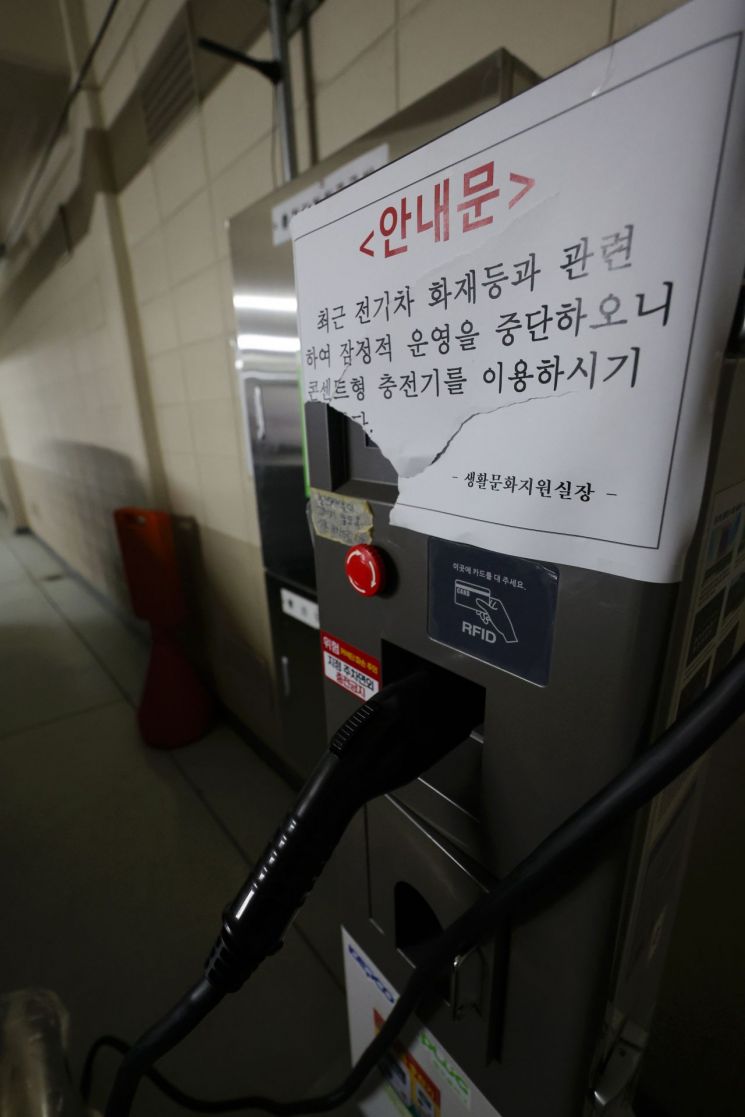 On the 12th, a notice of suspension of operation was posted on a fixed electric vehicle charger installed in the underground parking lot of an apartment in Seoul city.
 [Image source=Yonhap News]
On the 19th, the Ministry of Environment started a project this year to distribute slow chargers equipped with power line communication (PLC) modems for fire prevention, but has not presented specific plans for existing slow chargers.
Fire prevention slow chargers refer to chargers that can control the charging rate by enabling communication between the charger and the vehicle using a PLC modem during electric vehicle charging. Existing slow chargers do not have this function, so when the charging port is plugged into the electric vehicle, current continues to flow, potentially leading to an overcharged state. Overcharging the battery increases the risk of fire.
The need for slow chargers with fire prevention functions has been highlighted following a fire involving a Mercedes-Benz electric vehicle in an underground parking lot in Incheon earlier this month. The Ministry of Environment plans to provide a subsidy of 400,000 KRW to promote the distribution of fire prevention chargers equipped with PLC modems.
However, the government's distribution of fire prevention chargers is limited to new installations. There are no specific plans yet for existing chargers. A Ministry of Environment official only stated, "We will announce future measures regarding existing slow chargers."
According to data received by Im I-ja, a member of the National Assembly's Environment and Labor Committee from the Ministry of Environment, as of June this year, there are 368,056 electric vehicle chargers installed nationwide, of which 325,538 are slow chargers, accounting for 88.4% of the total. In multi-unit housing, 245,435 electric vehicle chargers are installed, of which 98.3% are slow chargers.
According to the charging industry, it is practically impossible to add a PLC modem to existing slow chargers, and they must be replaced with new chargers. A representative from a charging company said, "It is impossible to upgrade existing slow chargers by simply adding a modem," adding, "The main board must be replaced, and software including firmware and user interface (UI) must be completely modified." In other words, they must be replaced with new products. Since the function is completely changed, government certification must also be newly obtained. This is a project requiring at least several billion KRW in costs.
Experts point out that now is a time when vague public anxiety about electric vehicles is spreading, so bold government action is necessary. They say the government should spend the budget to replace existing slow chargers and, if necessary, ease certification procedures. Professor Kim Pil-su of Daelim University said, "To prevent electric vehicle fires, it is important to limit the charging rate," and added, "The government needs to allocate emergency budgets to add fire prevention functions to existing slow chargers and show proactive administration by easing type approval procedures through regulatory sandboxes."
Companies are moving quickly. EVSIS, a subsidiary of Lotte Innovate, announced on the 14th that it received test certification for a slow charger equipped with a PLC modem. A representative from the Korea Testing Certification (KTC) explained, "After several months of consultation with the Ministry of Environment, we started the fire prevention function test certification project for slow chargers in July," and added, "So far, four cases have been certified."
© The Asia Business Daily(www.asiae.co.kr). All rights reserved.
!["The Woman Who Threw Herself into the Water Clutching a Stolen Dior Bag"...A Grotesque Success Story That Shakes the Korean Psyche [Slate]](https://cwcontent.asiae.co.kr/asiaresize/183/2026021902243444107_1771435474.jpg)
















