Export Revenue of Buldak Bokkeummyeon Accounting for 80% of Sales
High Selling Price and Favorable Exchange Rate Gains
Expected to Maintain 20% Range in 2025 and 2026
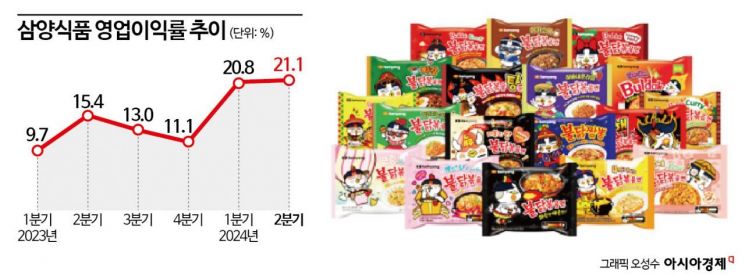
Samyang Foods, which has entered the "Buldak Bokkeummyeon heyday," has surpassed a 20% operating profit margin for two consecutive quarters. This means it has succeeded in improving management efficiency in the food industry, where operating profit margins typically remain in the single digits. The secret lies in the export of Buldak Bokkeummyeon, which accounts for nearly 80% of sales. Recently, sales prices in the U.S. and Europe, emerging as major markets, have been high, and with the added benefit of favorable exchange rates, Samyang Foods is achieving an unparalleled profit margin.
Nongshim 5%, Ottogi 7%... 'Buldak Syndrome' Samyang Records 21% Operating Profit Margin
According to industry sources on the 17th, Samyang Foods recorded an operating profit margin of 21.1% in the second quarter of this year. The operating profit margin is the ratio of operating profit to sales revenue. Samyang Foods posted sales of 424.4 billion KRW and operating profit of 89.4 billion KRW in the second quarter. As a result, it achieved an operating profit margin above 20% for two consecutive quarters following 20.8% in the first quarter. Considering that the food industry’s operating profit margin typically ranges from 5% to 7%, this is an impressive figure. Competitors Nongshim and Ottogi recorded operating profit margins of only 5.1% and 7.2%, respectively, in the second quarter.
The key to the high operating profit margin is the export of Buldak Bokkeummyeon. Samyang Foods’ overseas sales in the second quarter reached 332.1 billion KRW, surpassing 300 billion KRW for the first time. This represents a 74.9% increase compared to a year ago. Consequently, the share of overseas sales in Samyang Foods’ total sales rose to 78%.
Why Exports Outperform Domestic Sales
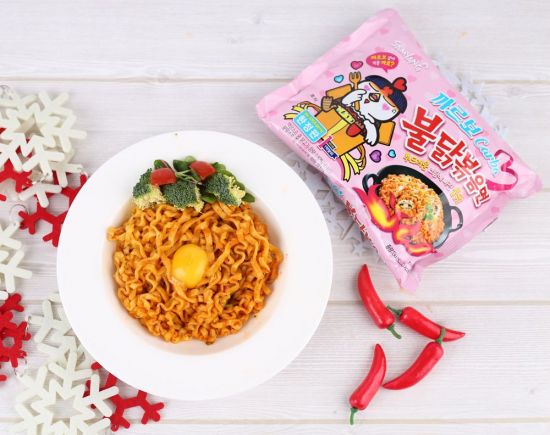
The export version of Buldak Bokkeummyeon has a higher average selling price than the domestic version. Even after considering shipping costs, the profit margin remains high. For example, the Carbo Buldak Bokkeummyeon is sold at Emart in Korea for 5,980 KRW per pack of four, approximately 1,500 KRW per unit. At Walmart, which sells Buldak Bokkeummyeon at the lowest price in the U.S., it is priced at $6.88 (about 9,300 KRW) for five packs, or $1.30 (about 1,900 KRW) per unit. Especially recently, Samyang Foods has secured sales channels mainly in the U.S. and Europe, where average selling prices are high, so the increase in exports has had an even greater effect on boosting operating profit margins. Moreover, with the continued high exchange rate, significant foreign exchange gains have been realized, enabling an operating profit margin in the 20% range.
The surge in Samyang Foods’ total sales is also related to the decline in domestic sales. In the second quarter, Samyang Foods earned 93 billion KRW domestically, a 2.6% decrease from 95.5 billion KRW in the same period last year. Since export volumes have higher margins, Samyang Foods appears to have chosen to supply the rapidly growing overseas demand rather than struggling to expand sales in the already saturated domestic ramen market.
However, the securities industry forecasts that profitability for Samyang Foods will decline in the second half of the year due to increased costs such as labor and advertising expenses. The expected operating profit margin is around 19-20%.
Nevertheless, with the completion of the Miryang Plant 2 in May 2025, the increase in export volume is expected to maintain an average operating profit margin in the 20% range for 2025 and 2026. Upon completion, the annual production capacity will increase by 38%, from 1.76 billion servings to 2.43 billion servings. Since Buldak Bokkeummyeon currently faces supply shortages relative to overseas demand, an increase in production volume is expected to lead to steep growth in sales and operating profit. The securities industry anticipates that Samyang Foods will record sales of around 2.5 trillion KRW and operating profit of 500 billion KRW in 2026.
© The Asia Business Daily(www.asiae.co.kr). All rights reserved.

















