"Specific Details to Be Reported to the Public Soon"
The Ministry of Health and Welfare announced that it will release the first implementation plan for medical reform related to the increase in medical school admissions early next month.
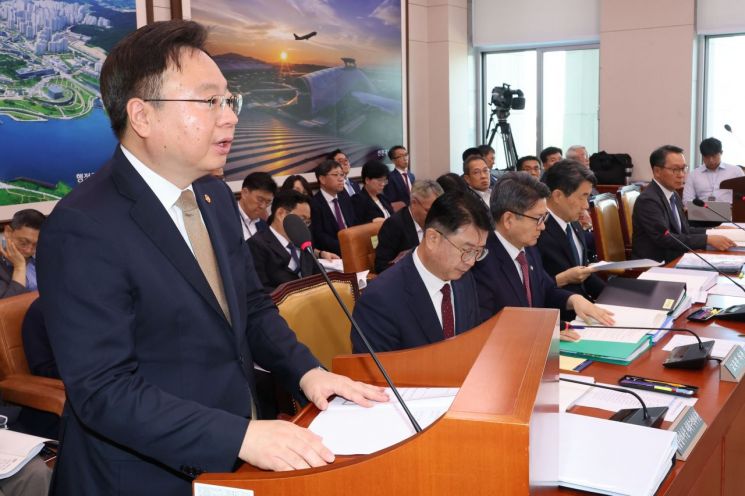 Minister of Health and Welfare Cho Kyu-hong is speaking at the joint hearing on medical school education held by the Education Committee and the Health and Welfare Committee at the National Assembly in Yeouido, Seoul, on the morning of the 16th.
 [Photo by Yonhap News]
On the morning of the 16th, Minister of Health and Welfare Cho Kyu-hong stated at the joint hearing of the National Assembly's Education Committee and Health and Welfare Committee, "The Medical Reform Special Committee will quickly discuss policies related to the expansion of medical school quotas, and we will announce the first implementation plan as early as next month."
He added, "We will devise various institutional support measures so that the increased number of doctors can reside in local areas and provide medical services," and "We will strive to report the specific details to the public soon."
He also emphasized, "The shortage of medical personnel in essential medical fields is a cumulative problem caused by delays in medical reform," and said, "We painfully accept this as a policy failure and will seek alternatives."
They also decided to consider ways to systematically examine patient harm during medical service gaps.
At the hearing, Kim Sung-joo, representative of the Korea Severe Disease Alliance, who appeared as a reference witness, pointed out, "The government says patient treatment is going well, but according to patient survey results, only about 30% receive normal medical care."
According to the Ministry of Health and Welfare, from February 19, when the collective resignation of residents began, until the 14th of this month, the Doctor Collective Action Damage Report and Support Center received a total of 4,188 consultations. Among these, 857 damage reports were filed, including surgery delays (491 cases) and refusal of treatment (131 cases).
In response to criticism that patient harm continues, Minister Cho said, "We will consider (a systematic investigation)."
Regarding concerns that the quality of medical education may decline due to the increase in medical school admissions, the government responded that it will reflect the related budget. Minister Cho said, "During the increase process, when the Medical Education Inspection Team checked each university, each university said they could adequately accommodate the increased quota using current facilities," adding, "However, since there are concerns about quality degradation, we will work with the Ministry of Education to properly reflect the budget to improve the quality of education in next year's budget proposal."
He showed a cautious stance regarding public medical schools and the regional doctor system to expand local doctors. He said, "I understand that public medical schools and the regional doctor system are the result of efforts to expand medical services in local areas, but considering concerns such as forced expansion by law, I think careful review is necessary," adding, "However, the government shares the same view on expanding local medical services and is exploring various methods, including medical fees (compensation for medical services)."
© The Asia Business Daily(www.asiae.co.kr). All rights reserved.

















