Construction Patterns of Fortress Walls and First Identification of Engraved Seongseok (Kakjiseongseok)
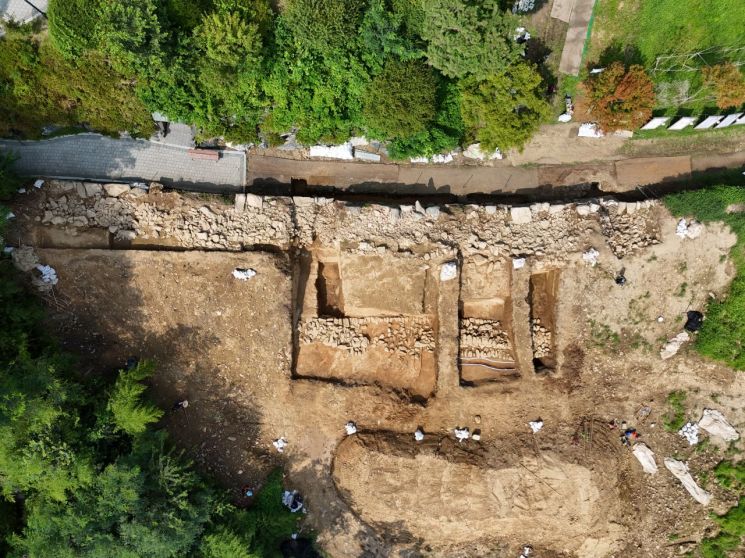 The fortress called Changseong (倉城), built to defend the grain storage facility at Gongsegotgoji, where Joseon Dynasty taxes in the Chungcheong region were kept, has been excavated for the first time.
For the first time, the Changseong (fortress built to defend a grain storage) has been excavated at the Gongsegotgoji site in Asan, Chungnam, where tax rice from the Chungcheong region was stored during the Joseon Dynasty.
On the 16th, the city of Asan announced that the Vision Cultural Research Institute had conducted an excavation of the eastern wall of Gongsegotgoji and, as a result, had confirmed for the first time the construction patterns of the fortress wall and the presence of inscribed fortress stones (Kakjaseongseok, stones engraved with characters).
Designated as a Chungnam Provincial Monument, Asan Gongsegotgoji is one of the main Joseon Dynasty grain storage facilities (Jochang) that stored tax rice collected from over 40 counties in Chungcheong-do. It is the only site in Korea where both the Jochang and the defensive Changseong, built for its protection, remain together. This excavation is expected to provide important data for research on the grain transportation system, Jochang, and Changseong of the time, and is anticipated to be of significant historical value.
Previously, the city began an excavation survey in 2022 on building sites related to Gongsegotgoji inside the Changseong. This year, the investigation expanded to the Changseong itself, confirming facilities and construction methods predating the fortress’s construction.
As a result, it was revealed that before the Changseong was built, a row of fences was constructed outside the warehouse site (Changji) to protect the Jochang. Later, during the reign of King Injo, a foundation was laid to support the weight before the fortress was built, and base stones were set, upon which fortress stones were stacked to form the Changseong.
Additionally, it was found that the fortress wall was divided into sections, with each assigned section marked with an inscribed fortress stone. The inscriptions on the stones are presumed to read "Jeongsan" and "Cheonan Ji," which likely indicate the counties mobilized for the construction of the fortress wall, similar to Myeoncheon Eupseong in Dangjin. Artifacts such as Buncheong ware, white porcelain, and roof tiles from the Joseon Dynasty were also unearthed.
A city official stated, "Based on the results of this excavation, we plan to use the findings as foundational data for the maintenance and restoration of Gongsegotgoji, together with Asan Gongseri Catholic Church, and aim to reestablish its value and status as a representative Jochang heritage site from the Joseon Dynasty."
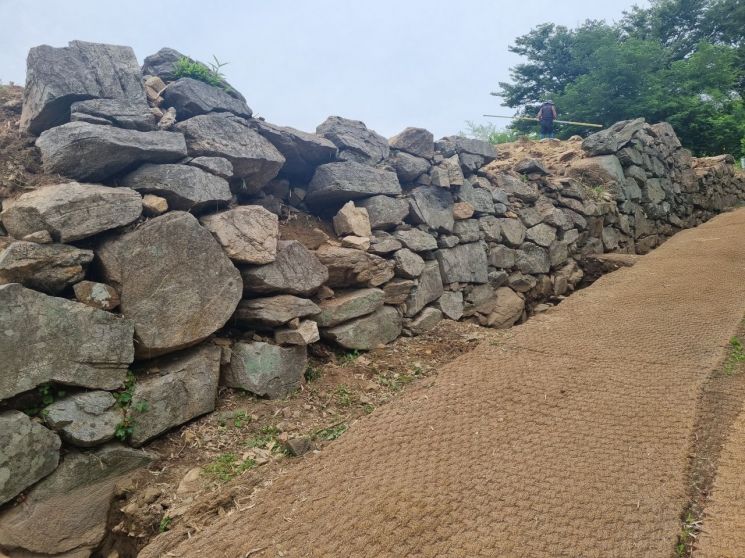 The fortress Changsung (倉城), built to defend the grain warehouse, was unearthed for the first time at Gongsegotgoji, where Joseon Dynasty taxes from the Chungcheong region were stored.
© The Asia Business Daily(www.asiae.co.kr). All rights reserved.
![User Who Sold Erroneously Deposited Bitcoins to Repay Debt and Fund Entertainment... What Did the Supreme Court Decide in 2021? [Legal Issue Check]](https://cwcontent.asiae.co.kr/asiaresize/183/2026020910431234020_1770601391.png)

















