Lee Jae-myung Expected to Win Party Election on 18th
Taking a Completely Different Elite Path
Possibility of Cooperation and Competition to Win Centrist Votes
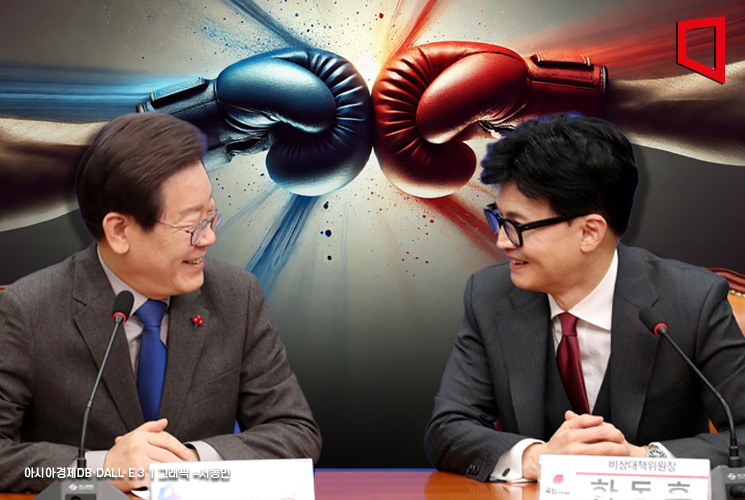
After the Democratic Party of Korea's nationwide party members' convention on the 18th, the leadership reshuffle between the ruling and opposition parties following the general election will be finalized. With Lee Jae-myung, the Democratic Party's presidential candidate, expected to win, an era representing Yeouido politics with Han Dong-hoon and Lee Jae-myung will begin. As the leading presidential candidates from both the ruling and opposition parties, the two face the challenge of proving themselves as political leaders capable of breaking through the deadlocked political situation caused by extreme confrontation and opening a new era.
Previously, at the July 27 party convention, Representative Han was elected with an overwhelming 62.8% support. He reaffirmed his position as the top conservative presidential contender by gaining overwhelming support from both party members and public opinion polls. Candidate Lee also received overwhelming support, including 89.1% in the online voting of party members, and is expected to secure over 80% support. With the leading figures of conservatism and progressivism rising as the de facto decision-makers of the ruling and opposition parties, unprecedented extreme confrontations as well as political solutions through negotiations have become possible.
Who are Han Dong-hoon and Lee Jae-myung?
Representative Han and Candidate Lee are the finest political elites produced by Korean society. Although both share a background in the legal profession, the paths they have taken are vastly different. Representative Han grew up in a wealthy environment and lived an elite life marked by top academic achievements and a career as a prosecutor. In contrast, Representative Lee rose from a childhood as a child laborer to achieve remarkable success. To put it simply, Representative Han represents the highest specs in terms of career, education, and environment in Korean society, while Representative Lee embodies the extreme dynamism of a "dragon rising from a small stream" type of success story.
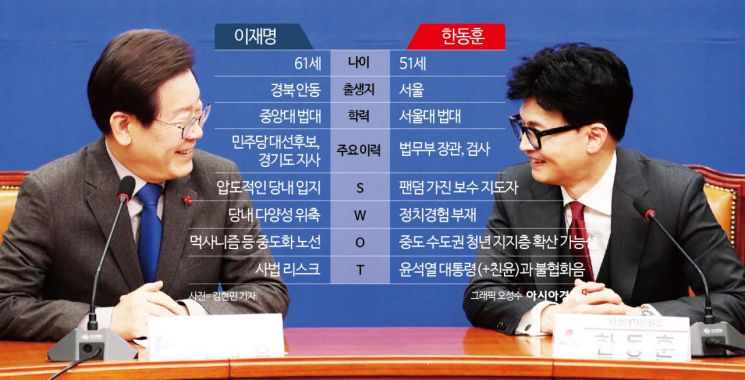
Born in 1973, Representative Han entered Seoul National University Law School in 1992. While enrolled, he passed the bar exam and entered the Judicial Research and Training Institute as part of the 27th class. After completing his military service as an Air Force legal officer, he became a prosecutor. He distinguished himself in investigations related to corporations and was known as a specialist in special investigations. He also became close to President Yoon Seok-youl during their time as prosecutors working on special investigation units. He led investigations into deep-rooted corruption during the early days of the Moon Jae-in administration.
During his tenure as Minister of Justice, Representative Han referred to the early investigations under the Moon Jae-in government as "the prime time of my prosecutorial career." However, after taking charge of investigations into Cho Kuk, then Minister of Justice and leader of the Cho Kuk Innovation Party, he faced persecution. Effectively forced to resign, he was later appointed Minister of Justice after President Yoon was elected, becoming a key figure in the administration. However, before the general election, after taking on the role of emergency committee chairman for the ruling party in crisis, he showed differences with President Yoon over responses related to Kim Geon-hee, the president's spouse, leading to a distancing from the president. After the election defeat, he stepped down from the emergency committee chairmanship but returned to politics by challenging the People Power Party's leadership election. Despite intense scrutiny from pro-Yoon factions during the party convention, he achieved a landslide victory in both party and public support.
Representative Lee was born in 1963 in Andong, Gyeongbuk. Due to difficult family circumstances, he worked as a child laborer in a factory in Seongnam, Gyeonggi Province. During this time, he suffered a hand injury in a press machine, which exempted him from military service. He completed middle and high school through the qualification exam and, due to excellent grades, entered Chung-Ang University as a scholarship student to support living expenses. After passing the bar exam, he worked as a lawyer and engaged in local activities in Seongnam before attempting to enter politics. After several attempts, he was elected mayor of Seongnam in the 2010 local elections. When allegations related to former President Park Geun-hye surfaced in 2016, he gained nationwide attention with outspoken calls for the regime's resignation, rising as a presidential contender. After losing the presidential primary, he was elected governor of Gyeonggi Province. In the 20th presidential election, he became the Democratic Party's presidential candidate but narrowly lost to President Yoon Seok-youl of the People Power Party by 0.73 percentage points. After the presidential election, he won the by-election for the National Assembly seat in Gyeyang-gu, Incheon. Subsequently, he was elected party leader at the Democratic Party convention and led the party to victory in the general election.
The two who will take charge of Yeouido politics
The situations faced by Representative Han and Candidate Lee are completely different. Throughout the party leadership race, Representative Han faced scrutiny from pro-Yoon factions due to discord with President Yoon, and even after taking office, he has shown differences over appointments such as the policy committee chair and the reinstatement of former Gyeongsangnam-do Governor Kim Kyung-soo. Despite his landslide victory at the party convention, having only been in politics for eight months, his position within the party is not yet solid. While he does have some support within the party, he is considered part of the non-mainstream faction in the National Assembly. However, the fandom-like support he has recently built, rare in conservative parties, has become a strong source of power.
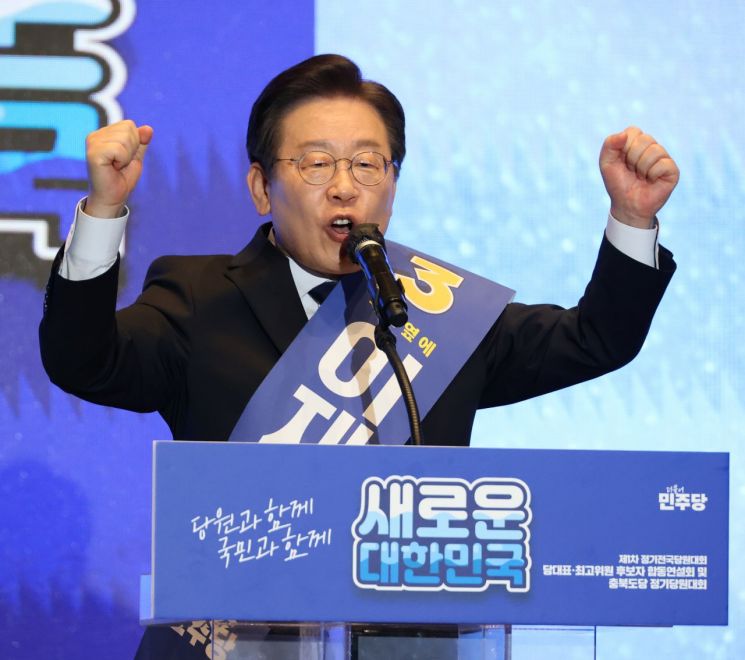
On the other hand, Representative Lee is the unrivaled number one within the Democratic Party. His position is so solid that it is described as a one-pole system. Many politicians who claimed to be non-mainstream lost in primaries or left the party during the general election. At the party convention, he departed from the traditional approach of consolidating support bases and instead advocated "Meoksa-ism," emphasizing that livelihood issues are paramount, putting forward centrist pragmatic agendas such as easing comprehensive real estate tax and financial investment income tax. However, Lee's centrist and pragmatic policy direction is expected to be controversial as these areas have been considered sacred within the Democratic Party.
What draws attention is the nature of the relationship the two will show going forward. During the last general election, Representative Han campaigned on a platform of judging Lee Jae-myung and Cho Kuk. However, cooperation possibilities have since been speculated. During the leadership race, Representative Han stated in media interviews, "The war-like general election is over, and now it's time to do politics," adding, "The public's common sense that criminals must be punished has not wavered, but since we will be political opponents, I will engage in dialogue and persuasion and be persuaded when necessary." Candidate Lee also expressed willingness to engage in dialogue. At a party leader candidate debate hosted by MBC on the 13th, he said, "Of course, the leaders of the ruling and opposition parties should meet and have frank conversations and efforts." However, he also remarked, "Sometimes it seems that calls for dialogue are not genuine but are made to create a certain image, which is a waste of time and political resources," expressing hope for substantive results rather than political showmanship or image-making.
The key point to watch is what kind of voter sentiment each will appeal to among the centrist electorate. Representative Han is actively pursuing support measures for vulnerable groups by emphasizing gap reduction. Political circles expect him to focus on the "Jungsucheong" (centrist, metropolitan area, youth) demographic. Candidate Lee is also expected to present a more centrist and pragmatic line, emphasizing livelihood issues alongside progressive agendas such as basic income. Winning the hearts of the centrist electorate is a challenge for both leaders and their respective parties and support bases.
Additionally, there is a significant possibility of unexpected common ground being explored, such as opposition parties expressing willingness to accept Representative Han's solutions on pension reform and the third-party recommendation for the special prosecutor law on the Chae Sang-byeong case. Currently, the two politicians could serve as bridges to break through the deadlocked political situation.
The variable is expected to be President Yoon Seok-youl. Although Representative Han is the ruling party leader, there is an uncomfortable atmosphere with the president, and Candidate Lee has also taken a confrontational stance against President Yoon. However, the dynamics between the ruling and opposition leaders could change depending on how much President Yoon respects and regards the political roles of the two and whether he considers them as dialogue partners.
Choi Byung-chun, director of the New Growth Economy Research Institute, said, "Currently, the three major powers in South Korea are President Yoon, Representative Han, and Candidate Lee, and it has been confirmed that President Yoon has no will to change. On the other hand, Representative Han and Candidate Lee are expected to pursue change," adding, "There have been various discussions about financial investment taxes, but unlike the past few months when no bills were passed through bipartisan agreement, new attempts are expected to be made going forward."
© The Asia Business Daily(www.asiae.co.kr). All rights reserved.
![From Hostess to Organ Seller to High Society... The Grotesque Scam of a "Human Counterfeit" Shaking the Korean Psyche [Slate]](https://cwcontent.asiae.co.kr/asiaresize/183/2026021902243444107_1771435474.jpg)


















