Professor Byun Youngjae's Team Develops Wireless Power Supply Track for Seamless Charging While Driving
Flexible Operation Without Expensive Magnets... Human Safety Verified
The era of electric vehicles that do not require searching for charging stations is approaching.
A research team at UNIST has developed a technology that wirelessly supplies power to vehicles in motion.
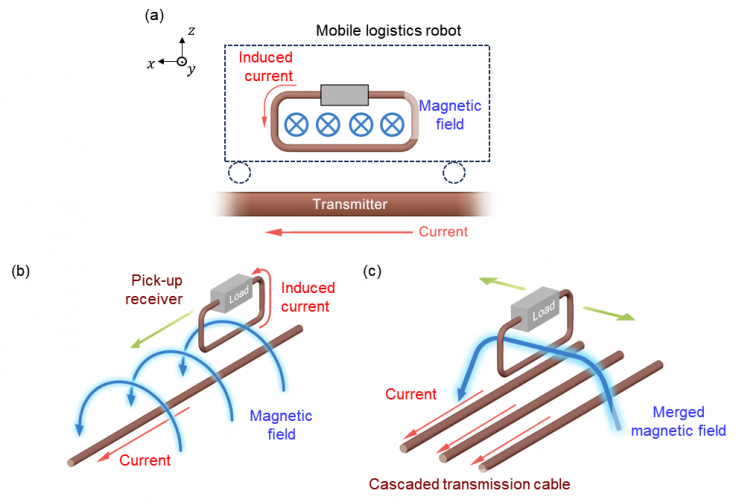
The team led by Professor Byun Youngjae from the Department of Electrical and Electronic Engineering at UNIST (President Park Jongrae) has developed a "wireless power supply track" that continuously provides power to moving vehicles. By forming a wide and strong magnetic field with wires, this technology allows flexible driving in all directions without the need for expensive ferromagnetic materials.
 [Research Team] From the left, Professor Byun Youngjae, Dr. Seo Seoktae, Researcher Cho Hyunkyung, and Researcher Kim Jungho
When current flows through the electromagnetic generator, a circular magnetic field is created. The use of multiple wires expands the range of the magnetic field, enabling efficient power transfer. Electric vehicles can flexibly drive on this power supply track formed by the wide magnetic field.
The team also developed an algorithm to optimize the structure of the power supply track and the power receiver, increasing the power transfer efficiency for electric vehicles up to 90%. Previous technologies tried to increase efficiency by using ferromagnetic materials, but high costs and low durability made practical application difficult.
To ensure the wireless power supply technology can be applied in real life, the team has completed human safety verifications, including standard certifications from the Institute of Electrical and Electronics Engineers (IEEE) and the International Commission on Non-Ionizing Radiation Protection (ICNIRP).
Professor Byun Youngjae explained, "Transportation means, including electric vehicles, need to drive flexibly not only in parallel directions but also vertically, but existing dynamic wireless charging technologies have not achieved this."
Cho Hyunkyung, the first author, said, "If this technology is applied to electric vehicles, it can solve the problems of long charging times and short driving ranges. Reducing battery capacity also lessens pollution from resource extraction such as lithium, enabling more sustainable use of natural resources."
The research results were published online in the international journal Applied Energy on August 12.
The research was supported by the Institute for Information & Communications Technology Planning & Evaluation (IITP) and the National Research Foundation of Korea (NRF) under the Ministry of Science and ICT.
© The Asia Business Daily(www.asiae.co.kr). All rights reserved.
![Clutching a Stolen Dior Bag, Saying "I Hate Being Poor but Real"... The Grotesque Con of a "Human Knockoff" [Slate]](https://cwcontent.asiae.co.kr/asiaresize/183/2026021902243444107_1771435474.jpg)












