Seoul apartment prices have risen for 21 consecutive weeks. Apartment prices in the metropolitan area also increased their rate of growth, indicating that Seoul's heat is spreading to the surrounding areas.
According to the 'Weekly Apartment Price Trends for the Second Week of August (as of the 12th)' released by the Korea Real Estate Board on the 15th, apartment prices in Seoul rose by 0.32% this week compared to last week. This marks the 21st consecutive week of increase.
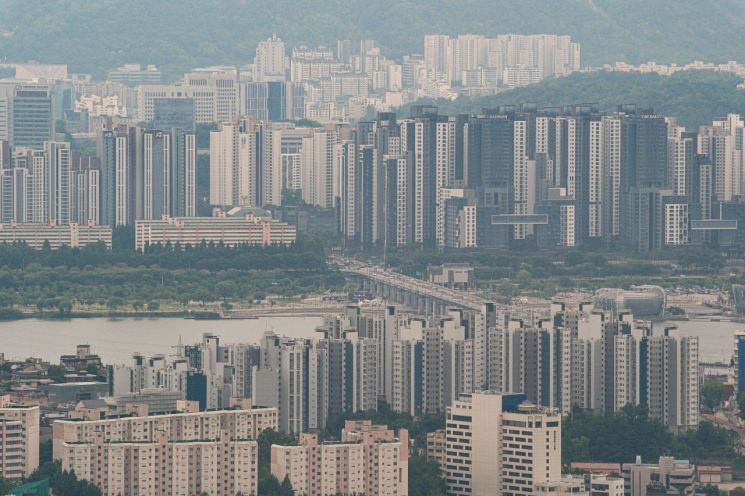
Recently, the weekly apartment price increase rate in Seoul showed a slight slowdown from '0.30% → 0.28% → 0.26%', but this week the rate of increase expanded again.
Typically, the second week of August is an off-season due to summer vacations, and it was right after the government announced the '8·8 Housing Supply Expansion Plan,' yet Seoul apartment prices rose by the largest margin in about 5 years and 11 months since the second week of September 2018 (0.45%).
The Real Estate Board explained, "The high level of transaction volume compared to the beginning of the year has supported the upward trend in apartment sale prices," adding, "Prices of listings are rising mainly in preferred complexes, and the continued chasing buying demand has increased the rate of growth."
This week, the so-called 'Gangnam 3 districts' and 'Mayongseong (Mapo, Yongsan, Seongdong districts)' led the rise in Seoul apartment prices.
Among Seoul's autonomous districts, Seongdong-gu (0.63%), centered around large complexes near Kumho and Haengdang-dong stations, saw the largest increase in apartment prices. This rate of increase is the highest in 10 years and 11 months since the third week of September 2013 (0.69%). Apartment prices in Seongdong-gu have risen by more than 0.5% weekly for seven consecutive weeks.
Following Seongdong-gu, the Gangnam 3 districts?Songpa-gu (0.58%), Seocho-gu (0.57%), and Gangnam-gu (0.46%)?showed high rates of increase. Gwangjin-gu (0.45%), Dongjak-gu (0.41%), Mapo-gu (0.39%), Gangdong-gu (0.37%), Yongsan-gu (0.36%), and Yeongdeungpo-gu (0.36%) also recorded increases above the Seoul average.
Apartment prices in Incheon (0.10% → 0.16%) increased at a faster rate than the previous week, while Gyeonggi Province (0.11% → 0.10%) saw a slight decrease. In Gyeonggi, apartment prices in Hanam-si (0.43%), mainly new buildings in Mangwol and Sinjang-dong, showed strength. Seongnam's Sujeong-gu (0.39%) and Gwacheon-si (0.33%) also rose. Due to these factors, the apartment price increase rate in the metropolitan area (0.16% → 0.18%) also expanded this week.
On the other hand, apartment prices in provincial areas (-0.02% → -0.02%) maintained their rate of decline, continuing a contrasting trend with the metropolitan area. Areas with many unsold units such as Daegu (-0.11%), Jeju (-0.06%), Gwangju (-0.05%), and Busan (-0.03%) experienced declines.
The nationwide weekly apartment price increase rate was recorded at 0.08% this week.
In the jeonse (long-term lease) market, Seoul apartment jeonse prices continued their upward trend for 65 consecutive weeks. The rate of increase slightly expanded from 0.17% last week to 0.19% this week.
The Real Estate Board stated, "Jeonse prices continue to rise due to a shortage of listings mainly in newly built complexes with high residential preference and good living conditions," adding, "The waiting demand for jeonse also continues, expanding the overall rate of increase in Seoul."
However, unlike last week when jeonse prices rose in all 25 districts of Seoul, this week jeonse prices in Gangdong-gu fell by 0.06% compared to the previous week, turning to a decline.
Jeonse price increase rates in provincial areas recorded 0.0%, marking a stabilization after 12 weeks since the fourth week of May.
© The Asia Business Daily(www.asiae.co.kr). All rights reserved.

















