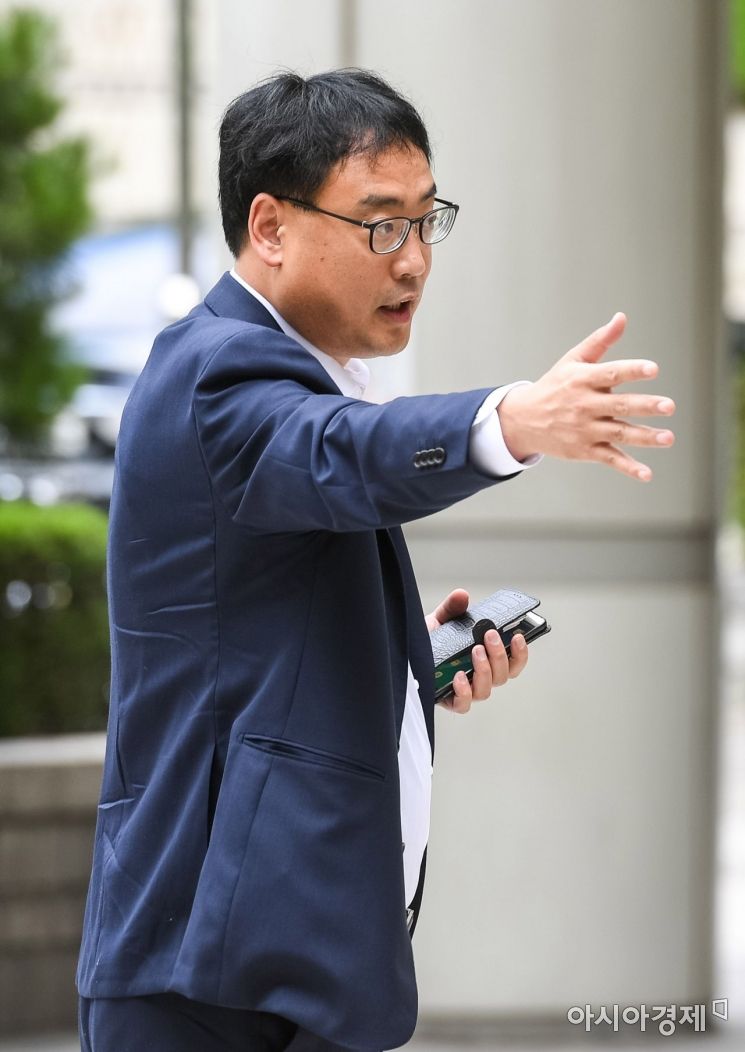
Byun Hee-jae, CEO of Media Watch, who was indicted for holding a rally in violation of COVID-19 quarantine guidelines in 2020, has been confirmed to receive a suspended sentence with a fine.
According to the legal community on the 15th, the Supreme Court's First Division (Presiding Judge Kim Seon-su, former Supreme Court Justice) upheld the original ruling that sentenced Byun to a fine of 1.5 million KRW with a one-year suspended sentence in the appeal trial for violating the Infectious Disease Control and Prevention Act.
The court stated the reason for dismissing Byun's appeal, saying, "There is no error in the lower court's judgment that found the defendant guilty without failing to conduct necessary hearings, violating the rules of logic and experience, exceeding the limits of free evaluation of evidence, or misunderstanding the legal principles regarding the establishment of the violation of the Infectious Disease Control and Prevention Act, the procedure for notifying the prohibition of assembly, freedom of assembly, and the principle of proportionality."
Byun was prosecuted for holding and participating in a rally under the name of the 'Media Watch Readers' Meeting' on the sidewalk in front of a building in Jung-gu, Seoul, from 1:30 PM to 2:25 PM on February 22, 2020, violating Seoul City's assembly ban measures to prevent the spread of COVID-19.
The day before the rally, the late Park Won-soon, then Mayor of Seoul, held an emergency press conference announcing restrictions on assemblies in downtown areas including the building in front of which the rally was held, Gwanghwamun Square, Cheonggye Plaza, and Seoul Plaza. Numerous banners, signboards, and printed materials notifying residents of the assembly restrictions and prohibited locations were installed in advance.
Additionally, on the day of the rally, February 22, 2020, at 12:43 PM, a Seoul city official handed Byun the official notice of assembly prohibition issued by the Mayor of Seoul on February 21, 2020, at the rally site in front of the building.
However, Byun, along with actor Jo Deok-je (real name Jo Deuk-je) and another participant A, took turns ascending the stage at the rally attended by about 50 people, criticizing the government and making statements to the effect that "the assembly ban order is unjust." Another participant B managed the rally by adjusting the sound system behind the stage.
The prosecution indicted Byun, Jo, A, and B for violating the Infectious Disease Control and Prevention Act by holding or participating in the rally in violation of quarantine guidelines.
Article 49(1) of the Infectious Disease Control and Prevention Act stipulates the obligation of the Minister of Health and Welfare, provincial governors, mayors, and district heads to take measures to prevent infectious diseases, enumerating in item 2 the restriction or prohibition of "entertainment, assemblies, ancestral rites, or other gatherings of multiple people."
Violations of such measures taken by the minister or local government heads are punishable by a fine of up to 3 million KRW under Article 80(7) of the same law.
In August 2022, the first trial court sentenced Byun to a fine of 1.5 million KRW, Jo to 500,000 KRW, and A and B to 1 million KRW each.
During the trial, Byun claimed innocence, arguing that a lawful assembly ban notice had not been issued, but this was not accepted.
The court judged that Byun and others recognized the Mayor of Seoul's assembly ban order before the rally based on the emergency press conference held the day before the rally, the media coverage of the press conference, the notification of assembly prohibition via text message to one of the rally's order maintainers by a Seoul city official, and the direct presentation of the assembly ban notice to Byun on the day of the rally.
The court stated, "Whether the assembly ban notice was lawfully delivered to the defendants is not an issue in determining the guilt or innocence of the violation of the Infectious Disease Control and Prevention Act in this case."
Furthermore, the court noted that under the Administrative Procedures Act, when an administrative agency imposes obligations or restricts rights on a party, it must notify the party in advance of the content and legal basis of the disposition. However, exceptions exist for urgent measures necessary for public safety or welfare, allowing such prior notification to be omitted. Therefore, "even if the Mayor of Seoul did not provide prior notice regarding this measure and assembly ban notification, it cannot be considered illegal."
While acknowledging that Byun and others held or participated in the rally in violation of the assembly ban notice aimed at preventing infectious diseases, the court considered factors such as the assembly ban notice being issued urgently just before the rally and the fact that the defendants' violation did not significantly increase the risk of COVID-19 spread in sentencing, imposing fines ranging from 1 million to 1.5 million KRW.
However, Jo was sentenced to a fine of 500,000 KRW considering his admission of guilt and the need for fairness with a defamation conviction under the Information and Communications Network Act, which had been finalized before the first trial verdict in this case.
Jo did not appeal, so his first trial sentence was finalized, while Byun and the other three appealed.
The second trial court also found no factual or legal errors in the first trial court's guilty verdict, which held that Byun, A, and B recognized the assembly ban order at least implicitly but proceeded with the rally.
However, the second trial court deemed the sentence imposed by the first trial somewhat excessive and accepted the defendants' claims of disproportionate sentencing, suspending the execution of the fines. The court sentenced Byun to a fine of 1.5 million KRW with a one-year suspended sentence, and A and B to fines of 1 million KRW each with one-year suspended sentences.
The court pointed out, "The assembly ban notice for the reported rally was issued urgently just before the rally, and the defendants appear to have committed the offense with at least conditional intent. Furthermore, the defendants seemed to have tried to conclude the rally within a short time. There is no evidence that the defendants' violation of the assembly ban significantly increased the risk of COVID-19 spread."
It added, "Considering other factors affecting sentencing such as the defendants' age, character, environment, motive, means and methods of the offense, and circumstances after the offense, the original sentence was somewhat heavy and unjust."
Byun appealed again, but the Supreme Court found no problem with the second trial court's judgment.
© The Asia Business Daily(www.asiae.co.kr). All rights reserved.
![User Who Sold Erroneously Deposited Bitcoins to Repay Debt and Fund Entertainment... What Did the Supreme Court Decide in 2021? [Legal Issue Check]](https://cwcontent.asiae.co.kr/asiaresize/183/2026020910431234020_1770601391.png)