Number of Emergency Room Visits Returns to Normal Levels
Sajik Residents 17%, Employed at Other Medical Institutions
As emergency rooms at tertiary hospitals across the country, including Chungbuk National University Hospital, temporarily suspended medical services, the government decided to cooperate with related agencies to respond to the situation. The government urged patients with mild symptoms to refrain from using emergency rooms.
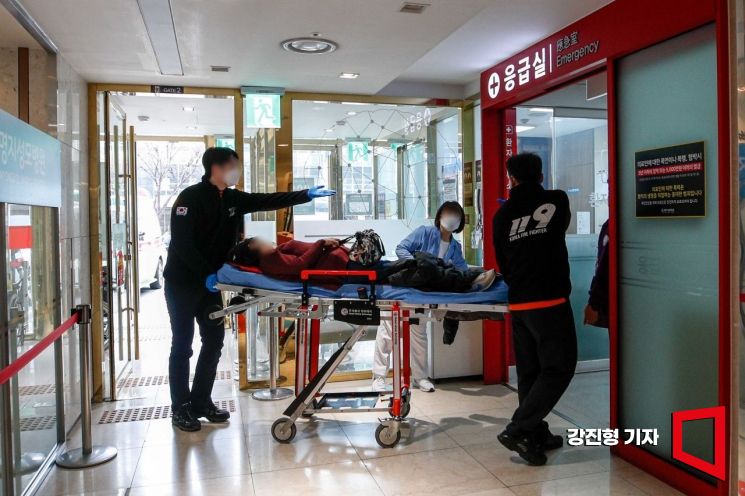 On the 11th, as collective actions by doctors, mainly residents, continue, a patient is entering the emergency room at a secondary general hospital in Seoul. Photo by Jinhyung Kang aymsdream@
On the 14th, Kwon Byung-ki, Essential Medical Support Officer at the Ministry of Health and Welfare, explained at the Central Disaster and Safety Countermeasures Headquarters briefing on doctors' collective action, "Emergency patient care at Chungbuk National University Hospital is currently operating 24 hours a day, but there were some disruptions in on-duty operations due to emergency medicine doctors taking leave or sick leave." He added, "Currently, the hospital is operating the emergency room normally with support from specialists in other fields such as pediatrics and adolescents, as well as personnel from the regional trauma center."
Kwon also stated, "I do not think there is a significant burden on emergency room care at this time," and added, "However, we will continuously cooperate with local governments and related agencies to monitor emergency room operations and manage the situation to prevent any gaps in medical care."
The emergency room at Chungbuk National University Hospital had been staffed by 10 specialists taking turns on duty, but due to recent staff shortages, it became impossible to maintain the existing duty system, leading to a temporary suspension of medical services on that day. Earlier, Sejong Chungnam National University Hospital in the same Chungcheong region also reduced emergency room services this month due to a shortage of emergency medicine specialists. At Sokcho Medical Center in Gangwon Province, two of the five dedicated emergency room doctors resigned, causing the emergency room to close for a week last month. At Soonchunhyang University Cheonan Hospital in Cheonan, Chungnam Province, the operation of the emergency medical center was also suspended after some emergency medicine specialists resigned.
However, according to the Ministry of Health and Welfare, despite the medical service gaps caused by the collective resignation of residents, the number of patients visiting emergency rooms has returned to normal levels. The average number of emergency room visits in the second week of this month was 19,347, which is 108% of the usual level. Among them, patients with moderate severity (between severe and mild) returned to 117% of the usual level, and mild patients returned to 101%.
Kwon said, "Since August, the number of emergency room patients has shifted to a decreasing trend," and added, "We will prepare measures considering the current emergency room situation during the Chuseok holiday."
Nevertheless, the government urged patients with mild symptoms to refrain from using emergency rooms as much as possible to ensure smooth emergency room operations. At the Central Disaster and Safety Countermeasures meeting held earlier that morning, Minister of Health and Welfare Cho Kyu-hong said, "The government is thoroughly preparing in advance to prevent serious disruptions in the treatment of severe and emergency patients, actively promoting supplementary tasks identified through communication with the field, such as securing emergency medical personnel, improving emergency room operation efficiency, and reorganizing transport and transfer systems." He added, "We also ask the public to yield emergency room use to severe and emergency patients if they have relatively mild symptoms."
Meanwhile, the additional recruitment of residents for the second half of the year at training hospitals, which runs until the 16th, is also expected to have few applicants. On the other hand, cases of residents who resigned finding employment as general practitioners at hospitals and clinics are increasing.
According to the Ministry of Health and Welfare, as of the 12th, 971 of the residents who resigned have been employed at medical institutions, an increase of 346 from 625 on the 5th. This accounts for about 17% of the total 5,701 residents who resigned. Among those employed, 42% work at hospital-level or higher medical institutions, while the rest practice at clinic-level facilities.
© The Asia Business Daily(www.asiae.co.kr). All rights reserved.
![User Who Sold Erroneously Deposited Bitcoins to Repay Debt and Fund Entertainment... What Did the Supreme Court Decide in 2021? [Legal Issue Check]](https://cwcontent.asiae.co.kr/asiaresize/183/2026020910431234020_1770601391.png)