'Repatriation of "Hanmal Uibyeong Documents" and "Hanil Gwangye Saryojip"
Documents Reveal Suppression and Surveillance of Uibyeong Throughout
Purchased with Lottery Fund by Overseas Korean Cultural Heritage Foundation
Materials that offer a glimpse into the traces of the righteous armies who participated in the anti-Japanese movement have returned to their homeland ahead of Liberation Day.
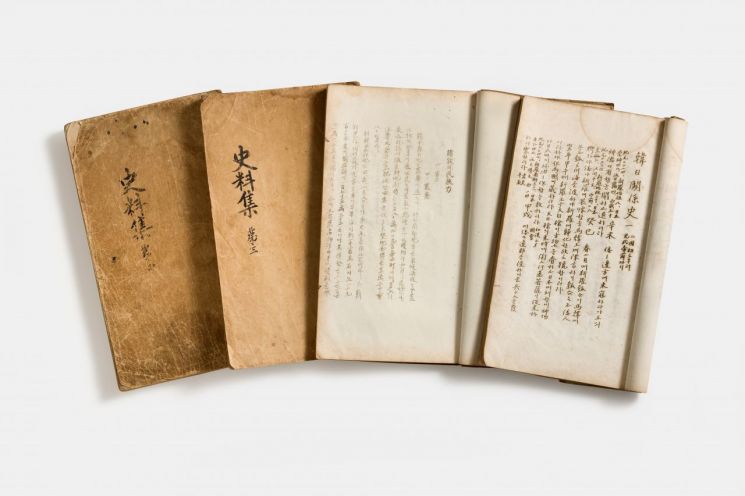
The Cultural Heritage Administration and the Overseas Korean Cultural Heritage Foundation recently announced on the 14th that they have repatriated the "Late Joseon Righteous Army Related Documents" and the "Historical Materials on Korea-Japan Relations (韓日關係史料集) - Materials on Korea-Japan Relations Submitted to the League of Nations," respectively.
The Late Joseon righteous army related documents consist of thirteen documents written between 1851 and 1909. They include writings by Heo Wi (1855?1908), who was active in the 13 Provinces Uprising Army, a united righteous army unit organized in 1907, and letters from Choi Ik-hyeon (1833?1907), a prominent patriotic righteous army leader during the late Joseon period.
The documents were made into two scrolls by attaching them horizontally in a long form. When fully unrolled, their lengths measure 406.5 cm and 569.5 cm, respectively.
Based on the writings at the beginning of the scrolls, the Cultural Heritage Administration believes that these materials were collected by Akutagawa Ch?ji (개천장치, 芥川長治), a Japanese military police officer during the colonial period, and were produced in their current form in August 1939.

Akutagawa Ch?ji was a figure who served as a corporal (伍長, a military rank meaning squad leader) in the Japanese military police under the Governor-General of Korea during the 1910s. Until 1935, he served as a police inspector at the Japanese Imperial Consulate General’s police department in Harbin and other locations.
The scrolls vividly reveal how the Japanese colonial government suppressed the righteous armies and systematically monitored them. Notably, Akutagawa titled each scroll as "Letters from the Leaders Who Rejected Japan in the Late Joseon Period" and "Manifestos of the Rebel Leaders Who Rejected Japan in the Late Joseon Period" (檄文, a document written to incite or express anger against injustice).
One notable part records a raid on the site where a poetry collection of Yu In-seok (1842?1915) was being compiled, stating that "a large number of subversive documents were seized." Yu In-seok was a righteous army leader who led anti-Japanese resistance in the Primorsky Krai region.
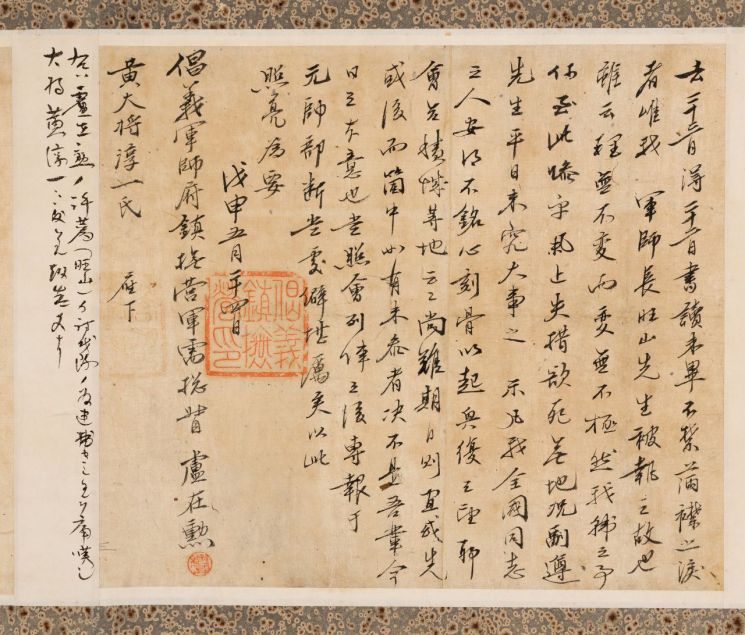 Documents Related to the Korean Righteous Army in the Late Joseon Period_Official Documents of No Jae-hoon, Governor of Jinmuyeong and Commander of the Creative Military Division
The documents convey the harsh realities faced by the righteous armies and their steadfast determination. A representative example is a writing by righteous army leader Noh Jae-hoon, presumed to have been written in 1908 when Heo Wi, the second commander-in-chief of the 13 Provinces Uprising Army, was captured. It reads, "How could we not engrave deeply in our hearts and raise the hope of restoration?" expressing sorrow over Heo Wi’s arrest while reaffirming the will to resist.
The foundation explained, "Considering the note that these are 'rare historical materials,' it appears that the materials collected while serving as a military police officer were deemed significant and personally preserved."
The righteous army related documents are said to have been held by a Japanese antique art dealer. The Cultural Heritage Administration purchased them through the Lottery Fund in July and recently brought them to Korea.
The Historical Materials on Korea-Japan Relations is a historical book compiled in 1919 by the Provisional Government of the Republic of Korea to demand the independence of the Korean people to the League of Nations. It is known as the first and only historical book compiled by the Provisional Government.
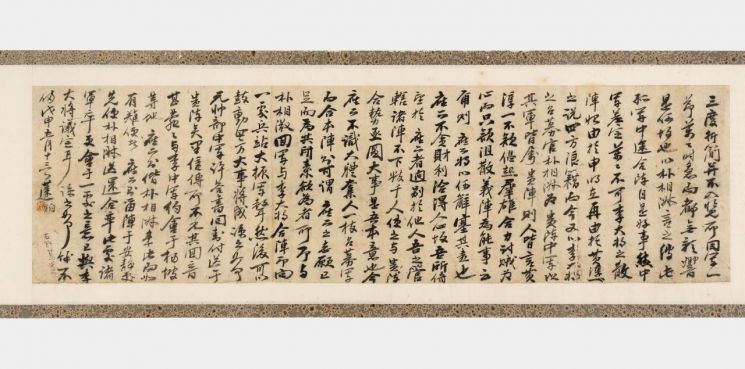 Document on the Korean Righteous Army during the Late Joseon Period_13 Provinces Volunteer Army Commander-in-Chief Heo Wi's Document
Composed of four volumes, the materials primarily focus on Korea-Japan relations, demonstrating Japan’s invasiveness from the Three Kingdoms period onward in chronological order. They also summarize the brutality of colonial oppression and the causes and development of the March 1st Movement.
Although 100 copies were produced at the time of compilation, only two complete copies are currently known: one held by the Independence Hall of Korea, a nationally registered cultural heritage, and another at the East Asian Library of Columbia University in the United States.
This material was donated in May by a Korean resident in the United States. It is considered highly valuable because it bears the seal of Kim Byung-jo (1877?1948), one of the national representatives of the March 1st Movement.
A foundation official explained, "Since it is presumed to be a manuscript copy (手澤本) that Kim Byung-jo kept close at hand, it is extremely important for research on the history of the Korean independence movement."
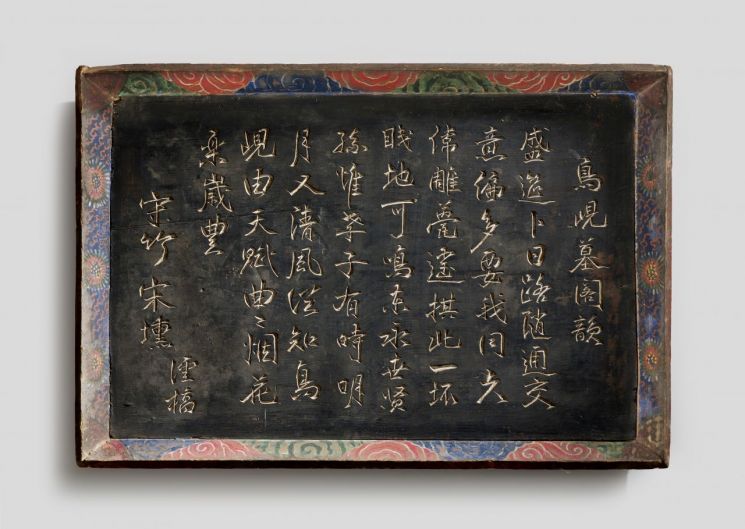
On this day, the Cultural Heritage Administration held a press briefing at the National Palace Museum of Korea in Jongno-gu, Seoul, unveiling the Late Joseon righteous army related documents, the Historical Materials on Korea-Japan Relations, and the "Johyeonmyogakun (鳥峴墓閣韻)" poetry plaque.
The poetry plaque was written by Song Hun (1862?1926), the father of Song Jin-woo (1890?1945), a devoted independence activist, and the founder of Damyang School. It was recently donated from Japan.
Choi Eung-cheon, head of the Cultural Heritage Administration, said, "This is a valuable achievement that goes beyond the physical recovery of cultural heritage that was abroad, restoring the spirit with which our ancestors protected the homeland."
© The Asia Business Daily(www.asiae.co.kr). All rights reserved.



















