Employment in July Reaches 100,000s After 3 Months... Up 172,000
Construction Industry Employment Index Hit Hard by Worsening Construction Market
Self-Employed Without Employees Decline for 11 Consecutive Months
Last month, the increase in the number of employed people exceeded 100,000 for the first time in three months, recovering to double digits. However, the number of construction workers decreased at the largest rate in 11 years, and the number of self-employed without employees declined for 11 consecutive months, highlighting the growing difficulties faced by vulnerable employment groups. The government has decided to increase public construction investment and provide livelihood support for construction workers. If employment declines worsen, the government is also considering designating the construction industry as a special employment support sector.
Construction Industry Takes a Direct Hit Despite Employment Indicator Recovery
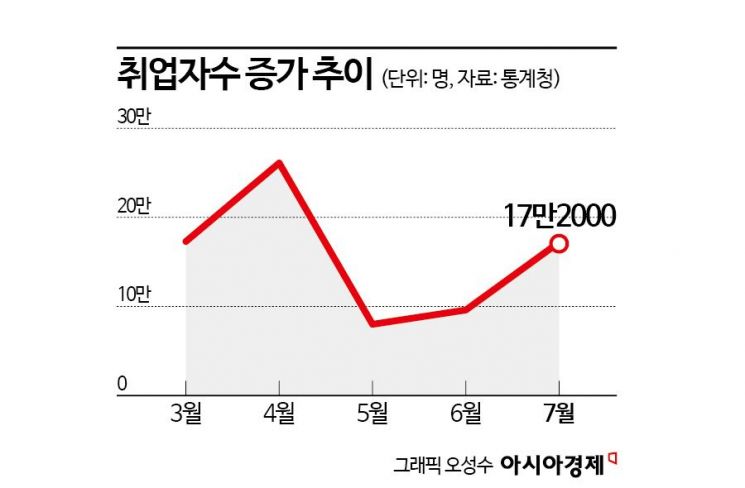
According to the ‘July Employment Trends’ released by Statistics Korea on the 14th, the number of employed people aged 15 and over last month was 28,857,000, an increase of 172,000 compared to the same month last year. The increase in employment fell below 100,000 for two consecutive months in May (80,000) and June (96,000), but recovered to the 100,000 level again after three months. However, this figure is still below the levels seen in March (173,000) and April (261,000).
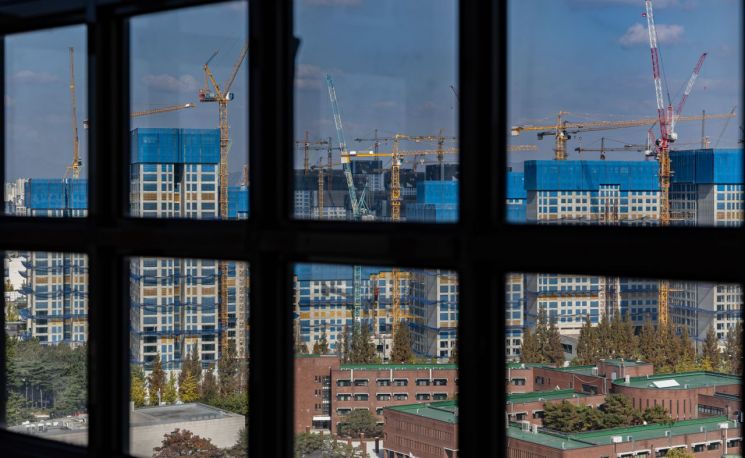
By industry, the decrease in construction employment was prominent. The number of construction workers decreased by 81,000 compared to the same month last year, marking the largest decline since the 7th industrial classification revision in 2013. Construction employment recorded negative growth for three consecutive months following May (-47,000) and June (-66,000). Manufacturing employment, which had been increasing for seven months, also turned to a decline with a decrease of 11,000.
Seo Un-ju, Director of the Social Statistics Bureau at Statistics Korea, analyzed, "The decline in construction employment in July was likely influenced by the worsening construction market as well as the heatwave and heavy rains. Employment has been continuously decreasing in general construction, and specialized construction has also seen consecutive declines for three months." A Ministry of Economy and Finance official added, "The decrease in construction employment, including specialized construction, seems to be affected by the bottoming out of apartment move-in volumes in June and July."
Manufacturing employment decreased by 11,000 (0.2%). Director Seo explained, "While employment among those under 40 decreased, employment among those in their 50s and 60s and older increased, and there are differences by sector within manufacturing."
Employment increased in health and social welfare services (117,000), information and communications (82,000), and transportation and warehousing (65,000). The service sector saw an increase of 286,000 in July, expanding from 183,000 in June.
The decline in self-employed workers also continued. Non-wage workers have been decreasing for five consecutive months since February (-57,000), with a decrease of 80,000 in July. In particular, self-employed without employees decreased by 110,000, marking 11 consecutive months of decline since September last year (-20,000). On the other hand, self-employed with employees increased by 48,000 last month, following a 34,000 increase in June.
By age group, youth employment (ages 15-29) decreased by 149,000. Youth employment has been declining for 20 consecutive months since November 2022. The youth employment rate also fell by 0.5 percentage points. Conversely, employment among those aged 60 and over increased by 278,000. Employment also rose by 110,000 in their 30s and 23,000 in their 50s.
The employment rate for those aged 15 and over was 63.3%, up 0.1 percentage points from a year earlier. This is the highest figure for July since monthly statistics began in 1982. The number of unemployed was 737,000, down 70,000 from the same month last year. The unemployment rate also fell by 0.2 percentage points to 2.5%.
Government Provides Emergency Support for Construction Jobs
The Ministry of Economy and Finance and the Ministry of Employment and Labor held a joint meeting of the inter-agency job task force on the same day to announce the ‘Construction Industry Job Support Plan’ and the ‘Strengthening Regional Youth Employment Support Plan for the Second Half of the Year.’
First, to meet the demand for construction jobs, the government plans to expand public institution investment by 2 trillion won in the second half of the year and quickly execute the unspent amount (8.6 trillion won) from the first half, including local public enterprise investments. The ‘Housing Supply Expansion Plan’ announced on the 8th will also be promptly implemented. The Ministry of Economy and Finance and the Ministry of Land, Infrastructure and Transport will prepare a ‘Construction Cost Stabilization Plan’ next month through a task force involving related ministries to reduce factors causing construction delays.
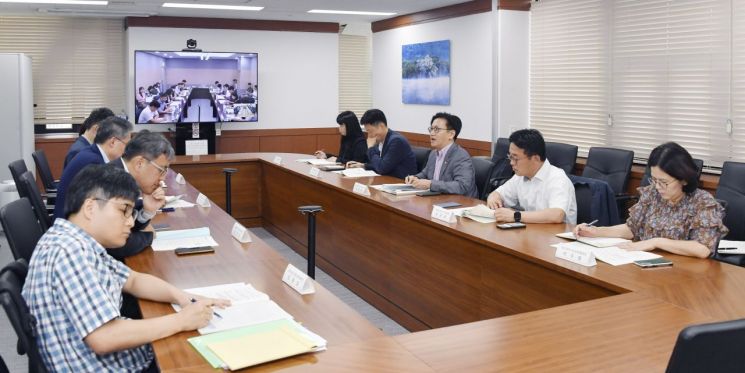 The joint task force (TF) meeting on jobs held on the 14th at the Government Seoul Office Building, chaired by Kim Beom-seok, 1st Vice Minister of Strategy and Finance, and Kim Min-seok, Vice Minister of Employment and Labor /
 In providing customized employment services for construction workers, support measures will be prepared according to the type of employment preference, such as continuous employment or career change. For those wishing to continue working, job information will be enhanced, and detailed information on regional and occupational labor supply and demand will be provided. For those seeking to improve construction expertise or transition to other industries such as manufacturing, tailored training programs will be supported. In the second half of the year, specialized training will be intensively provided to 17,000 people, and education linked to the construction worker grading system will be significantly expanded to cultivate skilled construction workers.
Training support for daily construction workers will be expanded to a level equivalent to special employment support sectors. From next month until December, the limit on the New Tomorrow Learning Card (Naeil Baeum Card) will be increased from 4 million won to 5 million won over five years for those newly issued or applying for an increase. The loan limit for training living expenses for daily construction workers will also be expanded from 10 million won to 15 million won.
The government will form an employment situation team and establish customized support plans if crisis-hit construction companies report large-scale employment changes. To support the settlement of unpaid wages, loan requirements for employers with wage arrears will be eased. If the decline in construction employment worsens, the government will consider designating the construction industry as a special employment support sector.
To support youth employment, a ‘Youth Employment All-Care Platform Pilot Project’ will be conducted this month at eight universities nationwide, including Seoul (Konkuk University, Sungshin Women’s University), Gyeonggi (Dankook University), and Busan/Gyeongnam (Dong-Eui University), providing recruitment linkage programs for more than 3,000 unemployed graduates.
Kim Beom-seok, First Vice Minister of the Ministry of Economy and Finance, said, "The decrease in employment in construction and self-employment continues, and difficulties for vulnerable employment groups, including youth, persist. We will closely monitor and respond to employment situations in each sector through the inter-agency job task force."
© The Asia Business Daily(www.asiae.co.kr). All rights reserved.
![User Who Sold Erroneously Deposited Bitcoins to Repay Debt and Fund Entertainment... What Did the Supreme Court Decide in 2021? [Legal Issue Check]](https://cwcontent.asiae.co.kr/asiaresize/183/2026020910431234020_1770601391.png)


















