14th AI Semiconductor Forum Breakfast Lecture
"In 5 Years, Automotive AI Semiconductors Will Also Shift from LPDDR to HBM"
SK Hynix has been revealed to supply the third-generation high-bandwidth memory (HBM), HBM2E, to Waymo's autonomous vehicle, known as the 'Google Car.' With the expansion of autonomous vehicles, it is expected that in five years, HBM will become common not only in artificial intelligence (AI) servers but also in automotive chips.
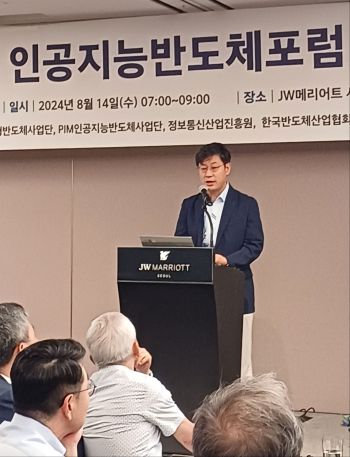 Kang Wook-sung, Vice President in charge of Next-Generation Product Planning at SK Hynix, is giving a presentation on the current status and future of automotive memory semiconductors at the "7th AI Semiconductor Forum Breakfast Lecture" hosted by the AI Semiconductor Forum on the 14th at JW Marriott Seoul in Seocho-gu, Seoul.
 [Photo by Moon Chae-seok]
Kang Wook-sung, Vice President in charge of next-generation product planning at SK Hynix, said at the '7th AI Semiconductor Forum Breakfast Lecture' hosted by the AI Semiconductor Forum on the 14th at JW Marriott Seoul in Seocho-gu, Seoul, "HBM2E (3rd generation) is being utilized in Waymo's autonomous vehicles."
Vice President Kang stated, "Currently, automotive DRAM semiconductors are transitioning from low-power double data rate (LPDDR) 4 to LPDDR5," adding, "HBM is expected to become mainstream in about three years at the earliest, or five years at the latest."
He continued, "We separately designed HBM2E for automotive use and supplied it to Waymo," noting, "SK Hynix is the only company so far supplying automotive HBM."
Regarding the question, "When do you expect the adoption of HBM chips, similar to how Tesla adopted LFP batteries?" Vice President Kang was cautious, saying, "If major companies install (HBM), the numbers will increase, but there is no company yet that intends to use HBM as the main chip from a specific customer."
Vice President Kang predicted that demand for HBM for autonomous vehicles will surge once level 3 to 4 autonomous driving becomes widespread. He said, "Higher computing power is essential for autonomous driving above level 2.5," adding, "The 4th generation HBM (HBM3), which performs 1 terabyte (TB) of computation per second on a single chip, meets these requirements."
He also anticipated that automotive NAND flash will transition from UFS to SSD. Vice President Kang said, "Automotive UFS was introduced about 3 to 4 years ago," and "Although SSD commercialization cases occurred 1 to 2 years ago, only a few completed car models worldwide have adopted it, and most companies are still in the research phase."
If HBM semiconductors expand from AI servers to autonomous vehicles, SK Hynix is expected to receive significant benefits. It is reported that SK Hynix has obtained the automotive semiconductor safety standard 'AEC-100' to add HBM to automotive solutions.
Vice President Kang dismissed concerns that HBM is vulnerable in terms of heat and safety within autonomous vehicles. He said, "HBM is made with silicon (the same as for data centers), and the requirements for data center HBM are very stringent, so automotive HBM is not significantly different," adding, "There is no problem applying it to vehicles."
© The Asia Business Daily(www.asiae.co.kr). All rights reserved.
![Clutching a Stolen Dior Bag, Saying "I Hate Being Poor but Real"... The Grotesque Con of a "Human Knockoff" [Slate]](https://cwcontent.asiae.co.kr/asiaresize/183/2026021902243444107_1771435474.jpg)
















