If Financial Investment Tax Introduced, Capital Gains from Individual Bond Trading Also Taxed
22% Financial Investment Tax Imposed on Bond Trading Gains Over 2.5 Million KRW
Concerns Over Decline in Individual Bond Trading
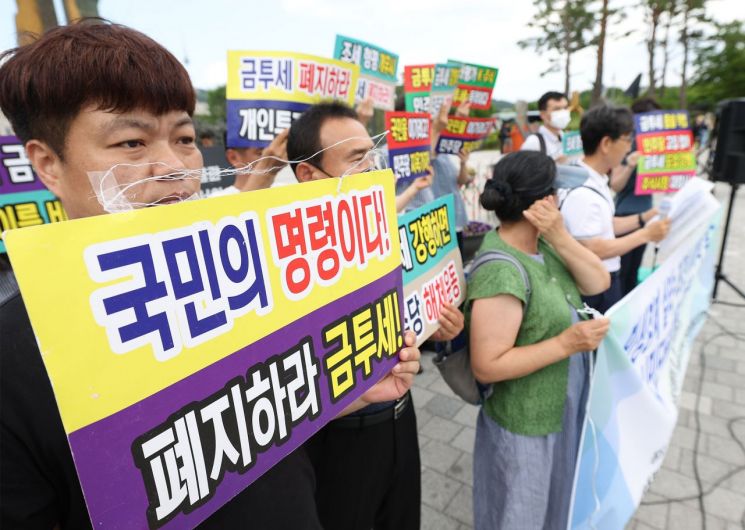 On the afternoon of June 25, near the Presidential Office in Yongsan-gu, Seoul, members of organizations such as the Korea Stock Investors Association and the Citizens' Coalition for the Abolition of the Comprehensive Real Estate Tax are urging the abolition of the financial investment tax.
 [Image source=Yonhap News]
Concerns have been raised that the Financial Investment Income Tax (FIIT), scheduled to be introduced next year, will have a significantly negative impact on the domestic bond market. As worries grow that the FIIT will adversely affect the overall capital market, difficulties are expected until its actual implementation.
FIIT Will Tax Individual Bond Trading Gains
According to the financial investment industry on the 14th, starting January 1 next year, individuals will have to pay taxes on gains from bond trading. The FIIT is a tax imposed when an individual's annual profits from financial investment products such as stocks, bonds, and funds exceed a certain amount. If an individual's bond trading gains exceed 2.5 million KRW annually, the FIIT burden ranges from a low of 22% to as high as 27.5% (including resident tax), depending on the amount.
Until now, individual investors in bonds have mainly invested in low-coupon government bonds with low nominal interest rates, aiming for capital gains rather than interest income. According to Mirae Asset Securities, all of the top 10 bonds held by individuals are government bonds, and 8 of these are low-coupon bonds. Since only interest income from bonds has been taxed and capital gains were tax-exempt, individuals have primarily invested in low-coupon bonds with low interest rates but higher expected returns to seek excess profits.
The number of individual participants in the bond market has also increased. The share of individuals in the Korean won bond market rose from about 1% in September 2022 to 2.5% last month. However, if the FIIT is implemented next year, capital gains from bond trading will also be taxed, which could lead to a contraction in individual bond investments. Unlike stocks, where taxation starts on capital gains exceeding 50 million KRW, bonds will be taxed starting from gains over 2.5 million KRW, making the FIIT as negative for the bond market as it is for the stock market.
Min Ji-hee, a researcher at Mirae Asset Securities, pointed out, "Low-coupon bonds are currently priced below face value, so in an environment where a mid- to long-term interest rate decline is expected, capital gains can be anticipated upon sale." She added, "However, if the FIIT increases the tax burden on individuals, a large volume of low-coupon bond sales may be released."
Concerns have also been raised that the introduction of the FIIT could reduce the attractiveness of the bond market. Lee Kyung-rok, a researcher at Shin Young Securities, analyzed, "There is a possibility that individual selling volumes, mainly government bonds, will be released until the end of December this year before the FIIT is introduced." He added, "Temporary selling volumes may be absorbed by the market, but this could have a crowding-out effect by encroaching on institutional investors' demand."
Lee further expressed concern, saying, "The potential reduction in new bond purchasing capacity may have a greater impact than the selling effect caused by the FIIT introduction. Especially when the bond market supply and demand are unfavorable, the weakening of individual investors' participation, which has helped form a certain demand base and eased upward pressure on market interest rates, could be problematic."
Political Conflict Over FIIT Introduction
As negative impacts of the FIIT on the capital market are anticipated, political controversy is intensifying ahead of the system's implementation. The government and ruling party argue for abolishing the FIIT, fearing capital market contraction, while the opposition insists that the FIIT should be implemented as planned.
Jin Sung-jun, Policy Committee Chair of the Democratic Party of Korea, stated, "All advanced financial markets have introduced the FIIT," and argued, "Concerns that the market will decline due to the FIIT are a kind of groundless fear."
However, concerns about the FIIT are also emerging within the Democratic Party, so difficulties are expected until the law is actually enforced. Lee Jae-myung, a candidate for the Democratic Party leadership, expressed the view that "a temporary easing or postponement of the FIIT is necessary due to the unfavorable stock market situation." Lawmaker Lee So-young also emphasized, "Capital market reform measures proposed long ago should be prioritized," adding, "Unless the instability of our stock market is improved through these measures, it is reasonable to delay the introduction of the FIIT."
© The Asia Business Daily(www.asiae.co.kr). All rights reserved.

















