‘Era of Low Birthrate and Aging Population Transformation, What Should Companies Prepare For?’ Report
“10 Million Elderly Population, Care Robots and Senior Smart Home Sectors Are Promising”
Samjong KPMG presented management strategies based on promising sectors and corporate value chains across various industries in the era of low birth rates and aging population.
On the 14th, Samjong KPMG analyzed the impact of demographic changes on seven industrial sectors?finance, tech, mobility, distribution & consumer goods, construction, healthcare, and leisure (travel & entertainment)?in its report titled ‘What Should Companies Prepare for in the Era of Low Birth Rates and Aging Population?’ and selected 23 promising sectors emerging in response to these changes.
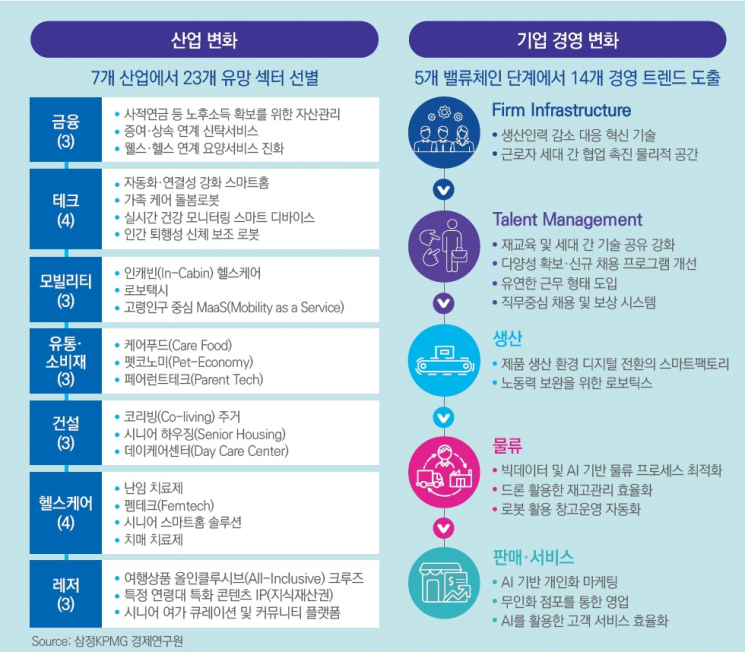 Promising Sectors and Changes in Corporate Management in the Era of Demographic Transformation [Data Provided by Samjong KPMG]
According to birth and death statistics from the Population Trend Survey, the number of newborns in South Korea last year was approximately 230,000, a decrease of about 47% compared to ten years ago. Conversely, the elderly population aged 65 and over reached 10 million (19.5% of the total population) as of last month, marking the imminent entry into a super-aged society.
In the finance industry, the need for asset management considering life-cycle consumption to diversify risks is emphasized. Advanced asset management, trust services, and ‘health & wealth management’ are emerging as promising fields.
In the tech industry, in response to the shortage of household labor and increased demand for senior health care due to demographic changes, smart home technologies and care robots that assist the daily lives and emotional well-being of the elderly and infants are gaining attention. Smart devices capable of real-time health monitoring and physical assistance robots addressing degenerative physical issues are also considered promising sectors.
In the mobility industry, targeting those aged 60 and above with increased purchasing power, ‘in-cabin healthcare’ (services that protect the safety and health of drivers and passengers through in-vehicle sensors) is emerging, along with robot taxis designed to address the aging workforce in passenger transportation. Additionally, ‘integrated mobility services (MaaS)’ centered on the elderly population are mentioned as promising sectors to efficiently provide transportation services in regions experiencing population decline.
In the distribution and consumer goods industry, the care food sector, which expands the consumer base beyond the elderly to include pregnant women, infants, and the general public, is emerging. According to the Ministry of Food and Drug Safety, the domestic care food market size was 506.7 billion KRW in 2022, growing at an average annual rate of 7.9% since 2018. Furthermore, the pet economy, referring to markets and industries related to companion animals, and the parent tech sector, which meets childcare demands through digital technology, are also emerging as promising fields.
According to Statistics Korea, by 2050, 4 out of 10 households are expected to be single-person households. Accordingly, in the construction industry, co-living housing that shares common spaces besides independent private spaces, senior housing that provides convenient and upscale living environments, and daycare centers offering care for the elderly and those with geriatric diseases are promising sectors.
In the healthcare industry, directly linked to low birth rates and aging, the femtech (female technology) sector, which integrates new technologies such as artificial intelligence (AI) and the Internet of Things (IoT) into women’s health management, is emerging. Femtech companies are growing mainly in specialized areas such as infertility, menstrual cycle management, and gynecological cancers. The Korea Insurance Research Institute forecasts that the femtech industry will reach a scale of 100 billion USD by 2030.
The report pointed out the need for flexible decision-making in areas such as ▲market and regional strategies ▲customer segmentation strategies ▲growth strategies ▲resource strategies based on each company’s perspective, capabilities, and strategies. Jin Hyung-seok, Senior Center Partner at Samjong KPMG, said, “In the era of low birth rates and aging population, companies must pioneer new markets with innovative management methods to find breakthroughs,” adding, “Facing demographic changes head-on and finding ways to effectively utilize existing resources is the shortcut to turning crises into opportunities.”
© The Asia Business Daily(www.asiae.co.kr). All rights reserved.

















