Contains the Righteous Army's Wish to Repel Japanese Imperialism
392 Chinese Characters Engraved on a Natural Stone Rock
A lengthy inscription carved into a rock on Cheonwangbong, the main peak of Jirisan National Park, expresses sorrow over the loss of the country to Japan during the Japanese colonial period and a longing for the day of liberation. On the 13th, the Korea National Park Service under the Ministry of Environment announced that it had discovered a rock inscription located just below Cheonwangbong in Jirisan National Park, engraved with the wishes of militia fighters who sought to drive out the Japanese occupation with the power of Jirisan.
This rock inscription was discovered in September 2021 by a descendant of militia leader Kwon Sang-sun from Hapcheon, Gyeongnam, who is said to have organized militia forces in Jirisan around 1894 to resist the Japanese. The descendant requested an investigation from the National Park Service in November of last year, which confirmed the inscription. The text is carved in 392 Chinese characters on a natural stone rock just below Cheonwangbong, covering an area 4.2 meters wide and 1.9 meters high. Among approximately 190 pre-modern rock inscriptions found nationwide in national parks, this one is located at the highest altitude (around 1900 meters above sea level) and contains the largest number of characters.
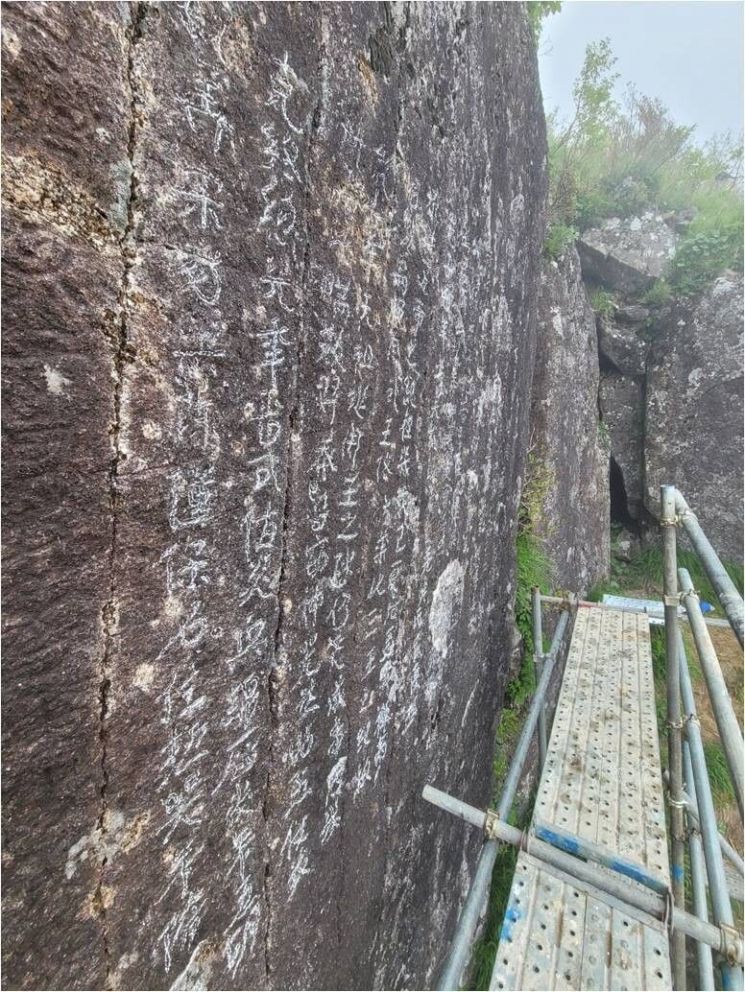 A lengthy inscription carved into a rock on Cheonwangbong, the main peak of Jirisan National Park, expresses sorrow over the country being taken by Japan during the Japanese colonial period and longs for the day of liberation.
 [Photo by Korea National Park Service]
Researchers from the National Park Service conducted a 3D scan of the worn inscription, made a rubbing of the full text, and requested experts to decipher it. As a result, it was confirmed that the text was composed by the late Joseon scholar Mukhee (1875?1942) and written by Kwon Ryun in 1924. The inscription references historical accounts of barbarian invasions found in Chinese classics, then states, "Today, it is said that heaven and earth are greatly closed; when will the signs of reopening appear? We will surely see the day when the barbarians are greatly unified, civilization shines brightly, and spreads widely. Yet, unable to contain our indignation and resentment, spitting blood and swallowing tears, we ascend this southern mountain (Jirisan) Cheonwangbong to record the great unification of the heavenly king. Ah! How sorrowful," ending with words lamenting the grief of losing the country.
Choi Seok-gi, deputy director of the Korean Seonbi Culture Research Institute who translated the text into Korean, explained, "The most important part of the inscription is the tone of passionate lamentation expressing the indignation of losing the country while longing for a bright and shining world by borrowing the dignity of Jirisan Cheonwangbong, symbolizing the heavenly king, to drive out the barbarians (Japanese)." Song Hyung-geun, director of the Korea National Park Service, said, "The discovery of a rock inscription related to militia fighters who resisted the Japanese at the summit of Jirisan, the sacred mountain of the nation, enhances the value of national park cultural heritage and is expected to be a very valuable resource for research on Jirisan humanities and regional studies."
© The Asia Business Daily(www.asiae.co.kr). All rights reserved.
![Clutching a Stolen Dior Bag, Saying "I Hate Being Poor but Real"... The Grotesque Con of a "Human Knockoff" [Slate]](https://cwcontent.asiae.co.kr/asiaresize/183/2026021902243444107_1771435474.jpg)
















